Inlay Hints
Inlay hints are special markers that appear in the editor and provide additional information about your code, like the names of the parameters. Other types of hints inform you about annotations, code authors, usages, and so on (depending on the language).
In inlay hints settings, you can configure what types of information you want to get in hints.
C++ hints
For C and C++ code, CLion provides the hint types described below, together with a Push-to-Hint mode that keeps hints hidden until you need them.
Parameter name hints
Parameter name hints are editor adornments that show parameter names next to the corresponding arguments at method calls. They can help you find your way through long (and sometimes nested) lists of parameters in function calls and aggregate initialization.
In the example below, parameter name hints help to spot the fact that height and width arguments are mixed up:

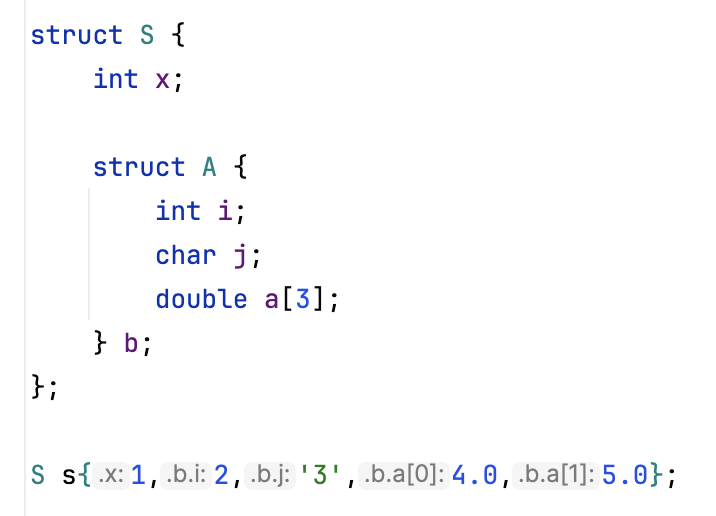
Parameter name hints show the names of the members you are initializing and help disentangle complex aggregate initializations in C++17 and later:
Type name hints
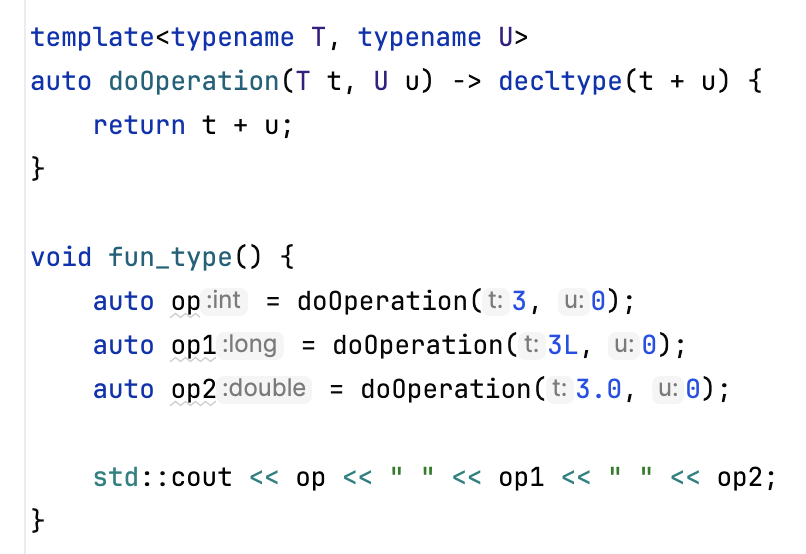
Type name hints help you when a type is deduced automatically by the compiler from the surrounding code. CLion provides type name hints for auto variables, function and lambda return types, in structured bindings, dependent code, and after function calls.
Auto variables
This kind of hints is available for variables with automatically deduced type, which use the auto or decltype(auto) type specifiers. By default, the hint will be hidden if the deduced type is clear from the initializer expression, for example when the initializer is a constructor call, a constant, or an explicit cast.
Structured bindings
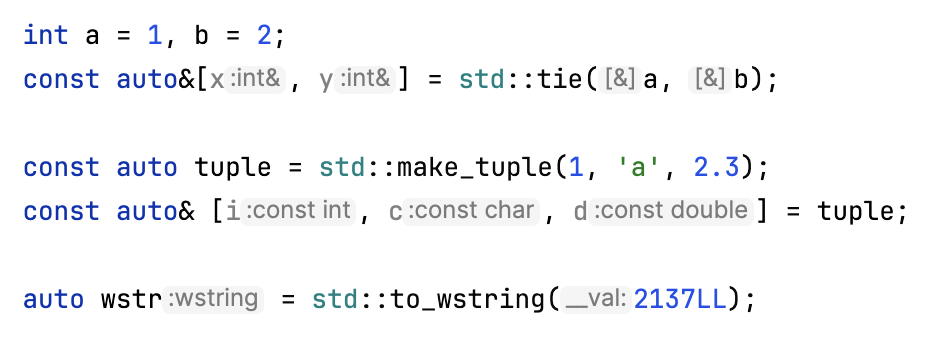
In C++17’s structured binding declarations, type hints are especially useful since the type of a structured binding cannot be explicitly specified.
Type conversion hints
Type conversion hints help make hidden implicit conversions visible, so that you are aware of potential performance and correctness implications.
CLion displays hints for different kinds of class type conversions, including object copying, object initialization using converting constructors or aggregate initialization, and calls to conversion operators.

You can also enable hints for standard conversions between built-in types, for example, conversions between numeric types that might lose precision or change the signedness of the type.
Other: Preprocessor directive hints
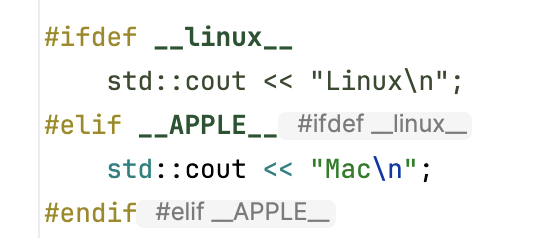
Preprocessor directive hints help you quickly understand how conditional inclusions (#ifdef, #ifndef, #if, #endif, #else, and #elif) correspond to macro definitions:
Push-to-Hint mode
Inlay hints can be helpful, but on the other hand they take editor space and may seem redundant in some cases.
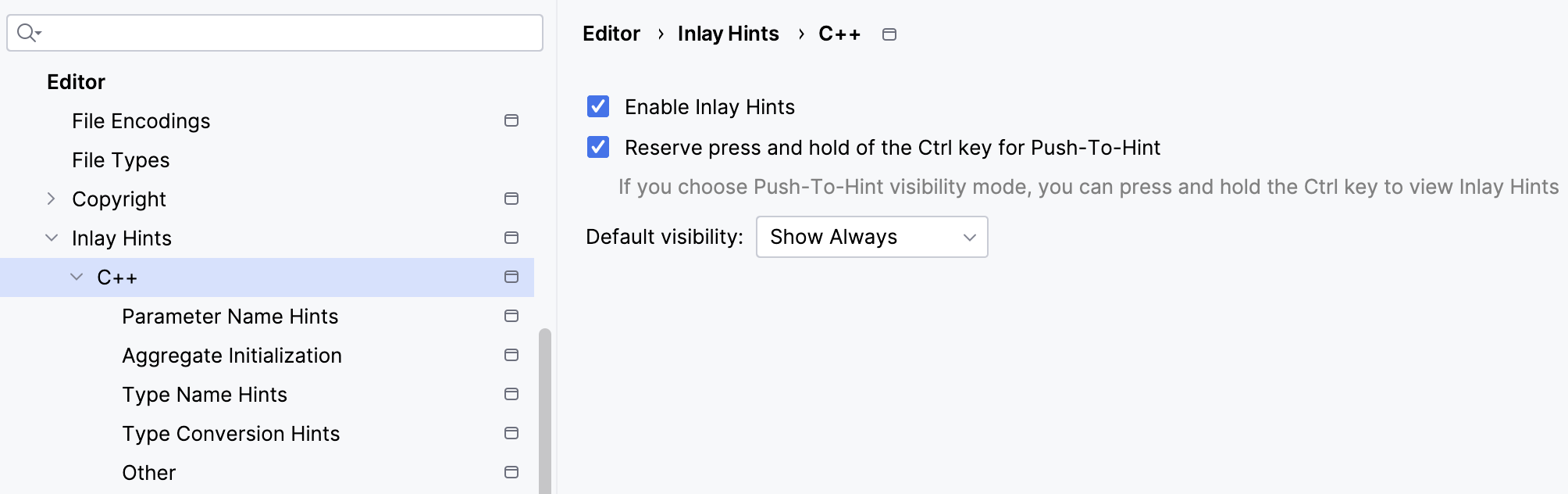
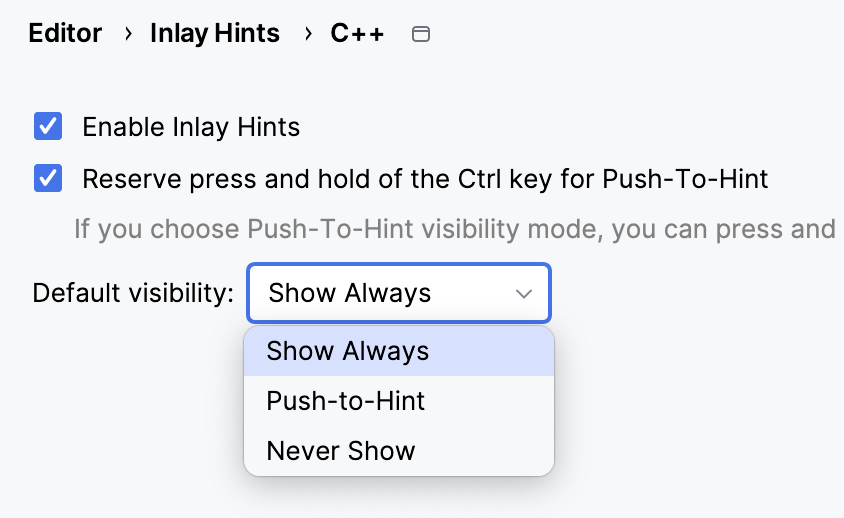
The Push-to-Hint mode (enabled by default) lets you keep the hints hidden, and only view them when needed by pressing and holding the Ctrl key.
To change the hints visibility, use the Default visibility switcher in :
Configure the appearance of inlay hints
Inlay hints take their color and style from the color scheme. Their size is based on the editor font: most hints are rendered one point smaller than the surrounding code and follow the editor zoom level. By default, CLion uses the font configured for the IDE user interface.
Change the color and style of inlay hints
In the Settings dialog (Ctrl+Alt+S) , go to , then select Inline hints.
Select the inlay hint type and state, and configure the font color and effects as required.
Use the editor font for inlay hints
In the Settings dialog (Ctrl+Alt+S) , go to .
Select the Use editor font for inlay hints option.
After enabling the option, CLion uses the font configured in for inlay hints.