Manage users
User types and roles
- User
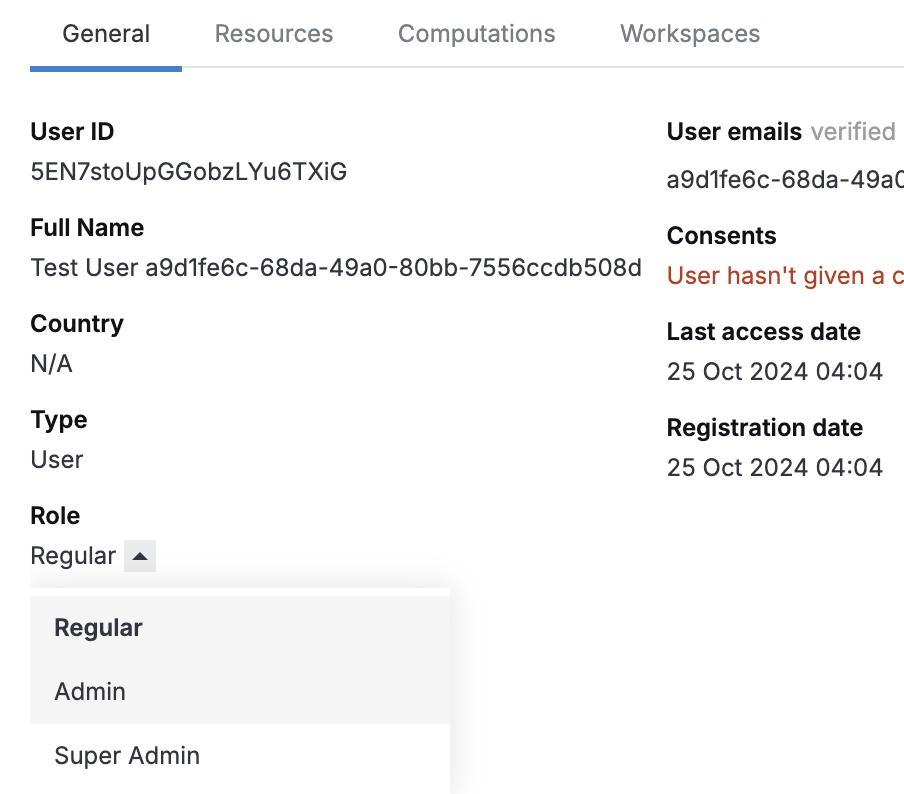
A user has full access to the functionality of Datalore. Their admin rights depend on the assigned role:
Regular: Can create notebooks, workspaces, and reports but has no admin rights.
Admin: Has access to the .
Super Admin: Has access to the and can change other users’ roles.
The first user registered in a Datalore installation is automatically granted the Super Admin role.
- Viewer
A special type of users who can only view notebooks and reports shared with them by other Datalore users. Viewers cannot create their own notebooks, workspaces or publish reports. They also cannot be assigned roles.
Plans
Plans are used to limit resources that are available for users. You define plans in Datalore configuration files and then assign them to users from the .
- Default personal plan
Assigned to all users by default according to your Datalore configuration.
Super Admins can change it to a non-default personal plan or group plan in the Admin panel.
- Non-default personal plan
Can be assigned to individual users in the .
When assigned, the non-default personal plan takes priority over any group plans that are currently associated with or will be associated with this user until a different personal plan is assigned.
- Group plans
Super Admins can assign group plans to all group members when creating or editing a group in the section of the . Group plans are a convenient way to assign the same plan to several people who do not have personal plans assigned to them.
When a user is a member of several groups, the plan listed last in the plan configuration has priority over the other group plans associated with this user.
To learn more about managing group plans, see Manage user groups.
Procedures
Access the Manage users tab
Click your avatar at the top right and select Admin panel.
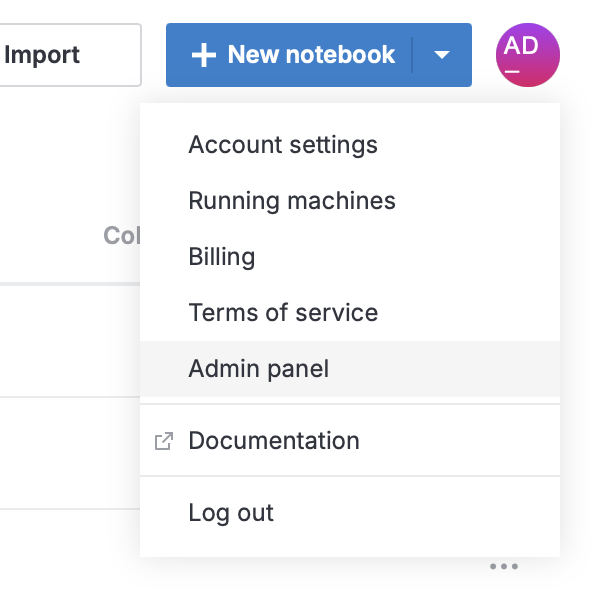
The Manage users tab of the Admin panel will open.
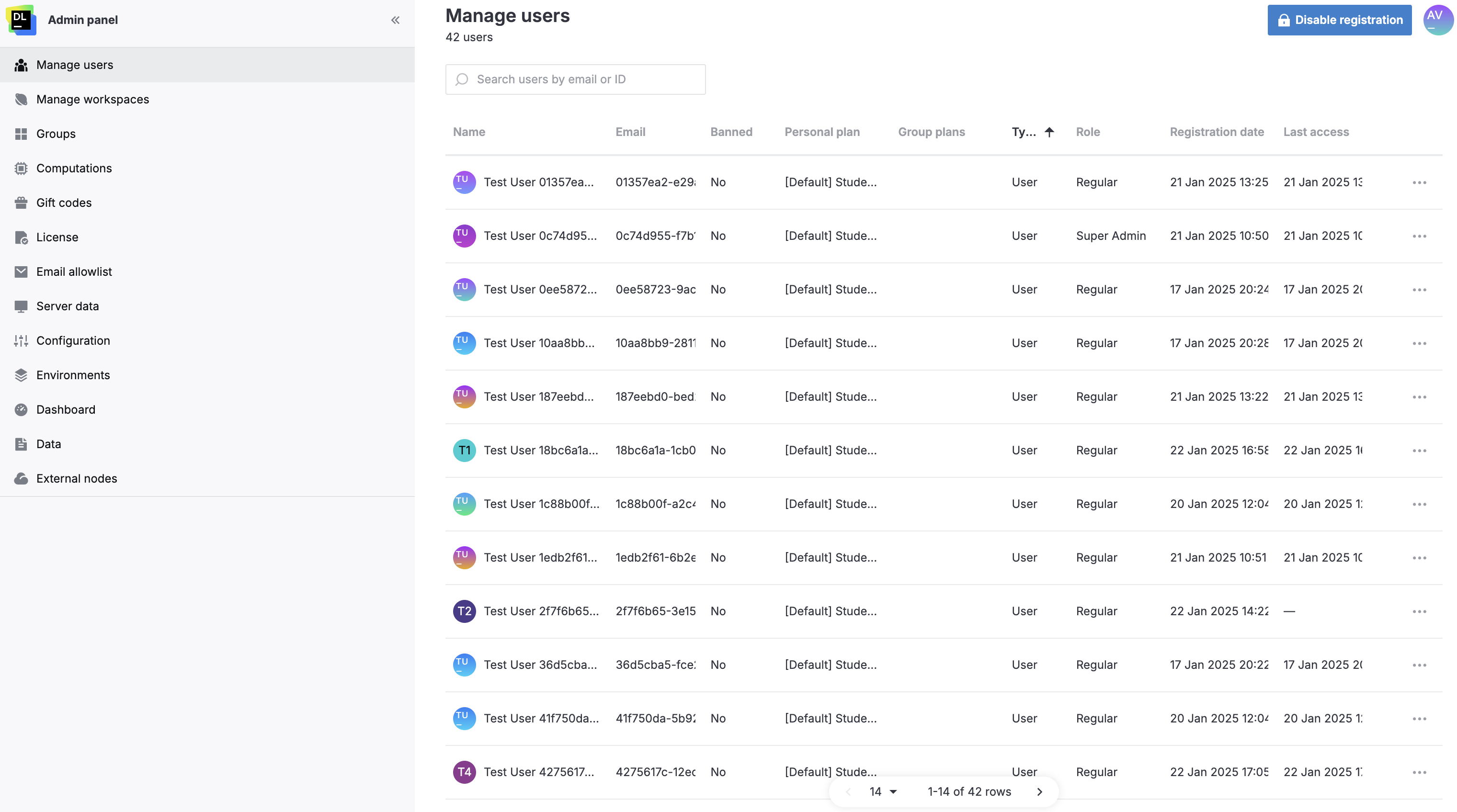
View or search the user list
To sort the list of users by category, click the corresponding column header.
To search users by their ID or email, or to filter the list, use the search bar at the top.
Create a user
A user has full access to the functionality of Datalore and can have different admin permissions depending on the role.
The procedure for creating a user depends on whether you use Datalore with Hub. If you do not know what Hub is, your installation most likely does not use it.
You can create users directly in Datalore’s only if you log in directly without Hub.
To create a user:
In the Admin panel, select Manage users on the sidebar.
Click the plus icon next to the Manage users.

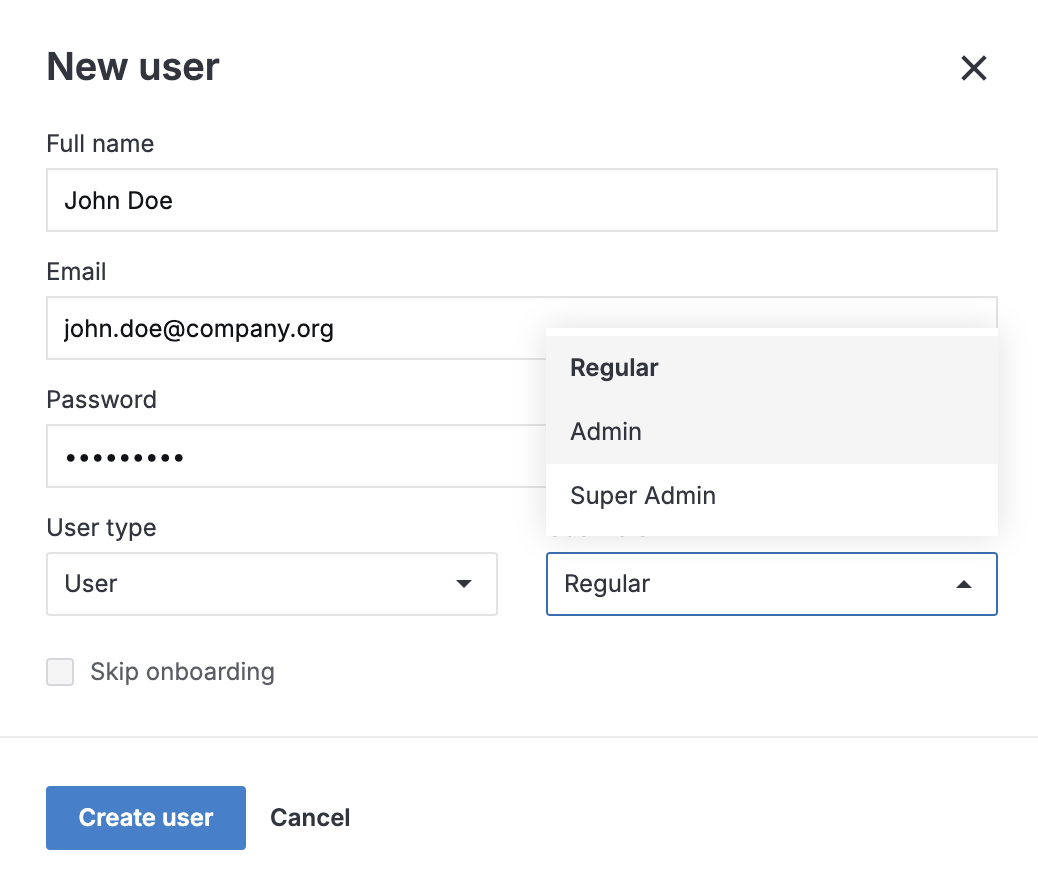
In the New user dialog that opened, enter the new user’s full name, email, and password.
To assign the Viewer type to the new user, expand the list under User type and select Viewer.
To assign a role other than the default Regular, expand the list under User role and select the required role.
Only Super Admins can assign the Super Admin role to a new user.
(Optional) To disable onboarding tips for the new user, select the Skip onboarding checkbox.
Click Create user.
If your installation uses Hub, you can create Datalore users only in Hub.
For instructions, see Create user accounts in the official Hub documentation.
Create a viewer
A viewer is a special type of users who can only view notebooks and reports shared with them by other Datalore users.
The procedure for creating a viewer depends on whether you use Datalore with Hub. If you do not know what Hub is, your installation most likely does not use it.
To create a viewer, follow the steps in Create a user and select Viewer in User type.
If you are registered in Datalore via Hub, you create a viewer role in Hub and assign it to a user.
To create the Datalore Viewer role:
In Hub, go to .
Enter the role name, for example, Datalore viewer, and click Create.
You will need this role name when granting the role to a user.
In Settings, specify the role key (
datalore-viewer).
To assign the Datalore Viewer role to a user:
In Hub, go to the Users page and select the user.
Switch to the Roles tab and click Grant role.
In the Grant role dialog that opened, enter Datalore Viewer in the Role field.
In Scope, select Global, unless configured otherwise.
Click Grant.
View user profile
The user profile allows you to view user information, manage their plans and roles, and access their workspaces.
To open the user’s profile:
In the Admin panel, select Manage users.
Select the user whose information you want to access.
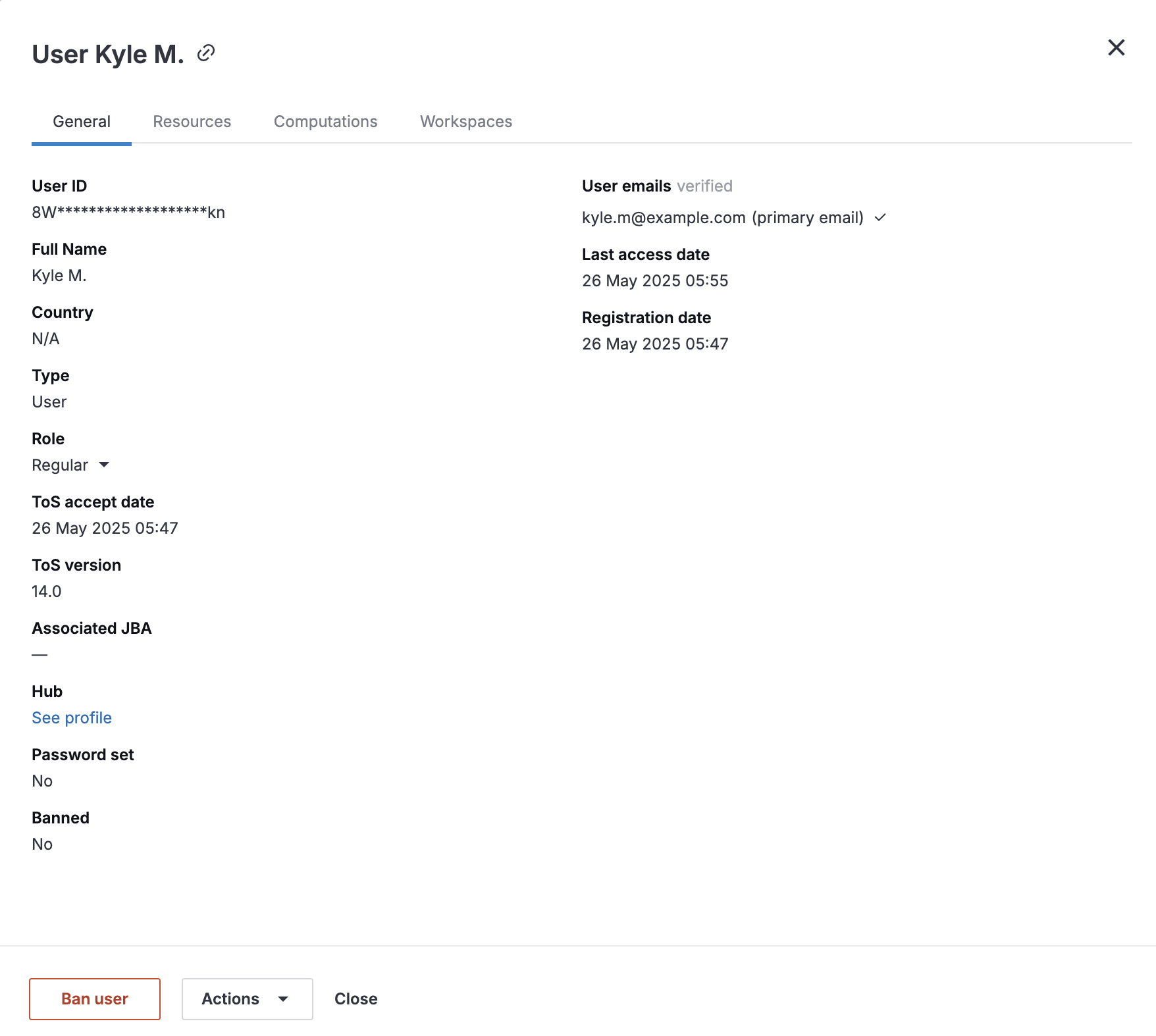
Optional steps:
To copy the link to the user’s profile, click the link icon in the title.
(For installations with Hub) To view the user in Hub, click See profile under Hub.
To view specific information, switch to the corresponding tab:
General: User type, user role, last access date, and other information
Resources: User’s plan, license, and machine and storage usage information
Computations: User’s machines that are currently running
Workspaces: User’s Home and own workspaces
To verify the user’s email, click Verify email. You can also resend the verification email.
Upgrade a viewer to a user
In the Admin panel, select Manage users.
Select the viewer account you want to upgrade to a user.
On the tab, open the dropdown in and select .
Downgrade a user to a viewer
In the Admin panel, select Manage users.
Select the user account you want to downgrade to a viewer.
On the tab, open the dropdown in and select .
Follow the prompts.
Change user's role
Roles determine what admin privileges the user has access to.
To change the role:
In the Admin panel, select Manage users.
Select the user whose role you want to change.
On the General tab, select the new role under Role:
Change user's plan
To change the user’s plan:
In the Admin panel, select Manage users.
Select the user whose plan you want to change.
Switch to the Resources tab.
Select the required plan under Plan.
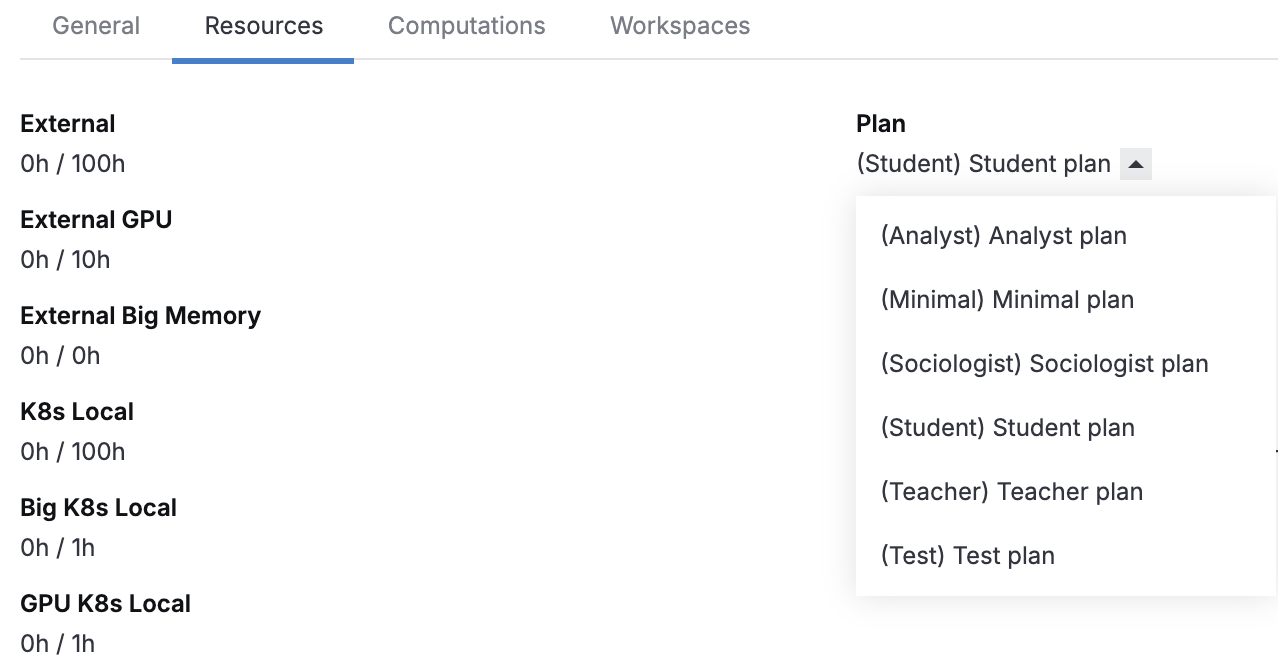
The plan you select will override any group plans assigned to the user.
Manage user's computations
In the Admin panel, select Manage users.
Select the user whose computations you want to manage.
Switch to the Computations tab.
To sort the list of computations, click the respective column header.
To stop a computation, click the ellipsis icon next to it and select the Stop in the popup menu.
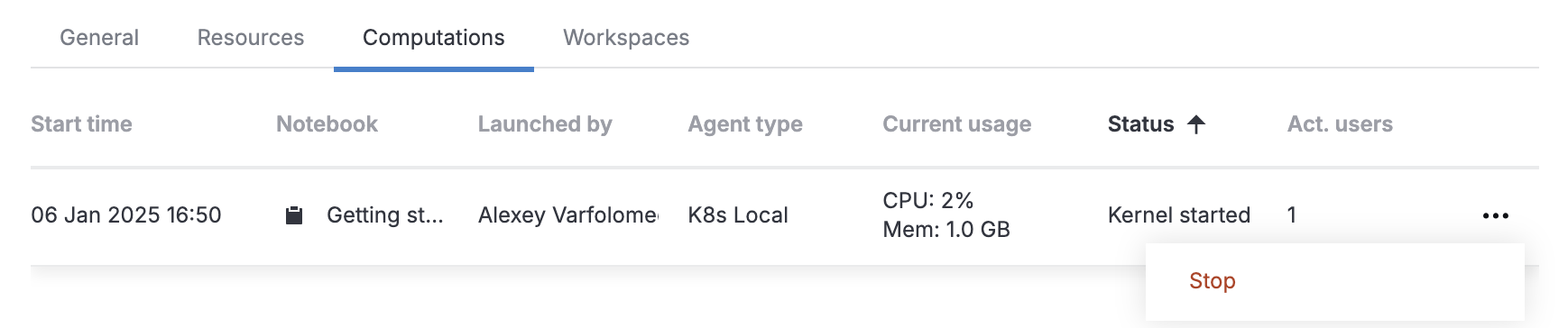
To copy the notebook identifier of a specific computation, click the corresponding copy icon in the Notebook column.
Manage user’s workspaces
In the Admin panel, select Manage users.
Select the user whose workspaces you want to manage.
Switch to the Workspaces tab.
To open a workspace, click the corresponding ellipsis icon and select Open in the popup menu.
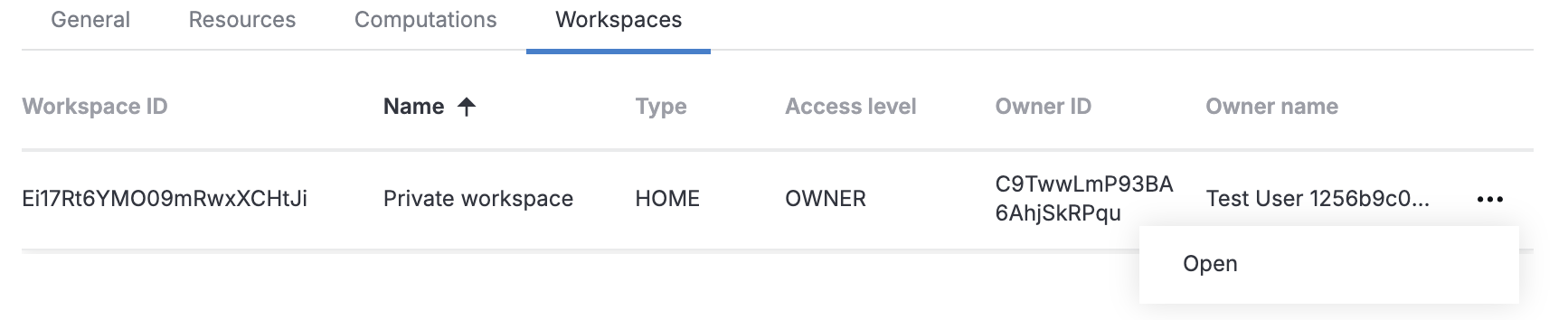
You will access the workspace from a new browser tab. As an admin, you can manage the workspace with edit rights.
To create a workspace that will be the user's own, do the following:
Expand the Actions menu at the bottom of the user's profile and select Create workspace for user.
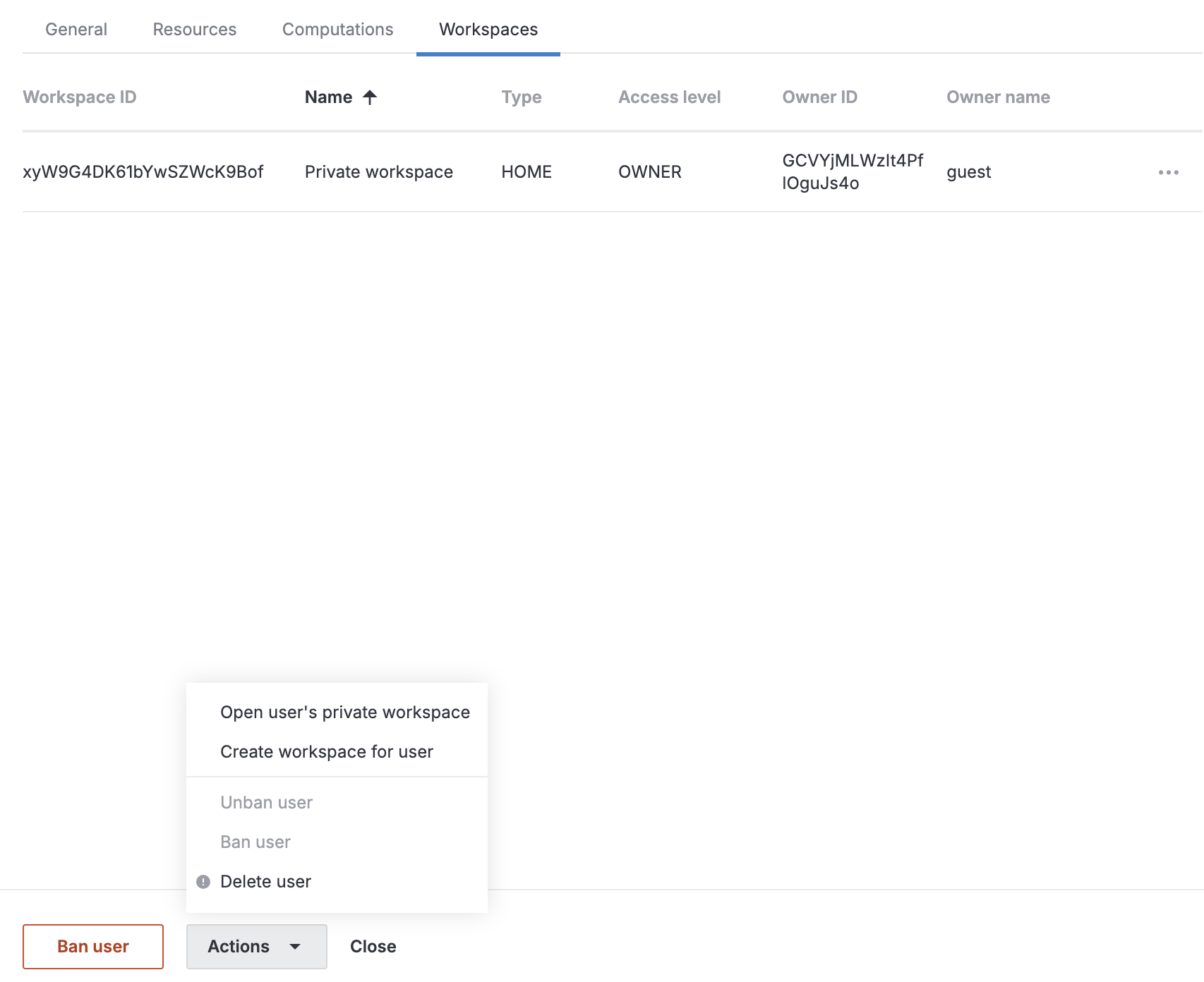
In the New workspace dialog, provide a title for the new workspace and click Create workspace.
Ban a user
When you ban a Datalore user, their account remains in the system, but they cannot perform any actions.
To ban a user:
In the Admin panel, select Manage users.
Select the user you want to ban.
At the bottom of the modal, click Actions and select Ban user.
(Optional) In the Ban user dialog, specify a reason for banning.
Click OK.
To unban the user, click Actions and select Unban user.
Delete a user
When you delete a user, it releases that associated seat and deletes all user data.
In the Admin panel, select Manage users.
Select the user you want to delete.
At the bottom of the modal, click Actions and select Delete user.
In the Delete user dialog, click OK.
Disable user registration
To configure whether users can register in your Datalore On-Premises instance:
Open the Manage users section.
Click Disable registrations at the top
To re-enable user registrations, click Enable registrations.