Source code navigation
You can quickly navigate through your code in the editor using different actions and popups.
Navigate with the caret
To see the previous caret position, select from the main menu or press Ctrl+Alt+Left. To move forward, select or press Ctrl+Alt+Right.
To quickly move to the top of the editor, press Ctrl+Page Up. To move the caret to the bottom of your editor, press Ctrl+Page Down.
To navigate to the last edited location, press Ctrl+Shift+Backspace.
To find the current caret location in the editor, press Ctrl+M. This action might be helpful if you do not want to scroll through a large file.
Alternatively, you can press Up and Down arrow keys to achieve the same result.
To highlight a word at the caret you are trying to locate, select from the main menu. If you are using Windows, you can also press Ctrl+F3.
To see on what element the caret is currently positioned, press Alt+Q.
To move caret between matching code block braces, press Ctrl+Shift+M.
To navigate between code blocks, press Ctrl+[ or Ctrl+].
Move the caret
You can use different actions to move the caret through code. You can also configure where the caret should stop when moved by words and on line breaks.
To move the caret to the next word or the previous word, press Ctrl+Right or Ctrl+Left.
By default, GoLand moves the caret to the end of the current word. When you move the caret to the previous word, it is placed at the beginning of the current word.
You can customize the caret position for these actions. In the Settings dialog (Ctrl+Alt+S) , go to . In the Caret Movement section, use the When moving by words and Upon line break options to configure the caret's behavior.
To move the caret forward to the next paragraph or backward to the previous one, press Ctrl+Shift+A and search for the Move Caret Forward a Paragraph or Move Caret Backward a Paragraph action.
You can also select a text and then move the caret forward or backward to a paragraph. Press Ctrl+Shift+A and search for the Move Caret Forward a Paragraph with Selection or Move Caret Backward a Paragraph with Selection action.
Find a line or column
In the Go to Line/Column dialog, specify a line or column number, or both, separating them with : and click OK.
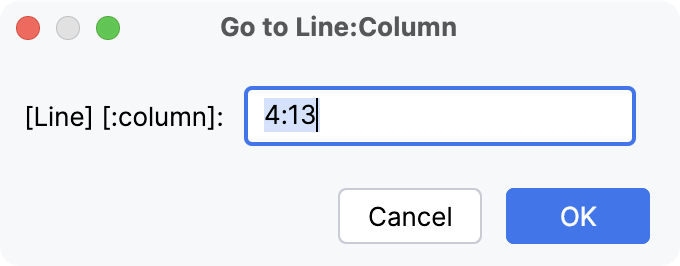
If you do not want to see the line numbers in the editor, in the Settings dialog (Ctrl+Alt+S) , go to and clear the Show line numbers checkbox.
Locate a code element with the Structure view popup
You can use the structure view popup to locate a code element in the file you are working on.
To open the structure view popup, press Ctrl+F12.
In the popup, locate an item you need. You can start typing a name of the element for GoLand to narrow down the search. Press Enter to return to the editor and the corresponding element.
While in the popup, you can sort file members, see anonymous classes and inherited members.
Navigate between code elements
Go to declaration and its type
You can navigate to the initial declaration of a symbol and the symbol's type from its usage.
Place the caret at the necessary symbol and press Ctrl+B. Navigate to Declaration or Usages look for implementations in the project scope first. Search results display project elements before non-project elements.
In go.work files, you can navigate to modules listed in the file. To navigate to a module, press Ctrl+B or press Ctrl and click the declaration.
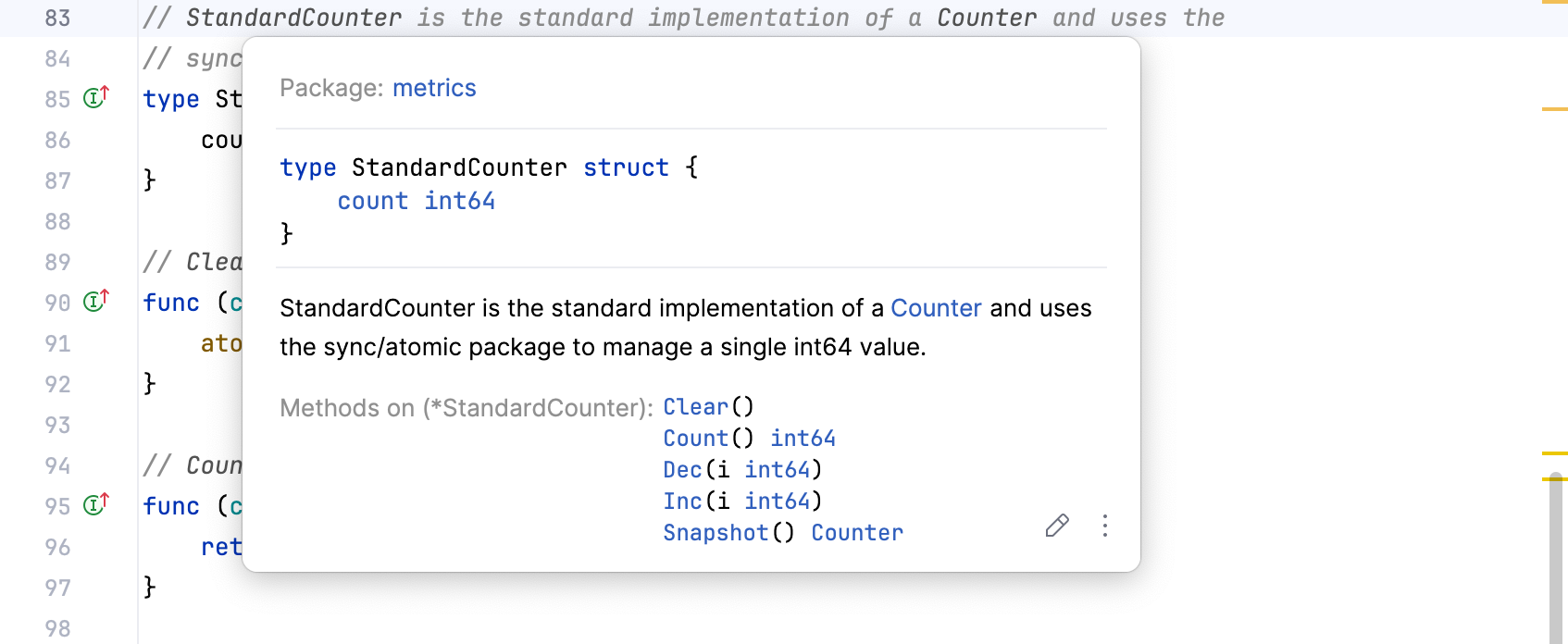
For a type declaration, press Ctrl+Shift+B.
Navigate to package-level declarations from comments
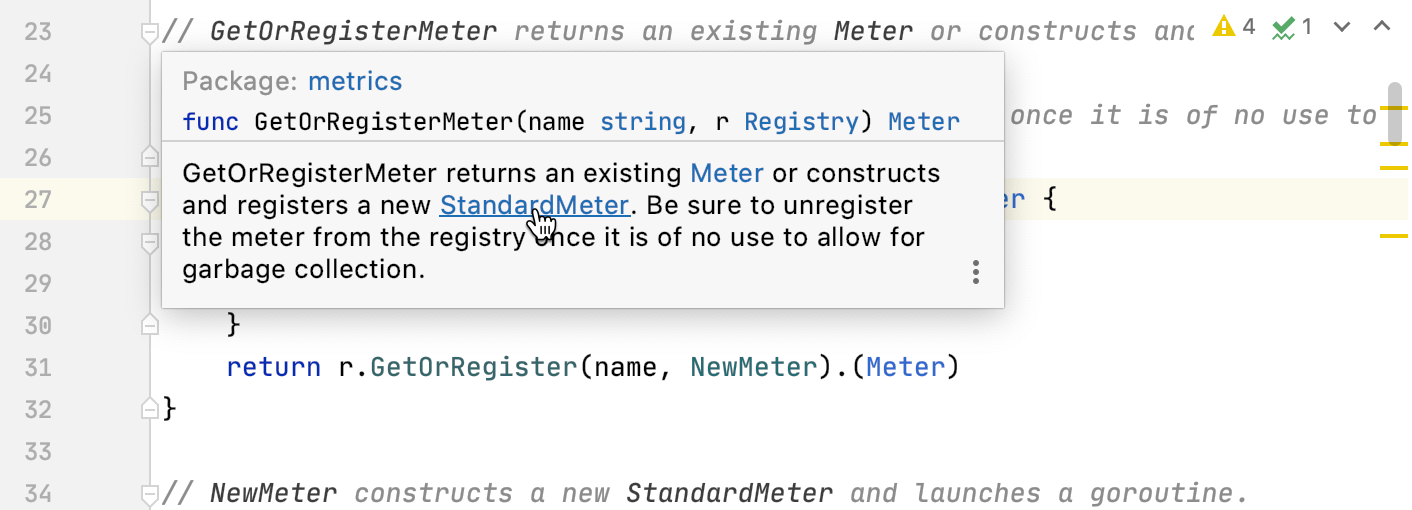
If you click the reference in comments, you can navigate to related package-level declarations in the same package. Also, you can use the Navigate to Declaration and Usage action (Ctrl+B) for such references.
Names of methods, functions, and structs in comments are highlighted.
GoLand highlights references to exported symbols only. Words are resolved to package-level declarations in the same package. Two words separated with a dot are treated either as
Type.Methodor aspackage.SymbolName.GoLand highlights references only if the name is unique to reduce the number of false positives.
Go to implementation
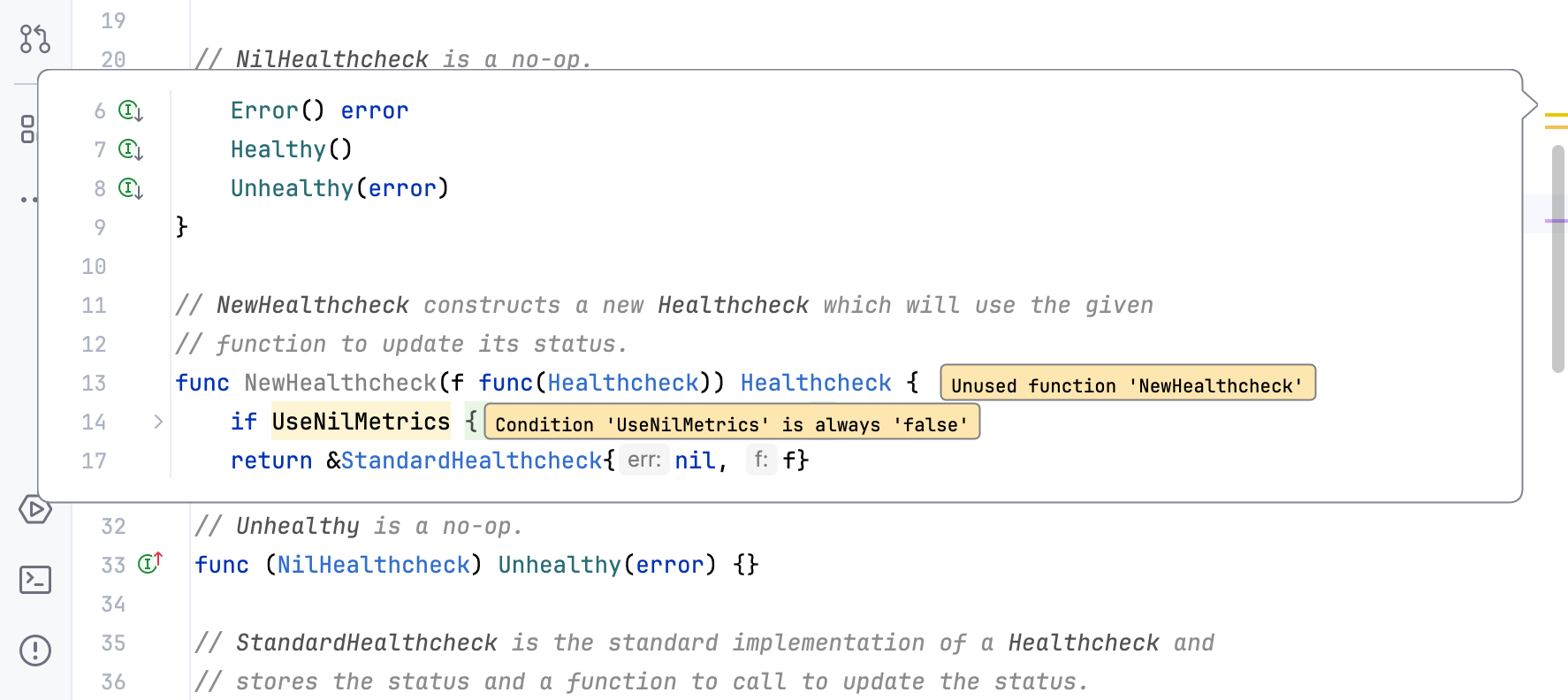
You can keep track of type implementations and overriding methods using the gutter icons in the editor, or by pressing the appropriate shortcuts, or by clicking Inheritors inlay hints.
Click one of the
 /
/ gutter icons located in the editor and select an ascendant or descendant class from the list.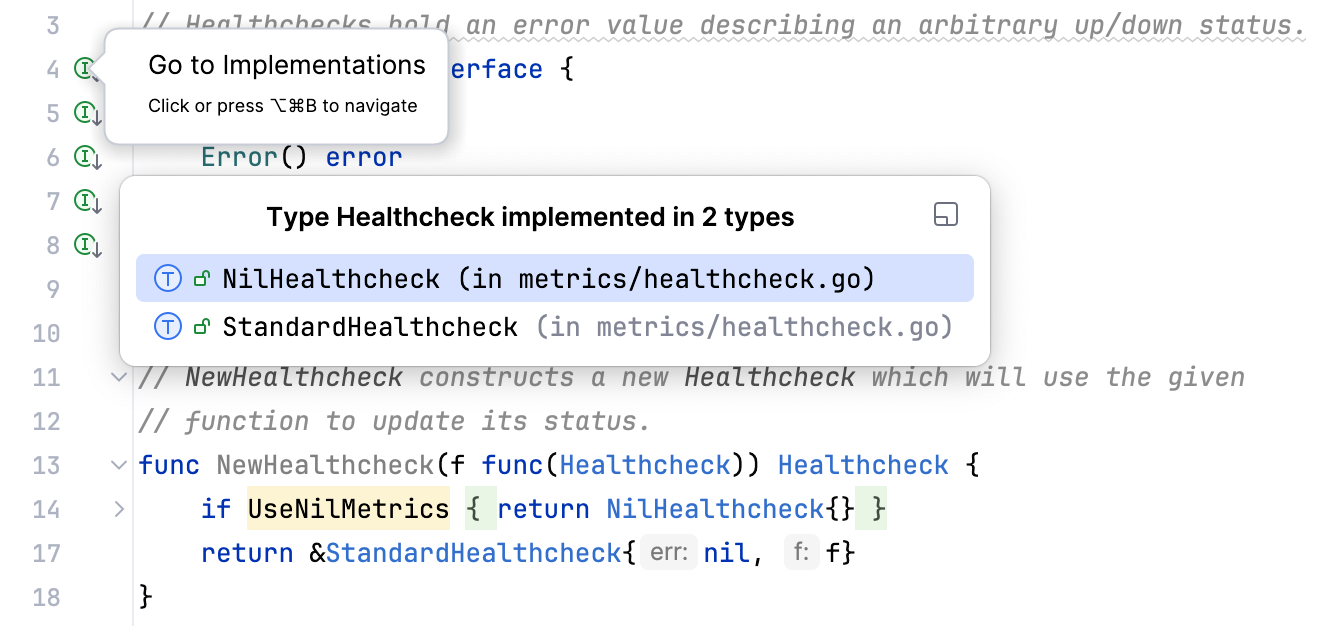
To navigate to the interface or to all the types that implement this interface, press Ctrl+U.
Starting from GoLand 2021.2, the Ctrl+U action navigates you to interfaces that are stored in the internal directory.
To navigate to the implementation, press Ctrl+Alt+B. Navigate to implementations look for implementations in the project scope first. Search results display project elements before non-project elements.
Navigate between errors or warnings
To jump to the next or previous found issue in your code, press F2 or Shift+F2 respectively. Alternatively, go to in the main menu.
GoLand places the caret immediately before the code issue.
Configure the way GoLand navigates between code issues: it can either jump between all code issues or skip minor issues and only navigate between detected errors. Right-click the code analysis marker in the scroll bar area and choose one of the available navigation modes from the context menu:
To have GoLand skip warnings, infos, and other minor issues, choose Problems with Highest Priority.
To have GoLand jump between all detected code issues, choose All Problems.
Browse through methods
To visually separate methods in code, in the Settings dialog (Ctrl+Alt+S) , go to and select the Show method separators option.
To open the Structure tool window, press Alt+7.