Tutorial: deploy your application to a minikube cluster
In this tutorial, you will learn how to start a local Kubernetes cluster with minikube directly from IntelliJ IDEA and deploy a sample application to it. As part of this process, you will build the application, create a Docker image, and deploy it to minikube.
Running Kubernetes locally is especially useful for prototyping, testing deployments, and learning Kubernetes workflows. Using the Docker and Kubernetes support available in IntelliJ IDEA, you will be able to start the cluster, deploy resources, and inspect your application without leaving the IDE.
Before you start
Before you start, make sure that you have the following installed and configured:
Enable required plugins
The functionality used in this tutorial relies on the following plugins:
The plugins are bundled and enabled in IntelliJ IDEA by default. If the relevant features are not available, make sure that you did not disable any of the plugins.
Press Ctrl+Alt+S to open settings and then select .
Open the Installed tab, find the required plugins, and select the checkboxes next to the plugin names to enable them.
Clone the sample project
To get started, clone the Spring PetClinic application from GitHub or open this project in IntelliJ IDEA if you already have it on your machine.
The source code of the application is hosted on GitHub at https://github.com/spring-projects/spring-petclinic.
In the main menu, go to .
Specify the URL of the repository and click Clone.
In the Open or Import Project dialog, select Gradle project to use Gradle as the main build system for the project.
If necessary, agree to open the cloned project in a new window.
Let us start with a simple Node.js Express application. Let this application consist of a hello_express.js file that returns Hello World! and outputs Example app listening on port 3000! in the console.
Create an empty project with Node.js
Click New Project on the Welcome screen or select from the main menu.
In the dialog that opens, select Node.js in the left-hand pane.
Specify the location of the application and its name, for example,
hello_world_docker.Specify the local Node.js runtime to use. Accept the suggested installation or select another one from the list, or even click Download if you do not have Node.js on your machine yet. Learn more from Create a new Node.js application.
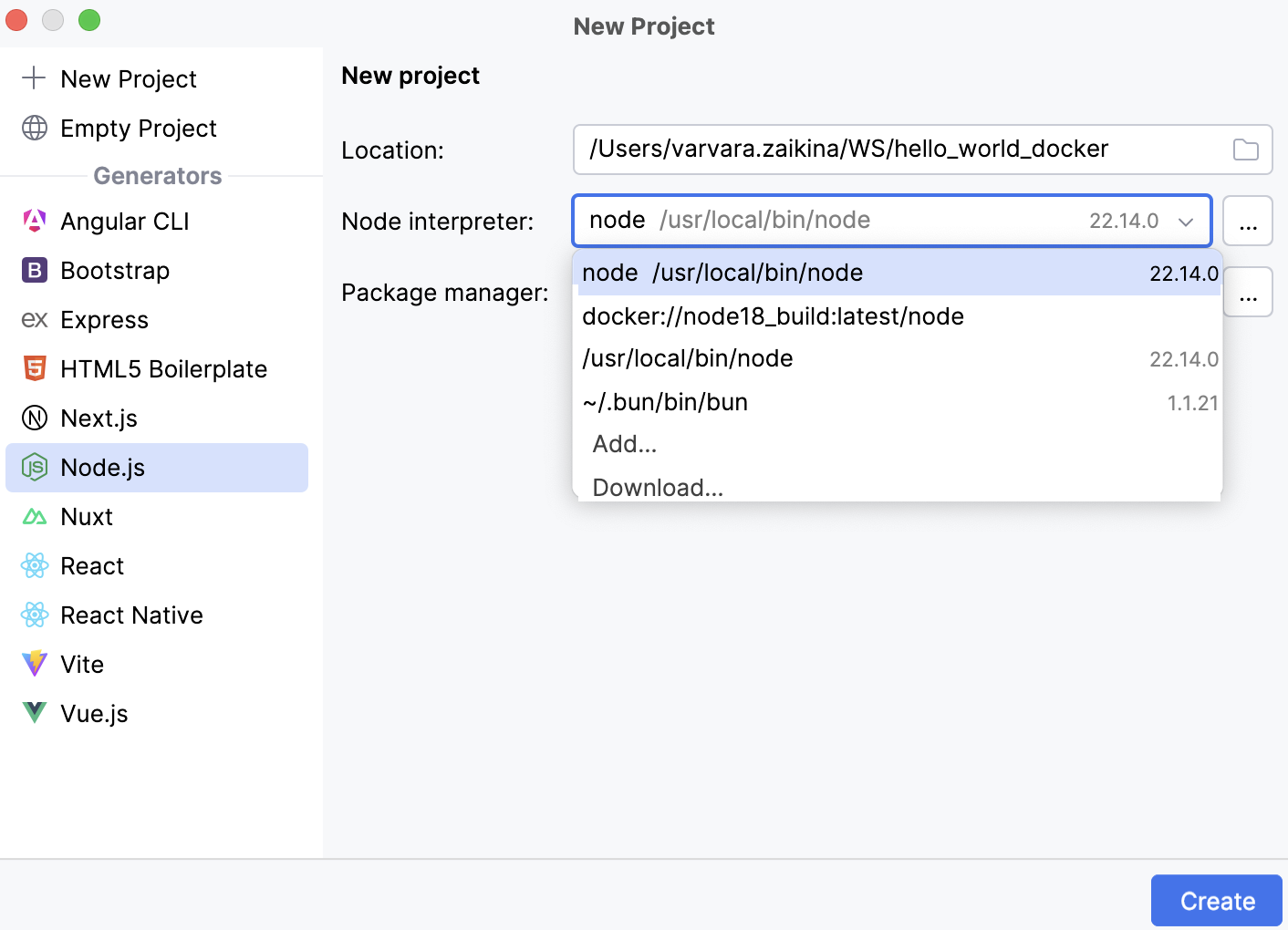
Click Create.
Populate the application
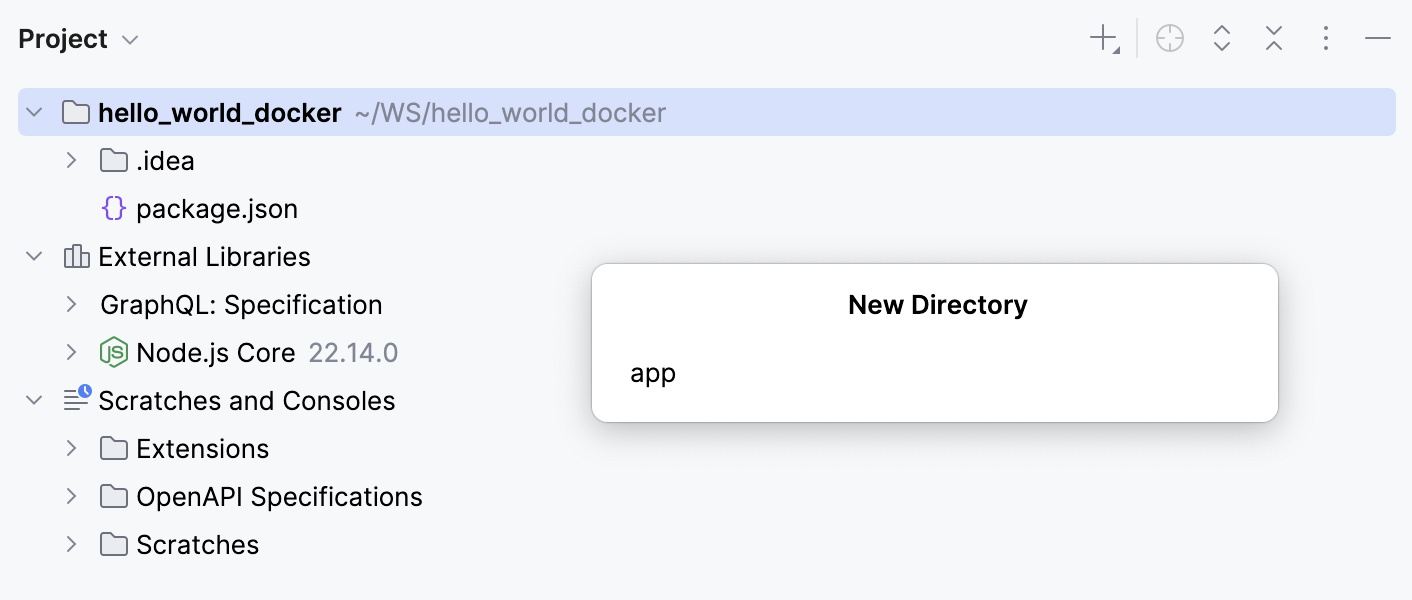
Let us create a separate folder for our application, this will help us later map local folders to folders in the container.
To do that, open the Project tool window Alt+1, right-click the project folder, select from the context menu, and then select . In the popup dialog that appears, specify the name of the folder, for example, app.
Now it is time to create a JavaScript file to place the code of our application in.
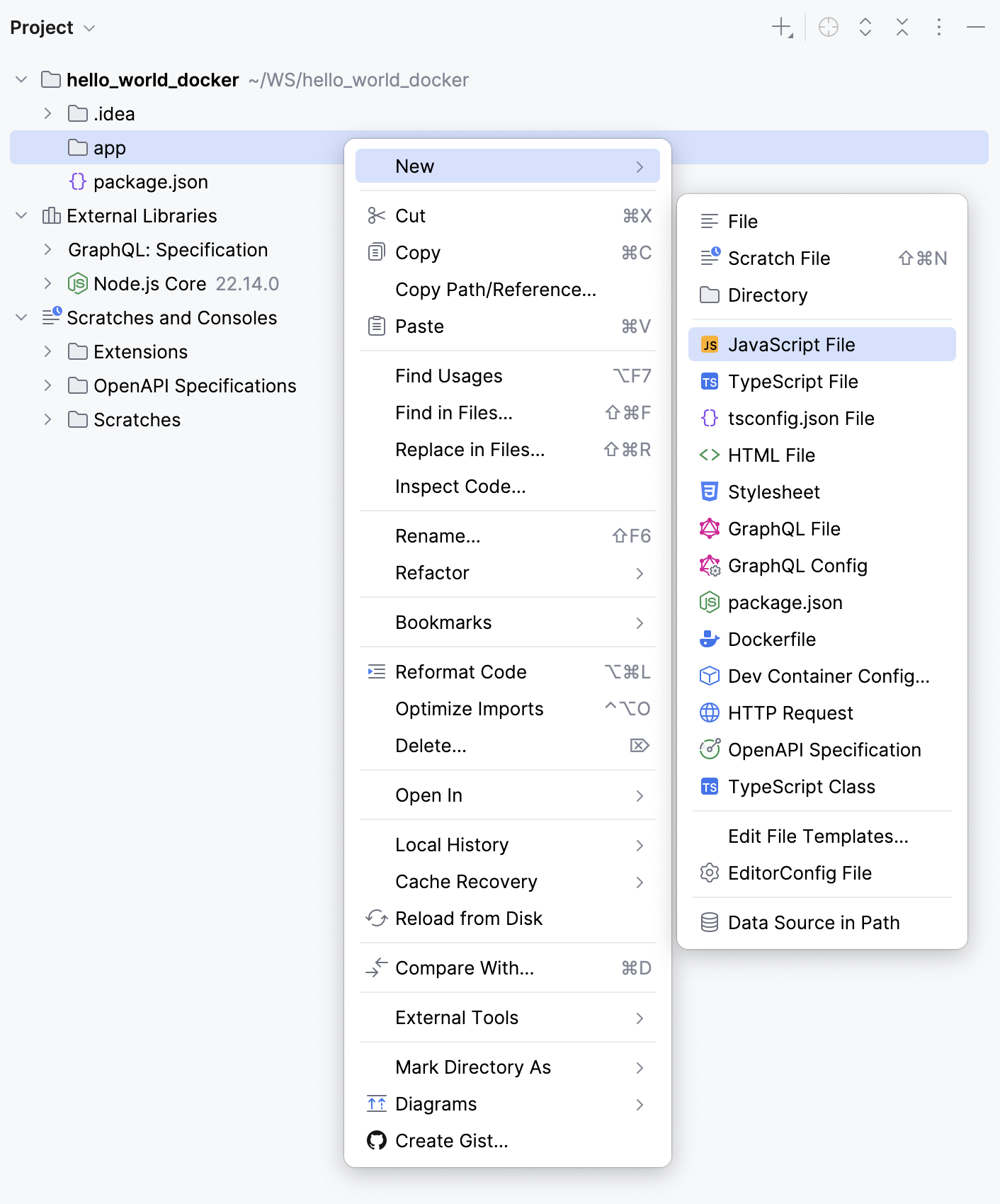
In the popup dialog that appears, specify the name of the file, for example, hello_express.js.
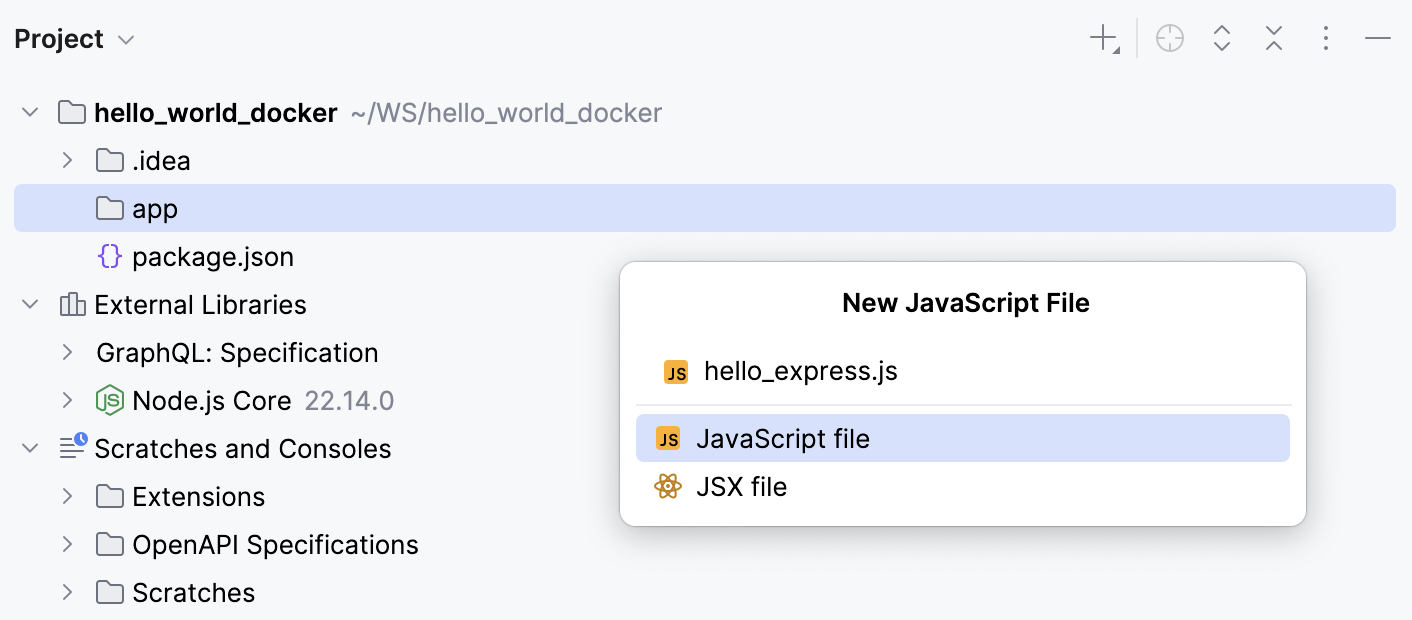
Open the newly created hello_express.js file in the editor and type the following code:
const express = require('express'); const app = express(); app.get('/', function(req, res) { res.send('Hello World!') }); app.listen(3000,function() { console.log('Example app listening on port 3000!') });As you might have expected, the
expressreference is not resolved and highlighted as an error. However, IntelliJ IDEA suggests a quick-fix as you hover over the reference: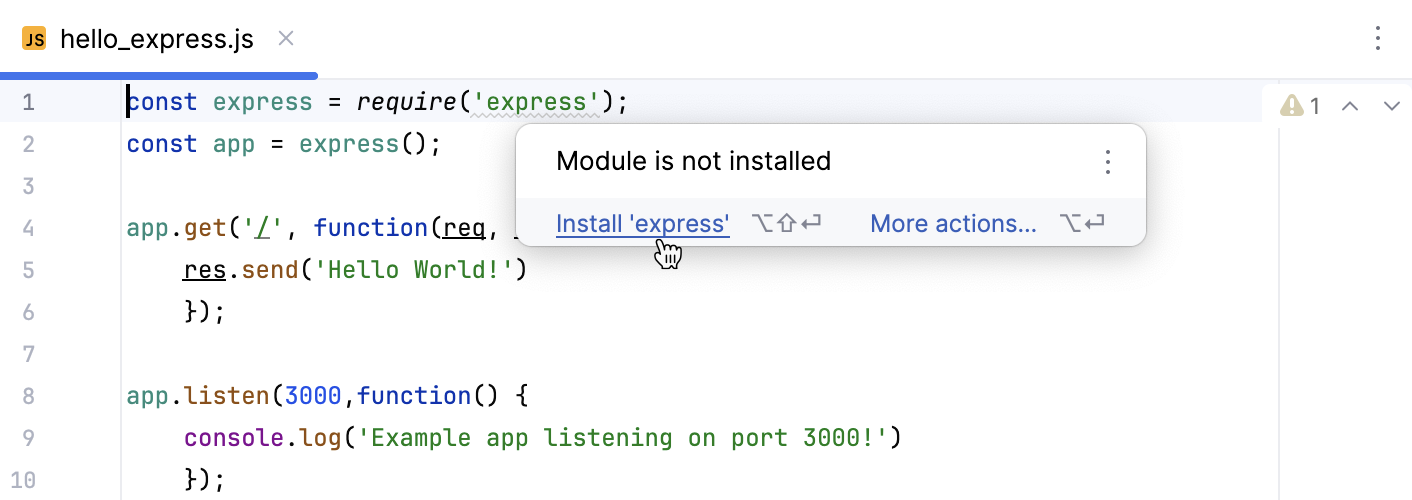
When you click the Install 'express' link,
expressis added to the package.json file and installed.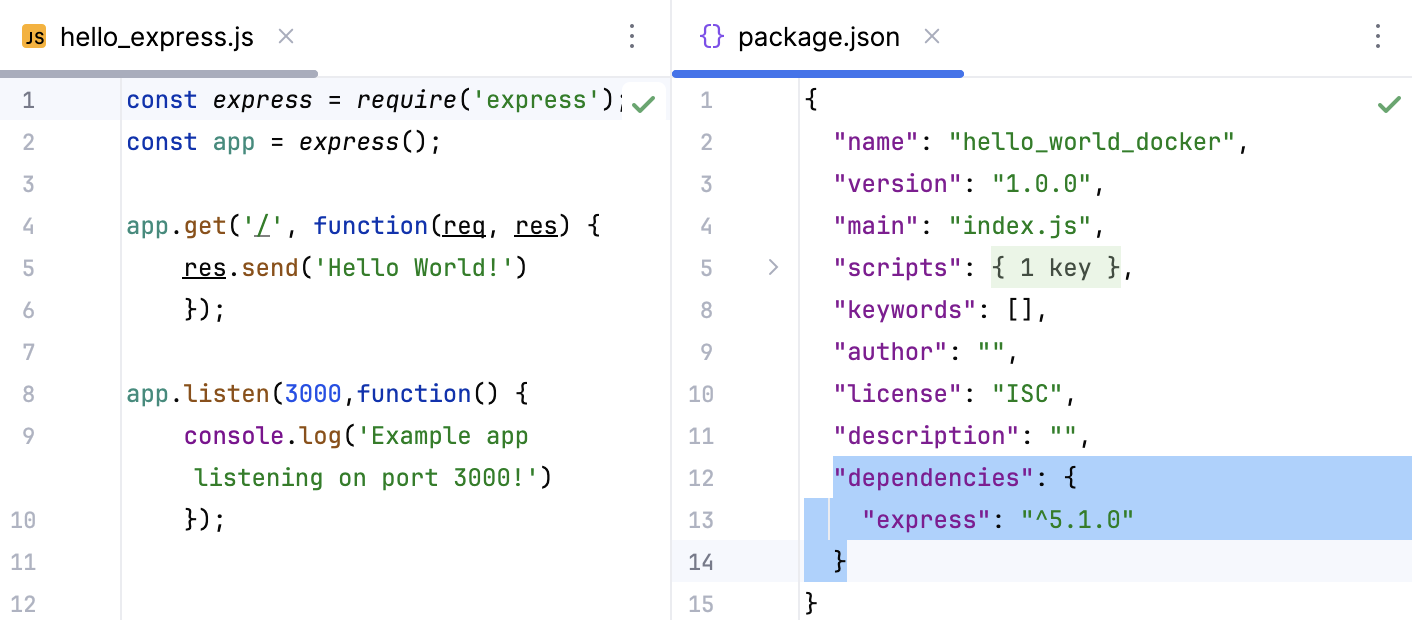
Run the application locally
Let us run our application locally to make sure it works as expected.
Open the hello_express.js file, right-click anywhere in the editor tab, and select from the context menu.
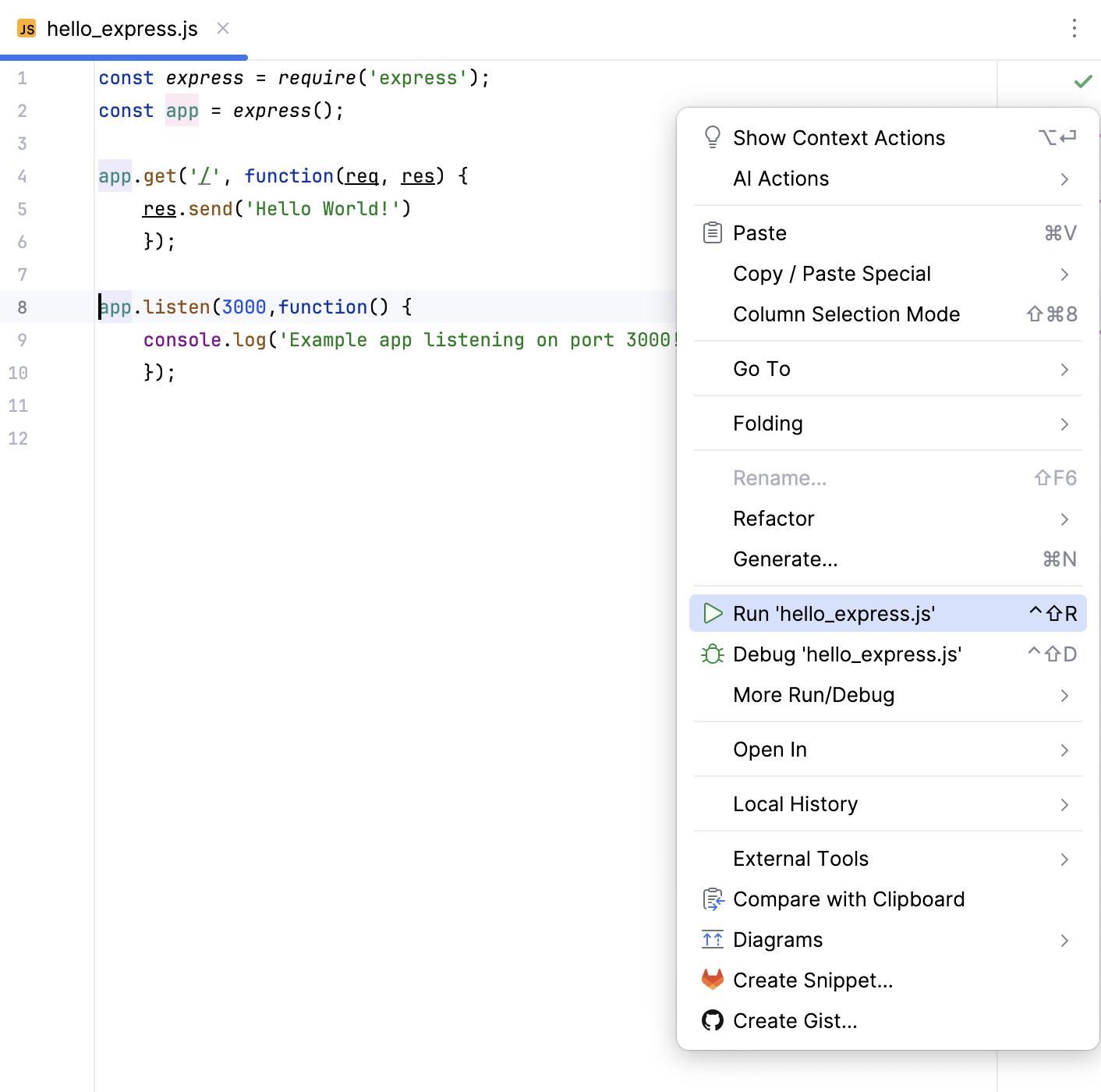
The Run tool window opens showing
Example app listening on port 3000!.If you open the browser at
http://localhost:3000, you will see that the page shows Hello World!, as expected.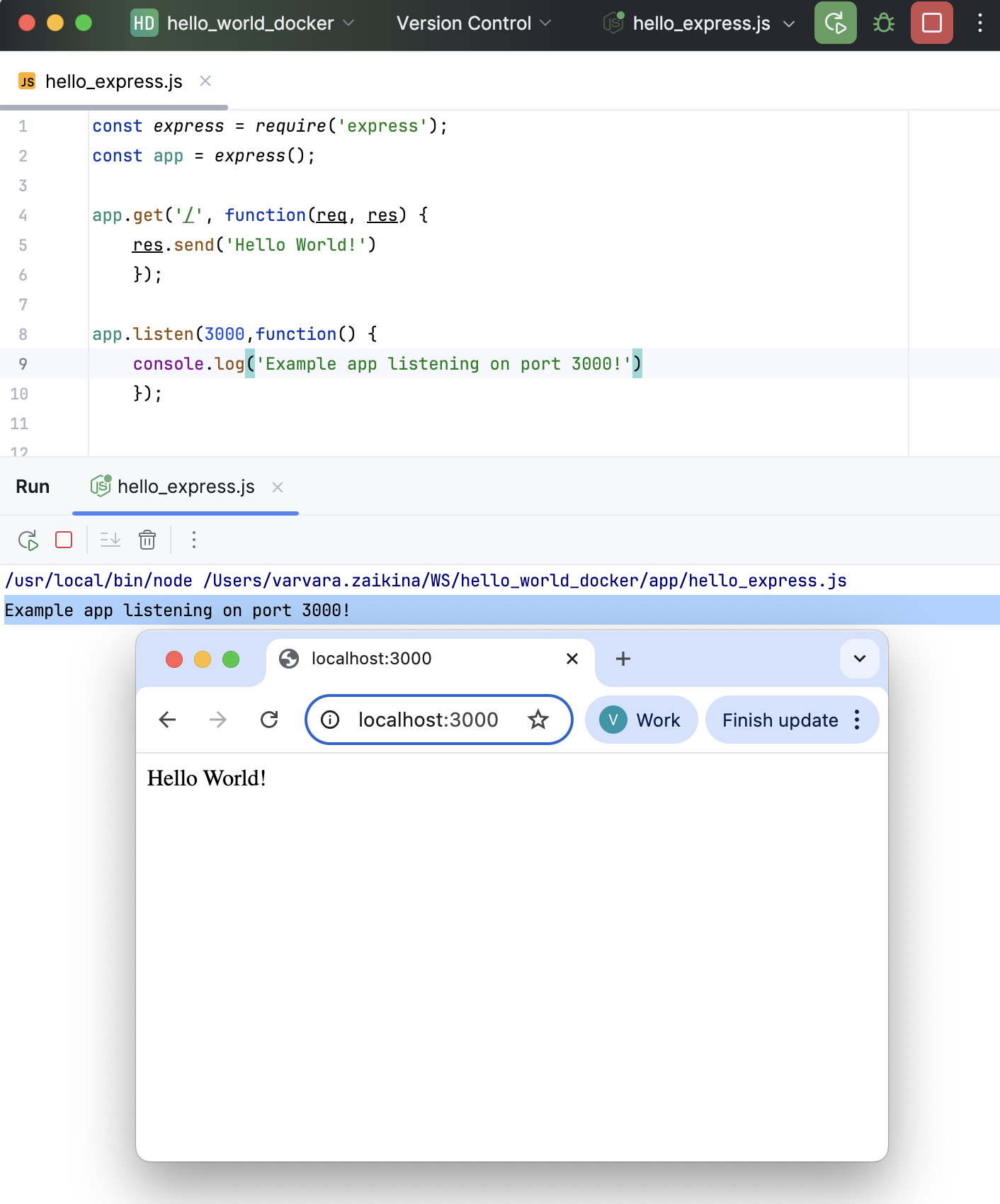
Build the application
Before deploying the application to Kubernetes, you need to build it and package into a container image. In this tutorial, we will use a Gradle task to compile the application source code, run tests, and produce an executable JAR file. This JAR file will later be used when creating a Docker image.
Open the Gradle tool window.
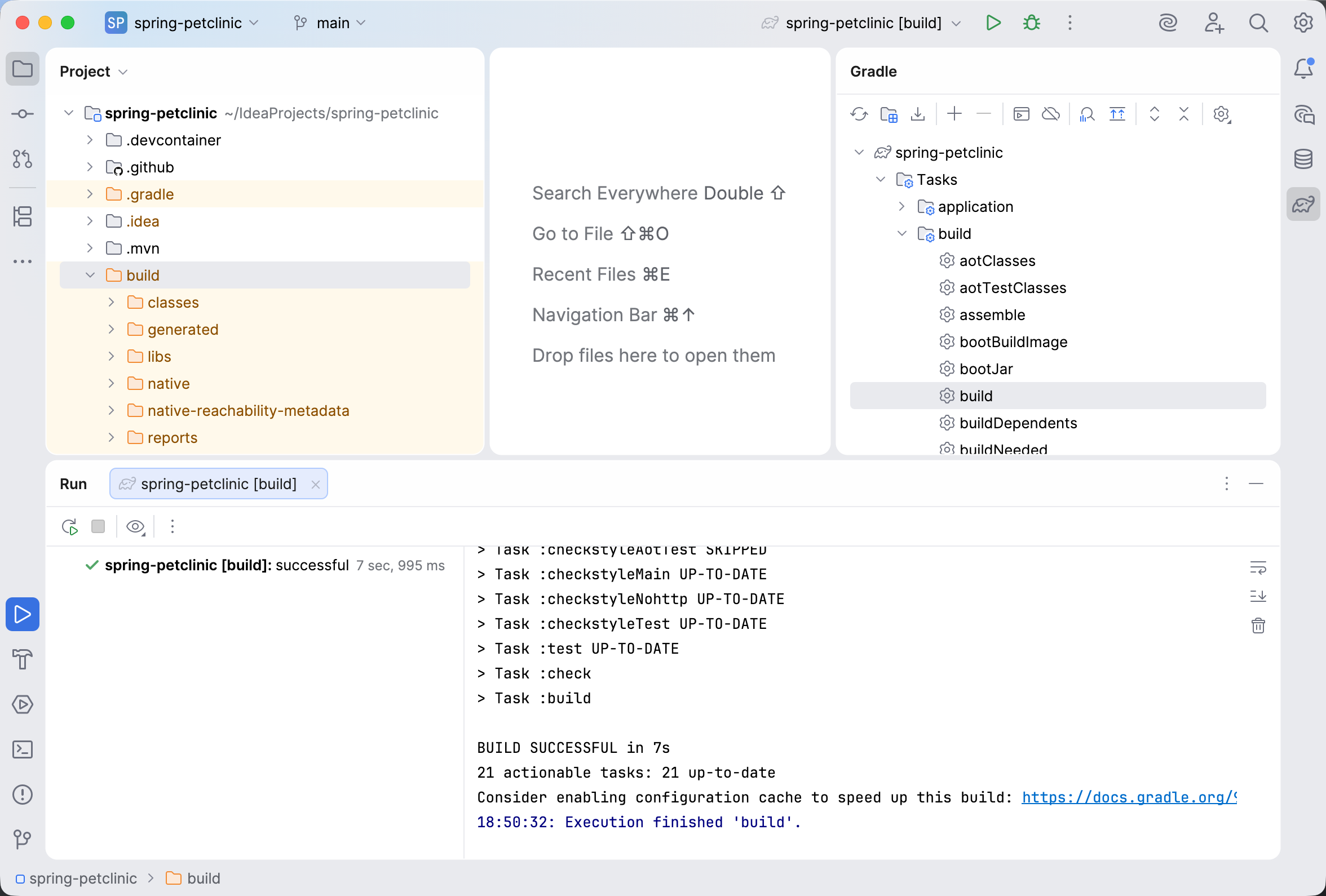
Expand the project node (spring-petclinic), then the Tasks node, and double-click the build task to run it.
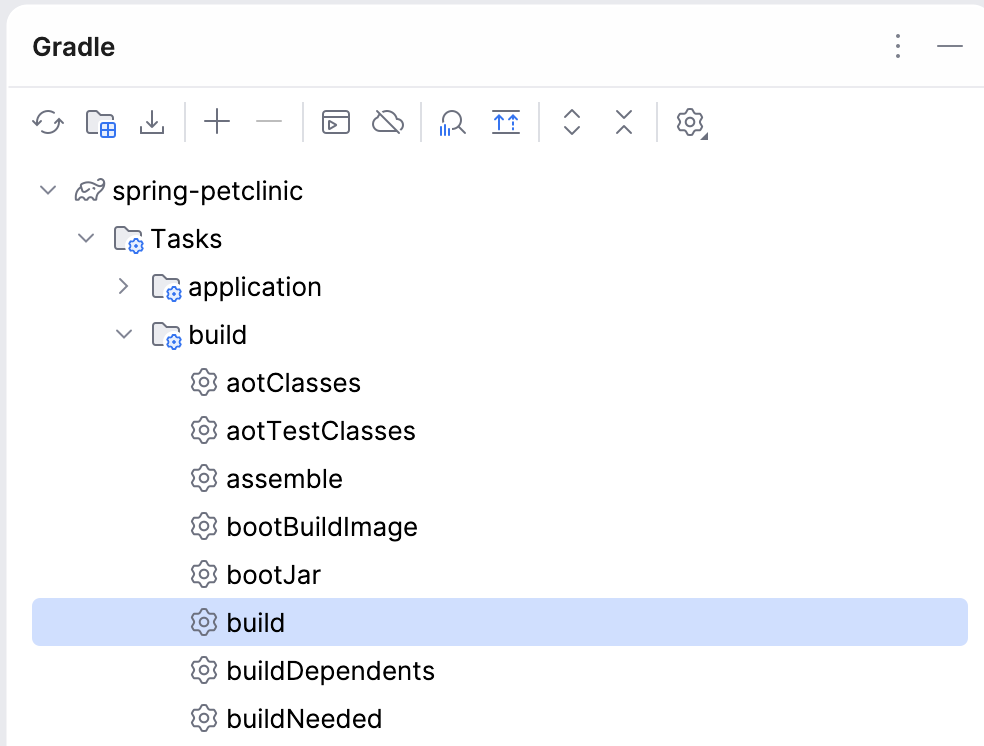
Wait for IntelliJ IDEA to finish the task. As a result, the IDE creates the build directory with artifacts in the project root.
Containerize the application
In this step, you will package the built application into a Docker image. Kubernetes will run this image later as a container in a pod.
Create a Dockerfile
In the Project tool window Alt+1, right-click the project root, point to New, and click File.
In the New File… dialog, type Dockerfile and press Enter.
If prompted, agree to add the file to Git.
Paste the following code to the new Dockerfile:
FROM eclipse-temurin:17-jre WORKDIR /app COPY build/libs/*.jar app.jar EXPOSE 8080 ENTRYPOINT ["java", "-jar", "app.jar"]
The created Dockerfile contains instructions for building a Docker image based on the eclipse-temurin:17-jre image, which provides a lightweight Java 17 runtime environment.
When you build the image, Docker copies the executable JAR file produced by the Gradle build from the build/libs directory of the project into the /app directory inside the container.
When you start a container from the image, Docker runs the java -jar app.jar command, which starts the Spring Petclinic application.
Create a Dockerfile
From the context menu of the project folder, select from the context menu, and then select .
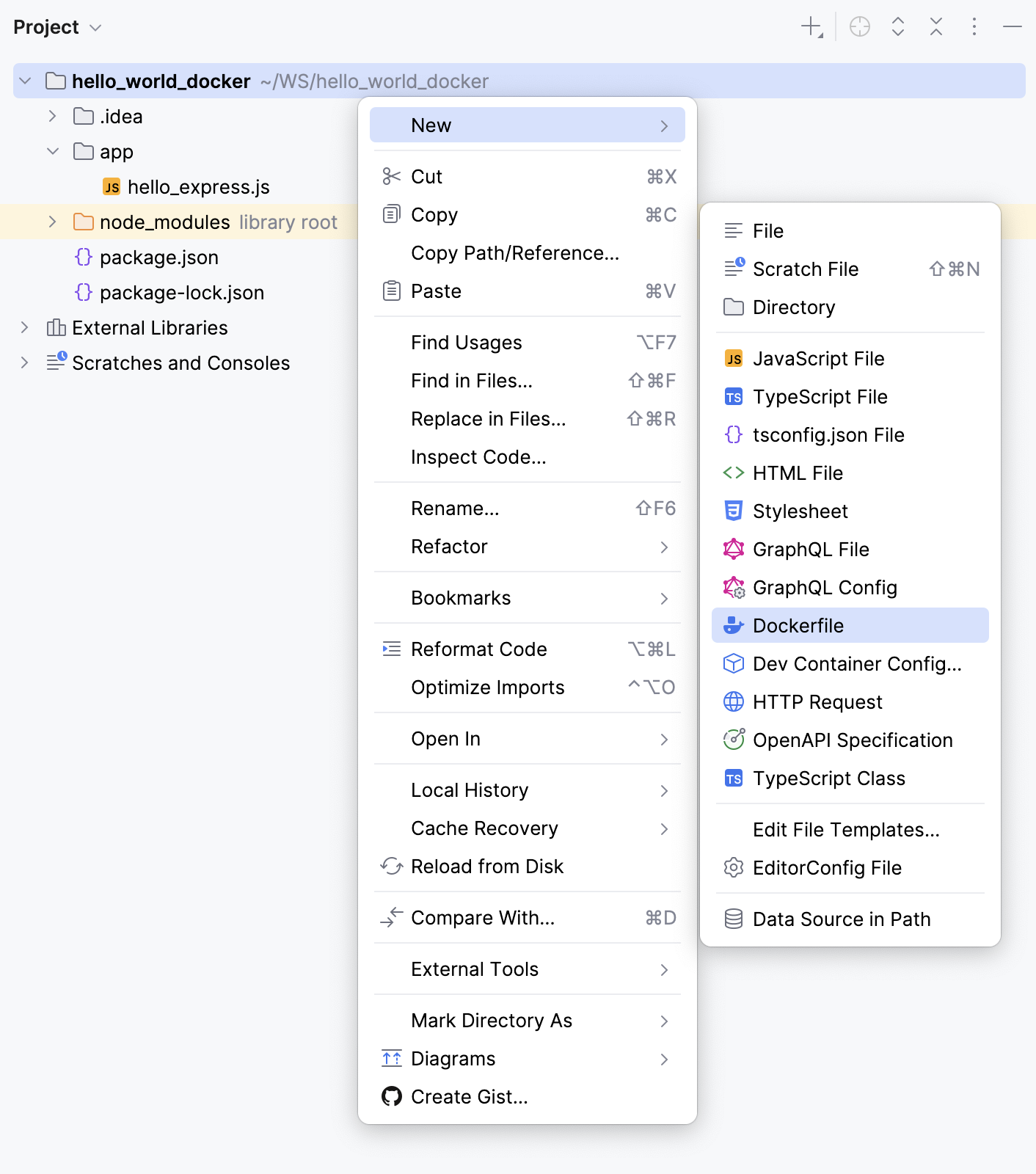
Open the newly created Dockerfile and type the following code:
FROM node:22-alpine WORKDIR /tmp COPY package*.json . RUN npm ci --omit=dev COPY ./app/ ./app/ CMD ["node","./app/hello_express.js"]This Dockerfile contains instructions for building an image based on the
node:22image from Docker Hub.When you run a container from this image, Docker sets copies the contents of the /app/ directory to the /tmp/app/ directory in the container (in our case, the /app/ directory contains the hello_express.js file). The package.json file is copied to /tmp/.
Then Docker sets the current working directory to /tmp and runs
node ./app/hello_express.js. As a result, the container log should showExample app listening on port 3000!.
Build the Docker image
Form the Project view, open Dockerfile in the editor.
Edit the file:
Change
ENV RAILS_ENV="production" \ BUNDLE_DEPLOYMENT="1" \ BUNDLE_PATH="/usr/local/bundle" \ BUNDLE_WITHOUT="development"to
ENV RAILS_ENV="development" \ BUNDLE_PATH="/usr/local/bundle"Change
EXPOSE 80 CMD ["./bin/thrust", "./bin/rails", "server"]to
EXPOSE 3000 CMD ["./bin/rails", "server", "-b", "0.0.0.0", "-p", "3000"]
In the gutter inside the Dockerfile, click
 and select New Run Configuration.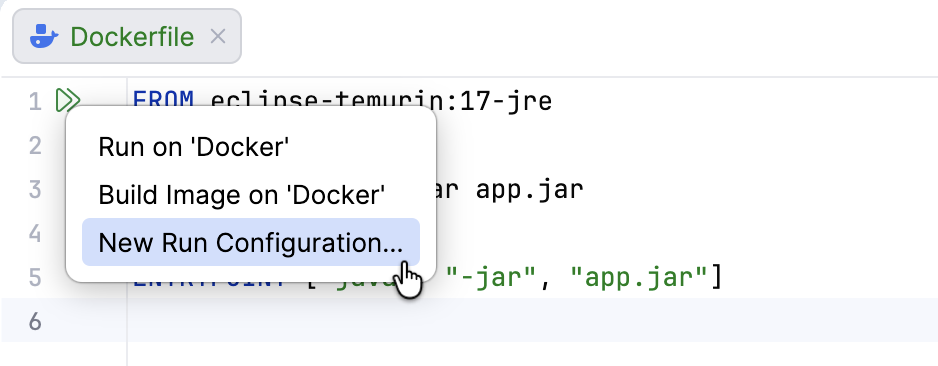
In the Edit Run Configuration dialog, specify
petclinic-appin the Image tag field andpetclinicin the Container name field. Then, click Run.
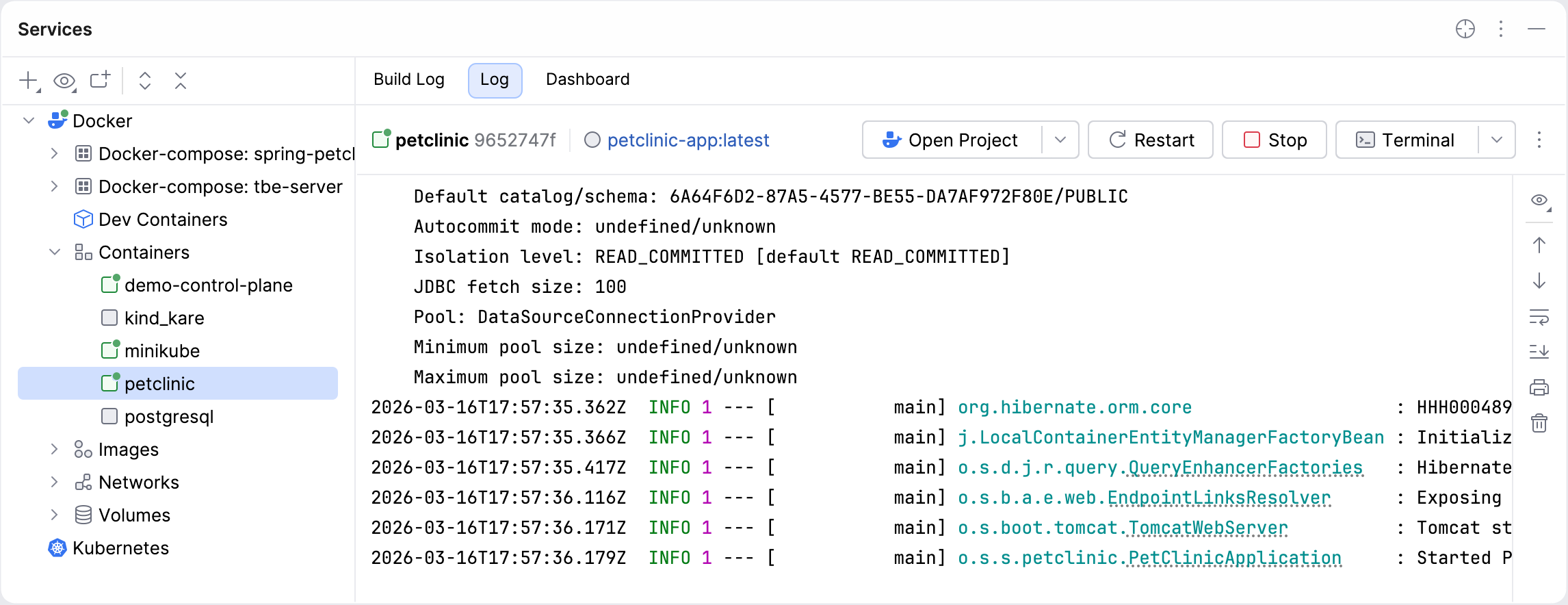
IntelliJ IDEA creates a Dockerfile run configuration, which builds an image from the Dockerfile and then runs a container based on that image. To follow the whole process, open the Log tab in the Services tool window.
Connect to minikube
Now that you have a Docker image with your application, you need to start a local Kubernetes cluster to deploy it to. We will use minikube to run a local, single-node Kubernetes cluster directly from IntelliJ IDEA.
Start minikube with the Docker driver
Open the Terminal tool window: go to or press Alt+F12.
Run the following command to start a local Kubernetes cluster and instruct minikube to use Docker as the virtualization driver:
minikube start --driver=dockerVerify that your cluster is up and running by using the command:
minikube status
Using the Docker driver runs the minikube cluster inside Docker containers, providing a lightweight environment well suited for local development.
Add the minikube cluster to IntelliJ IDEA
Open the Services tool window: go to or press Alt+8.
Select the Kubernetes node, click the Add Cluster button, and then select From Default Directory from the context menu.
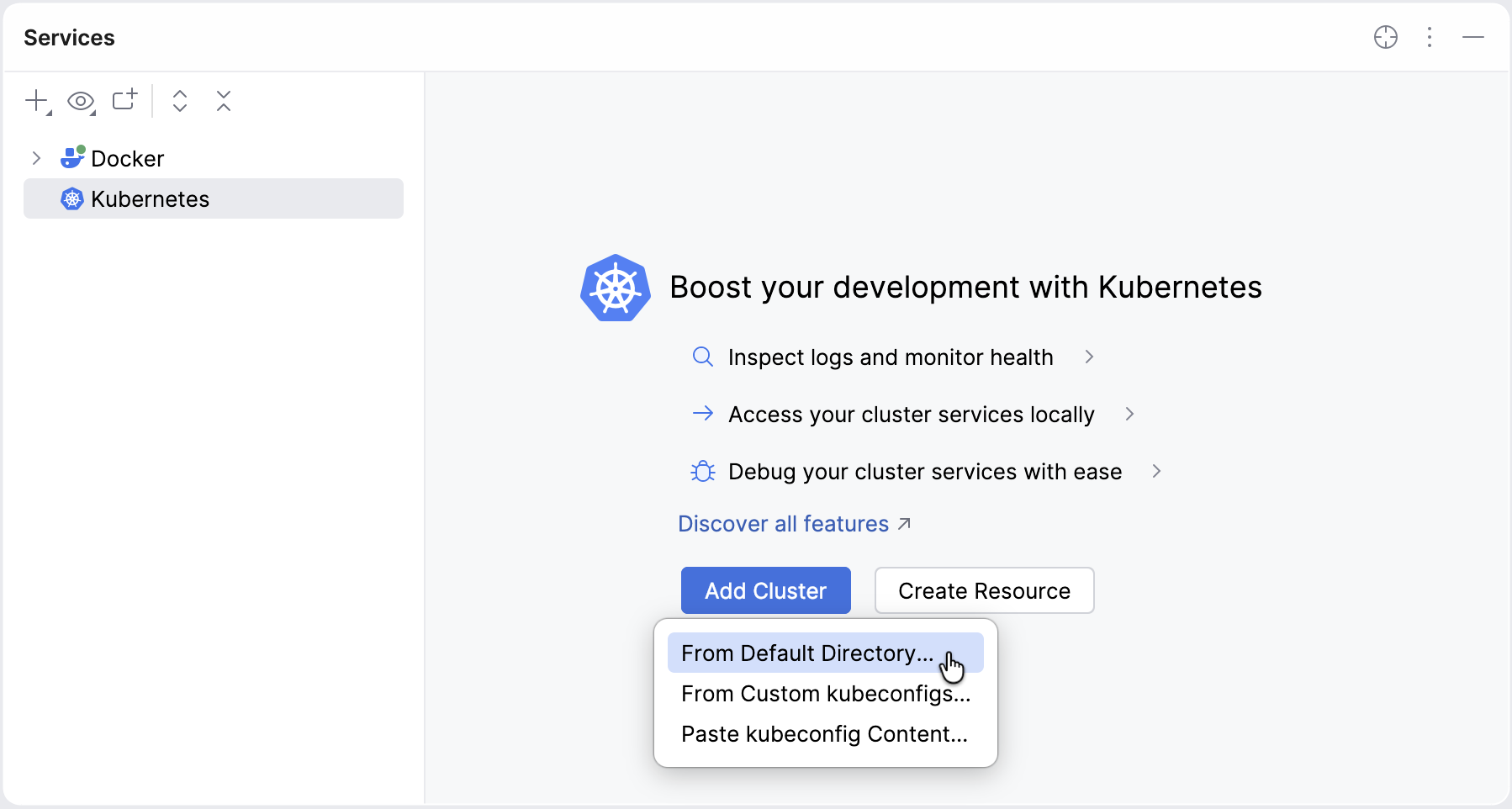
In the Add Clusters dialog, select minikube and click Add Clusters.
The added cluster will become available in the Services tool window.
In the Services tool window, right-click the minikube cluster and select Connect Cluster.
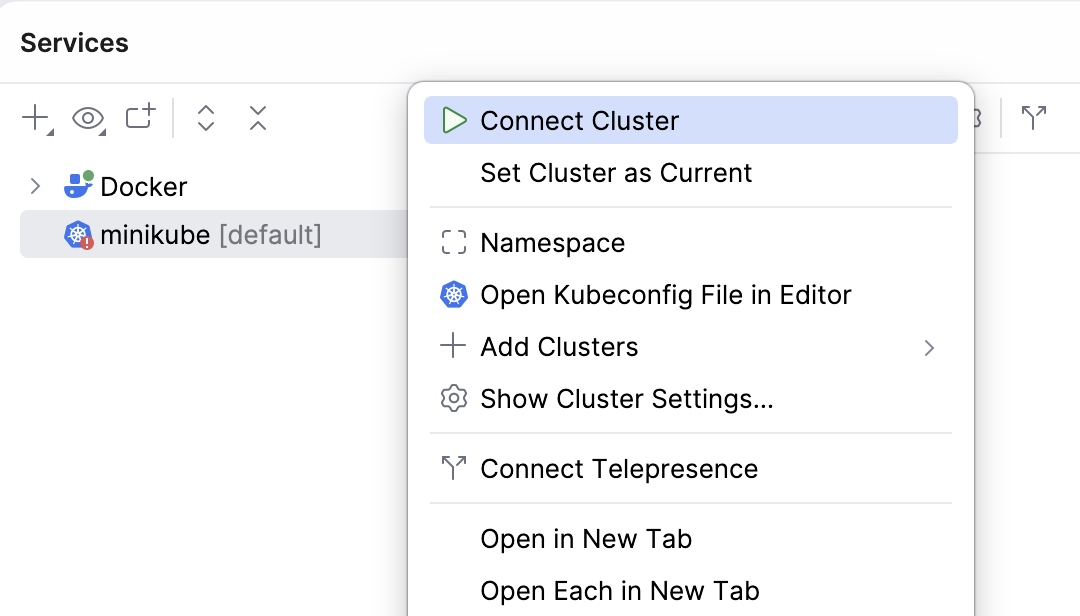
At this point, IntelliJ IDEA is connected to the running minikube cluster and can display its Kubernetes resources. You can explore namespaces, nodes, and other cluster objects directly from the Services tool window.
Deploy the application
Earlier in the tutorial, you already built the application image locally. However, the minikube cluster cannot automatically access images from your local Docker daemon. You need to load the image into minikube to make it available.
Load the Docker image into minikube
Open the Terminal tool window: go to or press Alt+F12.
Run the following command to build the container image in minikube:
minikube image load petclinic-appValidate that the
petclinic-appimage is available in your cluster by running:minikube image ls | grep petclinic-appYou should see
docker.io/library/petclinic-app:latestin the output.
Now that the image is available in minikube, the next step is to describe how Kubernetes will run it. Let us create two Kubernetes manifests:
Deployment, which helps you run your container in a pod
Service, which exposes your app so that you can access it from your machine
Create a Deployment manifest
In the Project tool window (Alt+1) , right-click the project name and select .
In the New Kubernetes Resource dialog, select the Deployment file type, specify
petclinic-deploymentas the manifest name, and press Enter.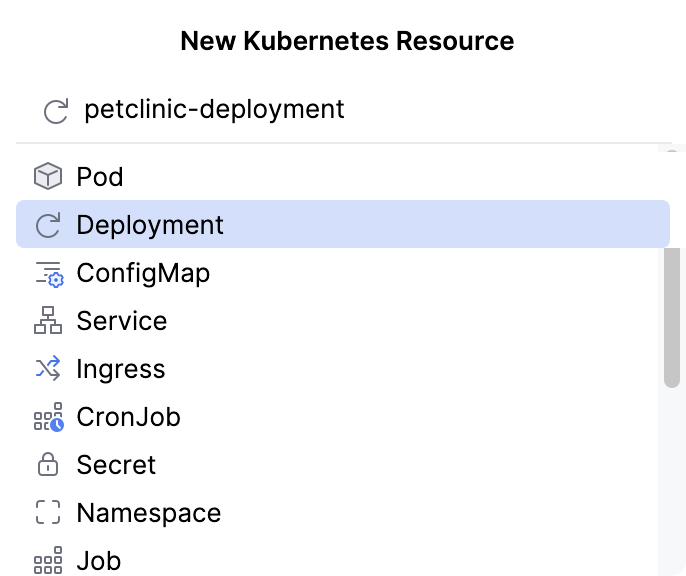
If prompted, agree to add the file to Git.
Replace the content of the resulting petclinic-deployment.yaml file with the following code:
apiVersion: apps/v1 kind: Deployment metadata: name: petclinic spec: replicas: 1 selector: matchLabels: app: petclinic template: metadata: labels: app: petclinic spec: containers: - name: petclinic image: petclinic-app:latest imagePullPolicy: IfNotPresent ports: - containerPort: 8080On the floating toolbar, select the current cluster and namespace, then click
 Apply to deliver the changes to the local cluster.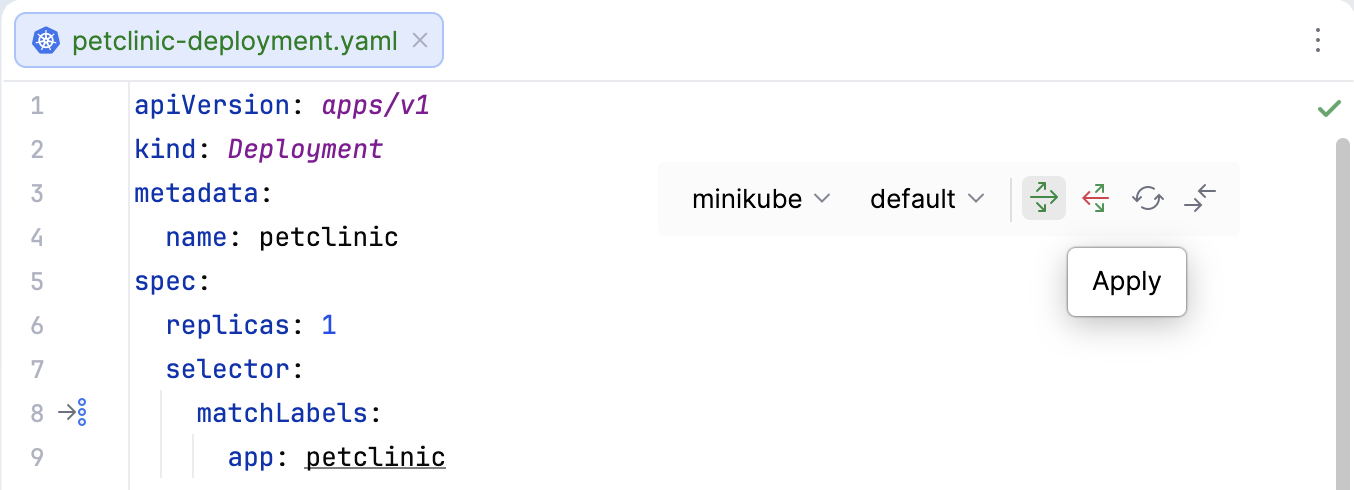
Create a Service manifest
In the Project tool window (Alt+1) , right-click the project name and select .
In the New Kubernetes Resource dialog, select the Service file type, specify
petclinic-serviceas the manifest name, and press Enter.If prompted, agree to add the file to Git.
Replace the content of the resulting petclinic-service.yaml file with the following code:
apiVersion: v1 kind: Service metadata: name: petclinic spec: type: NodePort selector: app: petclinic ports: - port: 8080 targetPort: 8080On the floating toolbar, select the current cluster and namespace, then click
Apply to deliver the changes to the local cluster.
Access the application
Open the petclinic-deployment.yaml file in the editor.
Click the Forward Ports inlay hint next to the
- containerPort: 8080property.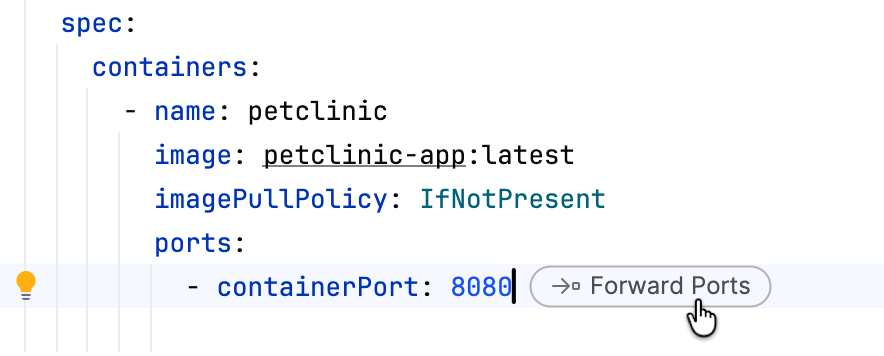
In the Forward Ports dialog, leave the default values and click Forward.
In the petclinic-deployment.yaml file, click the Open in Browser inlay hint.
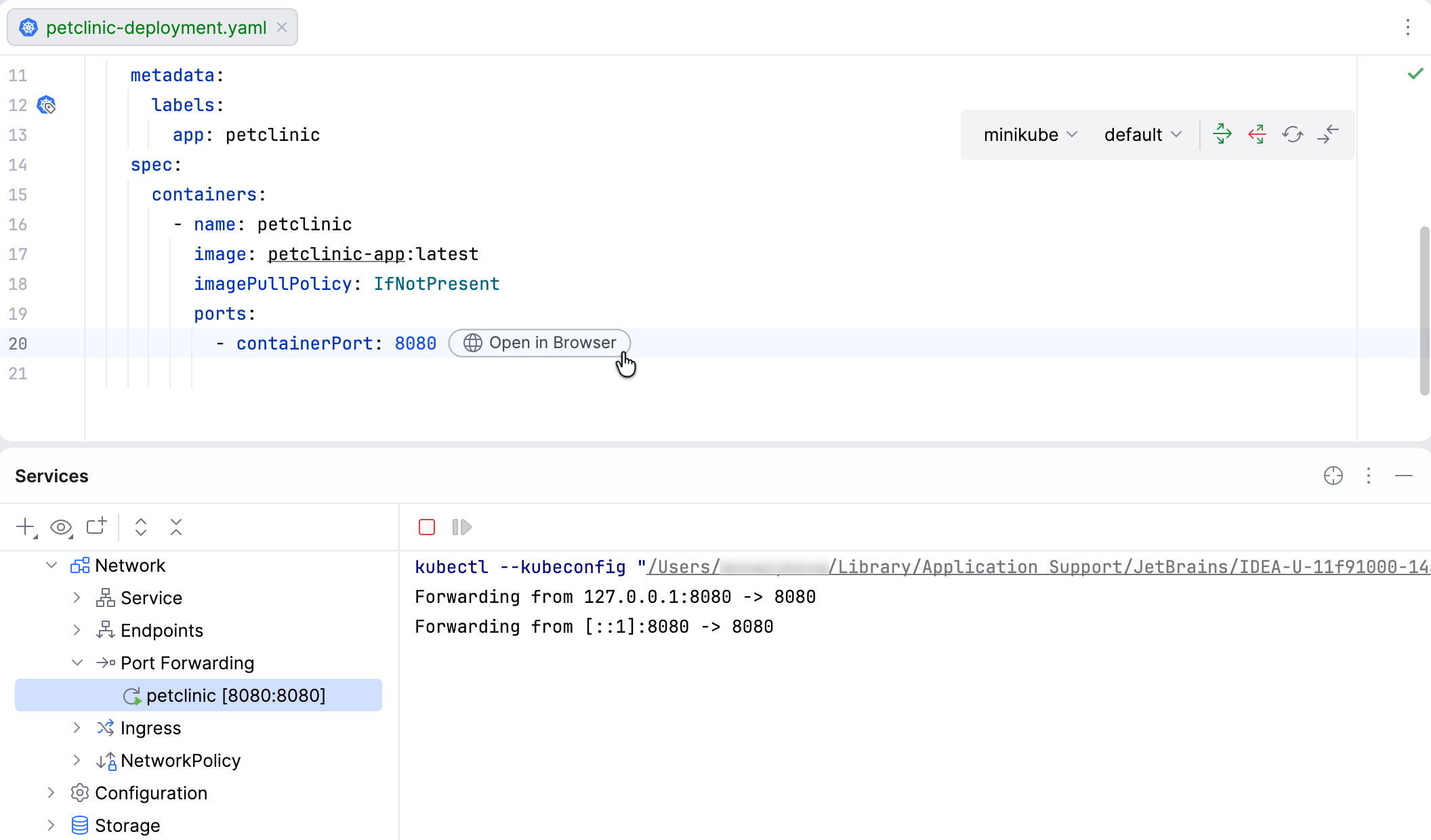
IntelliJ IDEA redirects you to your default browser, where you can check the Spring Petclinic application deployed in your local minikube cluster.
You have learned how to deploy a Spring application to a local Kubernetes cluster using minikube and IntelliJ IDEA. This approach enables quick local testing and experimentation with Kubernetes without requiring a remote cluster.
Next steps
Learn how to work with Kubernetes from these topics:
For a full list of available tutorials, refer to IntelliJ IDEA tutorials.