Shared indexes
Shared indexes let you reduce the time it takes for IntelliJ IDEA to analyze your project. Unlike regular indexes that are built locally each time the project is analyzed, shared indexes are generated once and are later reused on other computers whenever needed.
IntelliJ IDEA can build and use shared indexes for your JDK and your project's code. Whenever the IDE needs to reanalyze your project, it will use the available shared indexes and build local indexes for the rest of the project. Usually, this is faster than analyzing the entire project locally from scratch.
Install the plugin
To be able to use shared project indexes, the Shared Indexes plugin must be installed:
Press Ctrl+Alt+S to open settings and then select .
Switch to the Marketplace tab, type
Shared Indexesand click Install.Apply the changes and close the dialog. Restart the IDE if prompted.
Shared indexes for JDKs
To speed up the project analysis process, IntelliJ IDEA will use any pre-built shared JDK indexes it can and analyze the rest of the JDK locally. The IDE comes bundled with pre-built shared indexes for the three latest long-term support JDKs.
Shared project indexes
Shared project indexes are built for project sources and their dependencies. By generating indexes on a single computer and distributing them to other computers, you can avoid repeating the project analysis process on each machine. This way, each computer can benefit from the precomputed indexes without having to perform the expensive project analysis operations individually. This is the main advantage of shared indexes over regular indexes.
Before you begin
The computer that builds shared project indexes and any computers that use these shared indexes:
Should use the same IDE version to ensure index compatibility.
Can have different operating systems.
However, in previous IntelliJ IDEA versions, shared project indexes were OS-specific. Refer to the documentation that corresponds to your IDE version by using the version switcher in the top-left corner of this page.
Before incorporating shared project indexes into your infrastructure, you can evaluate how much time they can save on project analysis by running the command-line tool.
If you are satisfied with the results, you can keep using shared indexes. In more complex scenarios, you can customize sample scripts from the IntelliJ Shared Indexes Tool Example repository. For example, you can use a JSON configuration file to disable xz compression or use gzip compression when generating shared indexes.
Evaluate project analysis time with shared indexes
Before using shared project indexes in your workflow, you can check how much time they can save you. During the evaluation, the tool will generate some files in the directory that you have specified.
Download the latest version of the command-line tool and unzip the archive.
In the command line, navigate to the directory of the command-line tool and execute the binary file by running:
.\bin\ij-shared-indexes-tool-cli.bat boost./bin/ij-shared-indexes-tool-cli boost./bin/ij-shared-indexes-tool-cli boostwith the following options:
--ij: (mandatory) path to a locally installed IDE.--project: (mandatory) path to the project for which you want to build shared indexes.--port: port for running a local server. The default port is 25561.--data-directory: directory for storing generated indexes and server data. The default directory is ./ij-shared-indexes-tool-data.
For example:
.\bin\ij-shared-indexes-tool-cli.bat boost --ij "C:\Users\jetbrains\AppData\Local\Programs\IntelliJ IDEA Ultimate" --project "C:\Users\jetbrains\IdeaProjects\spring-petclinic"./bin/ij-shared-indexes-tool-cli boost --ij "/Users/jetbrains/Applications/IntelliJ IDEA Ultimate.app" --project "/Users/jetbrains/IdeaProjects/spring-petclinic"./bin/ij-shared-indexes-tool-cli boost --ij "/home/jetbrains/.local/share/JetBrains/Toolbox/apps/intellij-idea-ultimate/" --project "/home/jetbrains/IdeaProjects/spring-petclinic"Wait for some time. After that, the project analysis time with shared indexes and without them will appear.
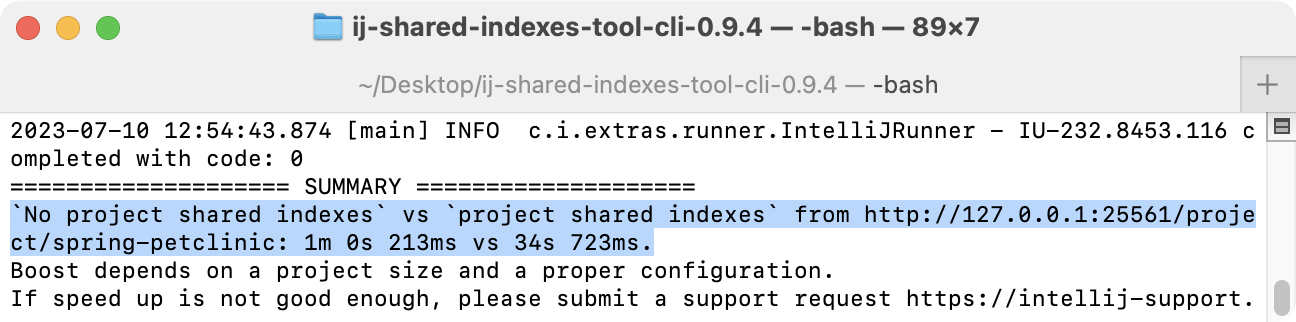
By comparing the difference in time, you can decide whether you want to use shared project indexes in your workflow or not.
Shared project indexes usage overview
In order to be able to work with shared project indexes, you must:
Generate project indexes
Use these steps to generate index files. After the indexes have been generated, you will need to upload the files to a file server or S3-compatible storage.
Download the latest version of the command-line tool and unzip the archive.
In the command line, navigate to the directory of the command-line tool and execute the binary file via the command line by running:
.\bin\ij-shared-indexes-tool-cli.bat indexes./bin/ij-shared-indexes-tool-cli indexes./bin/ij-shared-indexes-tool-cli indexeswith the following options:
--ij: (mandatory) path to a locally installed IDE.--project: (mandatory) path to the project for which you want to build shared indexes.--base-url: (mandatory) Indexes server URL. The base URL that will be used to define the full URL where shared indexes are hosted.--data-directory: directory for storing generated indexes and server data. The default directory is ./ij-shared-indexes-tool-data. You should upload files from this directory to the server specified in thebase-urlparameter.
Example for production: If you are generating shared indexes for a production use case, you can create indexes that you will upload to your file server or S3-compatible storage. For example:
.\bin\ij-shared-indexes-tool-cli.bat indexes --ij "C:\Users\jetbrains\AppData\Local\Programs\IntelliJ IDEA Ultimate" --project "C:\Users\jetbrains\IdeaProjects\spring-petclinic" --base-url "http://your-aws-bucket.s3-website.eu-north-1.amazonaws.com"./bin/ij-shared-indexes-tool-cli indexes --ij "/Users/jetbrains/Library/Application Support/JetBrains/Toolbox/apps/IDEA-U/ch-1/232.8453.116/IntelliJ IDEA 2023.2 EAP.app" --project "/Users/jetbrains/IdeaProjects/spring-petclinic" --base-url "http://your-aws-bucket.s3-website.eu-north-1.amazonaws.com"./bin/ij-shared-indexes-tool-cli indexes --ij "/home/jetbrains/.local/share/JetBrains/Toolbox/apps/intellij-idea-ultimate/" --project "/home/jetbrains/IdeaProjects/spring-petclinic" --base-url "http://your-aws-bucket.s3-website.eu-north-1.amazonaws.com"Example for testing: If you are testing shared indexes locally, you can create indexes that you can upload to a local server. For example:
.\bin\ij-shared-indexes-tool-cli.bat indexes --ij "C:\Users\jetbrains\AppData\Local\Programs\IntelliJ IDEA Ultimate" --project "/Users/jetbrains/IdeaProjects/spring_example_project" --base-url "http://127.0.0.1:8080" --data-directory "C:\Users\jetbrains\ij-shared-indexes-tool-data"./bin/ij-shared-indexes-tool-cli indexes --ij "/Users/jetbrains/Library/Application Support/JetBrains/Toolbox/apps/IDEA-U/ch-1/232.8453.116/IntelliJ IDEA 2023.2 EAP.app" --project "/Users/jetbrains/IdeaProjects/spring_example_project" --base-url "http://127.0.0.1:8080"./bin/ij-shared-indexes-tool-cli indexes --ij "/home/jetbrains/.local/share/JetBrains/Toolbox/apps/intellij-idea-ultimate/" --project "/Users/jetbrains/IdeaProjects/spring_example_project" --base-url "http://127.0.0.1:8080" --data-directory "/home/jetbrains/ij-shared-indexes-tool-data"Once the project indexes have been generated, a message with the information required to configure shared indexes in your project will appear.
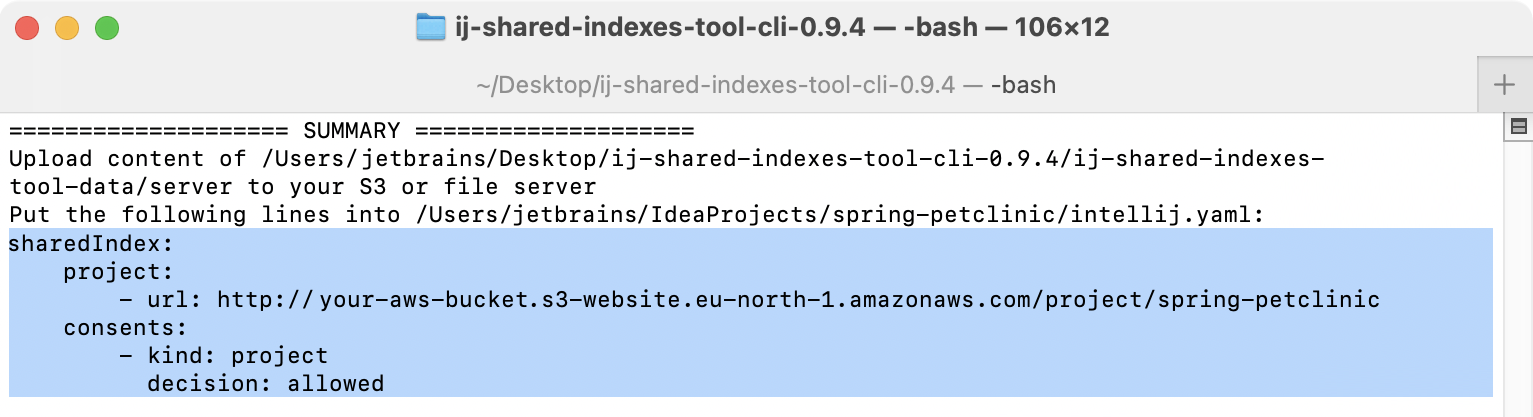
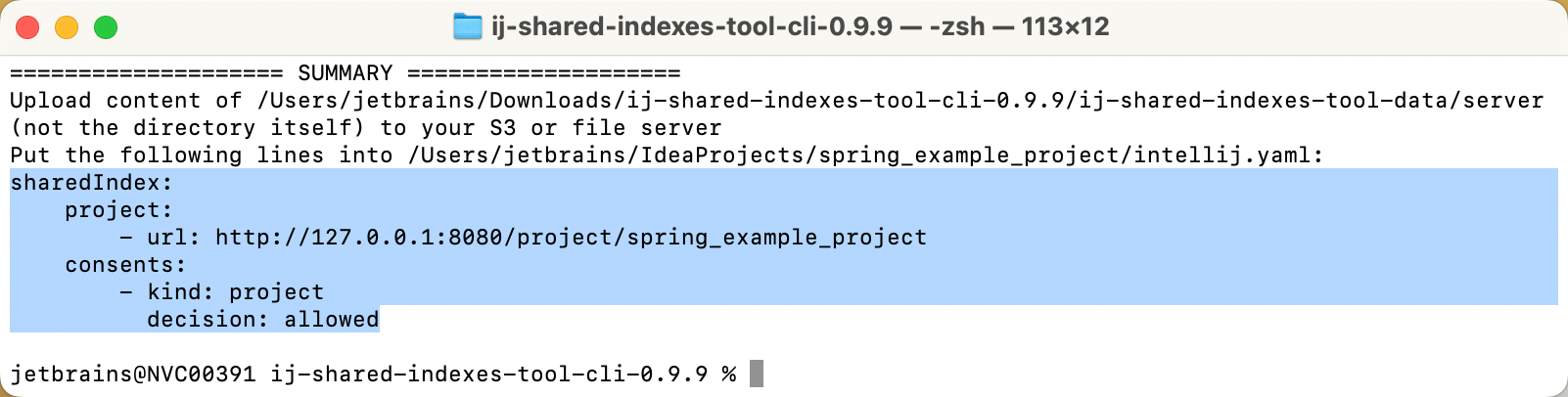
After you have generated indexes, two folders appear in the directory you have specified when executing the indexes command: server and temp. The index files are stored within the server directory.
Upload files to the storage
After you have generated indexes, two folders appear in the directory you have specified when executing the indexes command: server and temp. The index files are stored within the server directory.
Uploading shared indexes to a remote storage
Upload the data and the project folders from the server directory to your file server or S3-compatible storage. The storage location should have the same base URL as the URL that was defined using the
base-urlparameter when generating the indexes.
Publishing shared indexes when testing locally
When testing shared indexes, you can use the server command to start a server on the generated files.
In the command line, navigate to the directory of the command-line tool and execute the binary file by running:
.\bin\ij-shared-indexes-tool-cli.bat server./bin/ij-shared-indexes-tool-cli server./bin/ij-shared-indexes-tool-cli serverwith the following options:
--port: port for running a local server.--server-directory: directory for server data. The default directory is ./ij-shared-indexes-tool-data/server.
For example:
.\bin\ij-shared-indexes-tool-cli.bat server --port 8080 --server-directory "C:\Users\jetbrains\ij-shared-indexes-tool-data\server"./bin/ij-shared-indexes-tool-cli server --port 8080 --server-directory "/Users/jetbrains/ij-shared-indexes-tool-data/server"./bin/ij-shared-indexes-tool-cli server --port 8080 --server-directory "/home/jetbrains/ij-shared-indexes-tool-data/server"

Configure access to shared indexes
Once the project indexes are uploaded to the file storage, they can be downloaded and applied on another computer.
In the project directory, create a new file intellij.yaml and copy the information from the terminal to the new file, for example:
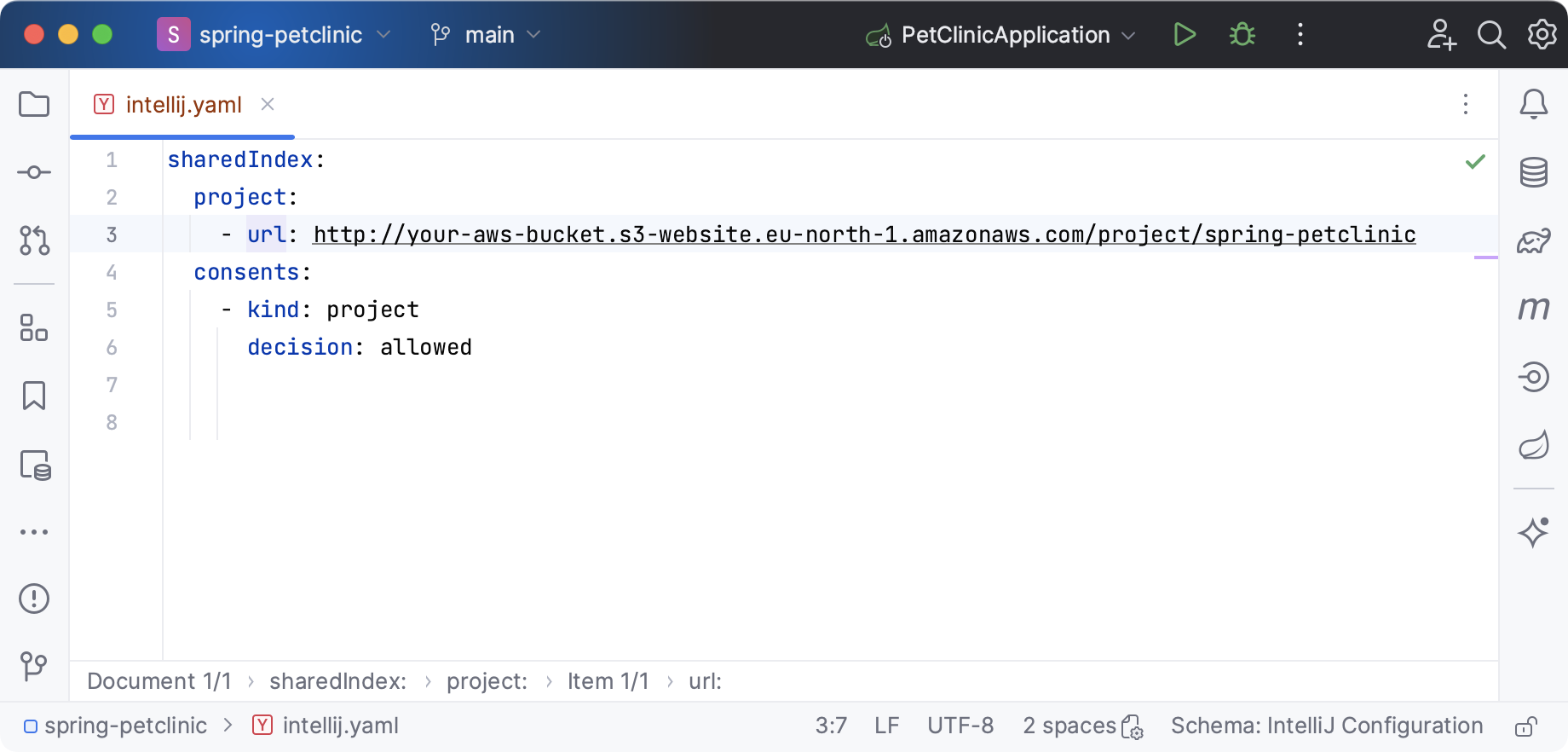
If the project has not been analyzed yet or you have cleared the system cache, the IDE will download the shared indexes and use them.
In the default configuration, the IDE will download the shared indexes automatically. You may choose to change this and confirm every download manually.
Project indexes will be downloaded to index/shared_indexes in the IDE system directory.
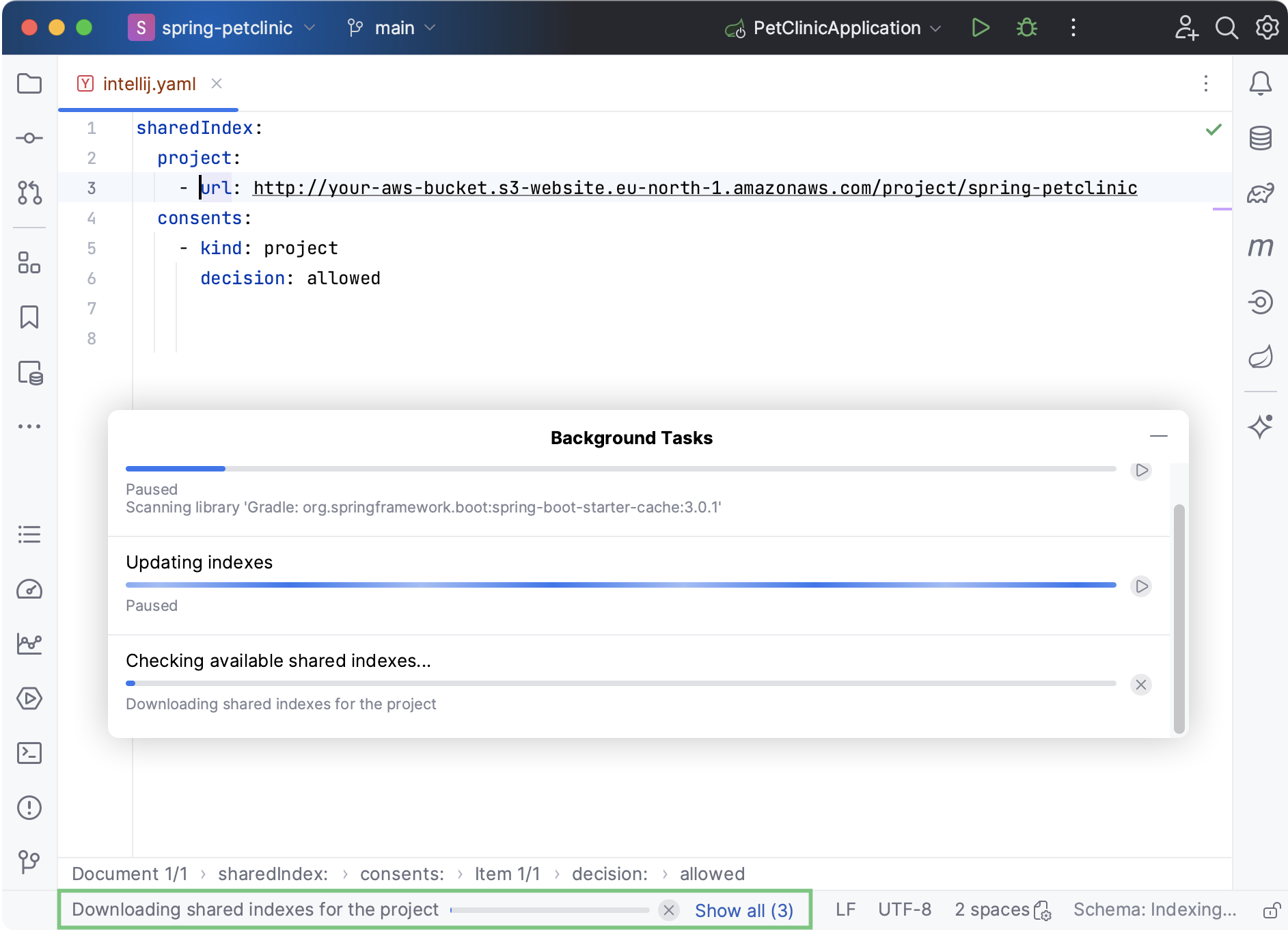
When the indexes are being downloaded, the progress is displayed in the status bar.
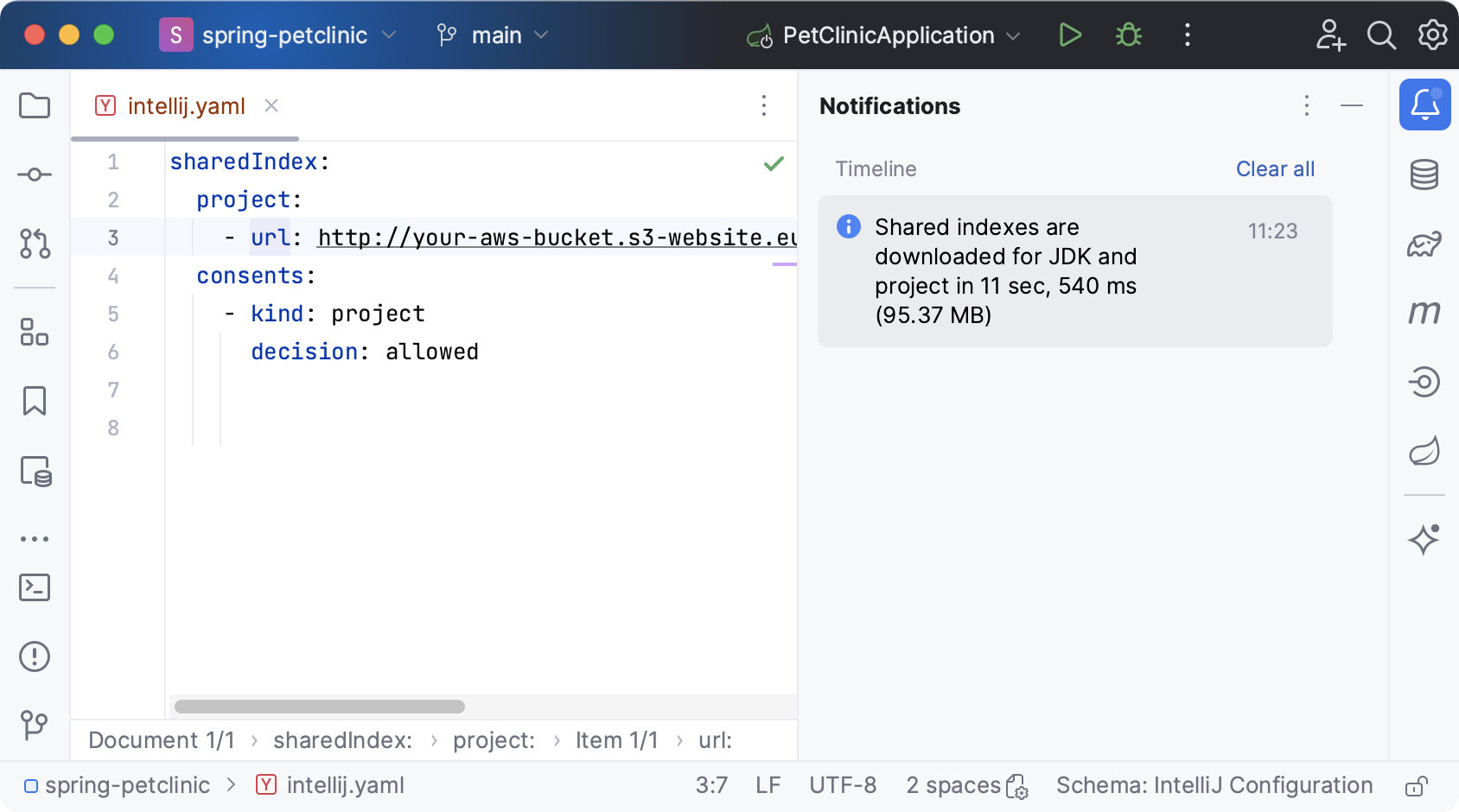
When everything is ready, a corresponding notification will appear in the Notifications tool window.
Change the way indexes are downloaded
In the default configuration, the IDE will be downloading shared indexes automatically. You can confirm every download manually.
From the intellij.yaml file, remove the
consentssection and restart your project.In the Settings dialog (Ctrl+Alt+S) , select and in the Project Shared Indexes area, select Ask before download.
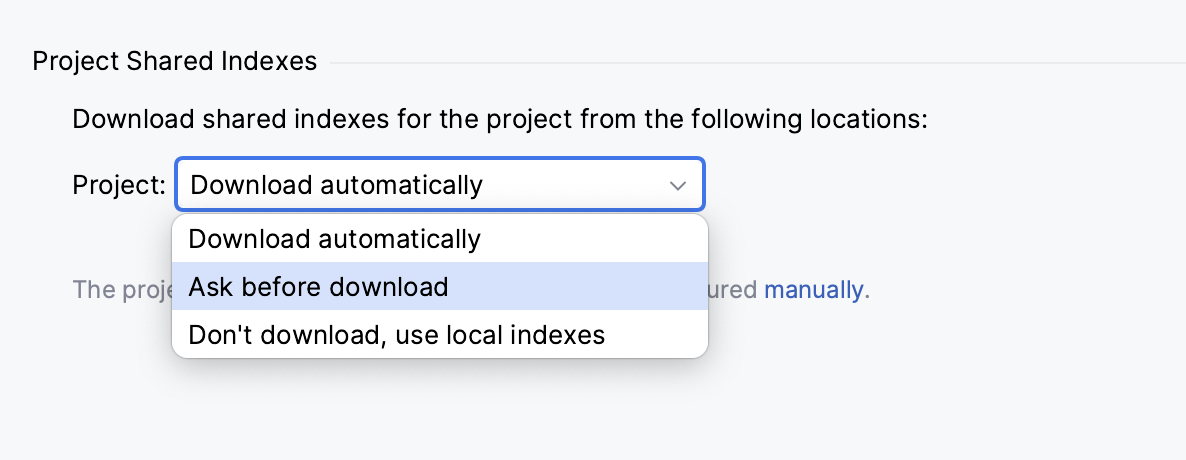
Apply the changes and close the dialog.
Invalidate downloaded shared indexes
After invalidation, IntelliJ IDEA will download and use new shared indexes if they are available. Otherwise, new indexes will be built locally during project analysis.
From the main menu, select .
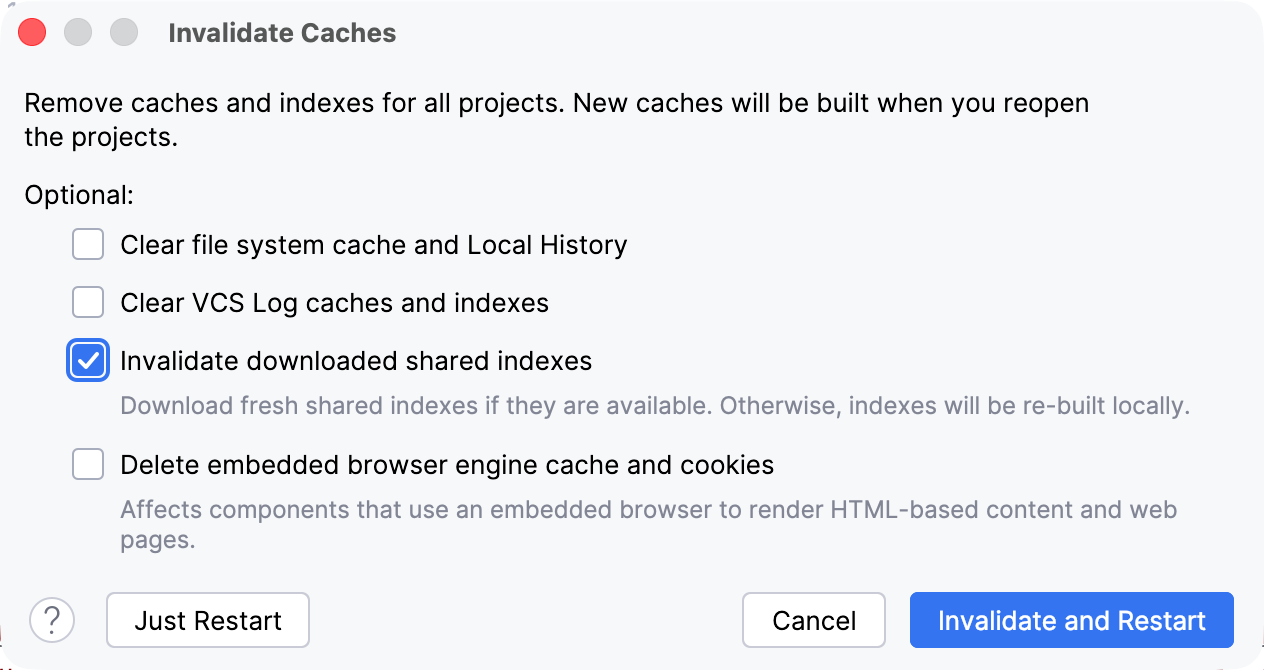
Select Invalidate downloaded shared indexes and click Invalidate and Restart.
Shared indexes CLI command reference
- boost
Measures the project analysis speed up with project shared indexes. Options:
--project: (mandatory) Path to a project.--ij: (mandatory) Path to a locally installed IDE.--port: Port for running a local server. The default port is 25561.--data-directory: Directory to use for generation and server data.
- indexes
Generates project shared indexes and makes them ready to be uploaded. Options:
--project: (mandatory) Path to a project.--ij: (mandatory) Path to a locally installed IDE.--base-url: (mandatory) Indexes server URL.--data-directory: Directory to use for generation and server data.
- server
Starts a server on local indexes. Options:
--port: port for running a local server. The default port is 25561.--server-directory: directory for server data. The default directory is ./ij-shared-indexes-tool-data/server.
- version
Displays shared indexes version information. Options:
--ij: (mandatory) path to a locally installed IDE..
You can keep using shared indexes from the command line. In more complex scenarios, you can customize sample scripts from the IntelliJ Shared Indexes Tool Example repository.