Keycloak Auth Module
The Keycloak authentication module is a pre-configured OAuth 2.0 module that lets users log in to YouTrack with their Keycloak credentials.
Enable Keycloak Authentication
To let users with existing Keycloak accounts log in to YouTrack, enable the authentication module.
This procedure takes place in three steps:
Create a Keycloak Auth Module. When you create an authentication module, YouTrack generates a redirect URI to use with the authorization service. This URI identifies the source of each login request.
Generate a Client ID and Secret in Keycloak. Every login request sent from YouTrack includes a unique identifier. The ID and secret you store in the authentication module tell the Keycloak authorization service that each login request is authorized.
Enable the Auth Module in YouTrack. When you have generated the information that YouTrack uses to authenticate with the Keycloak authorization service, copy the values into YouTrack and enable the module.
Create a Keycloak Auth Module in YouTrack
First, create the Keycloak authentication module. When you perform this action, YouTrack generates a redirect URI to use with the authorization service.
From the main navigation menu, select
 .
.Click the New module button.
The Select an identity provider dialog opens.
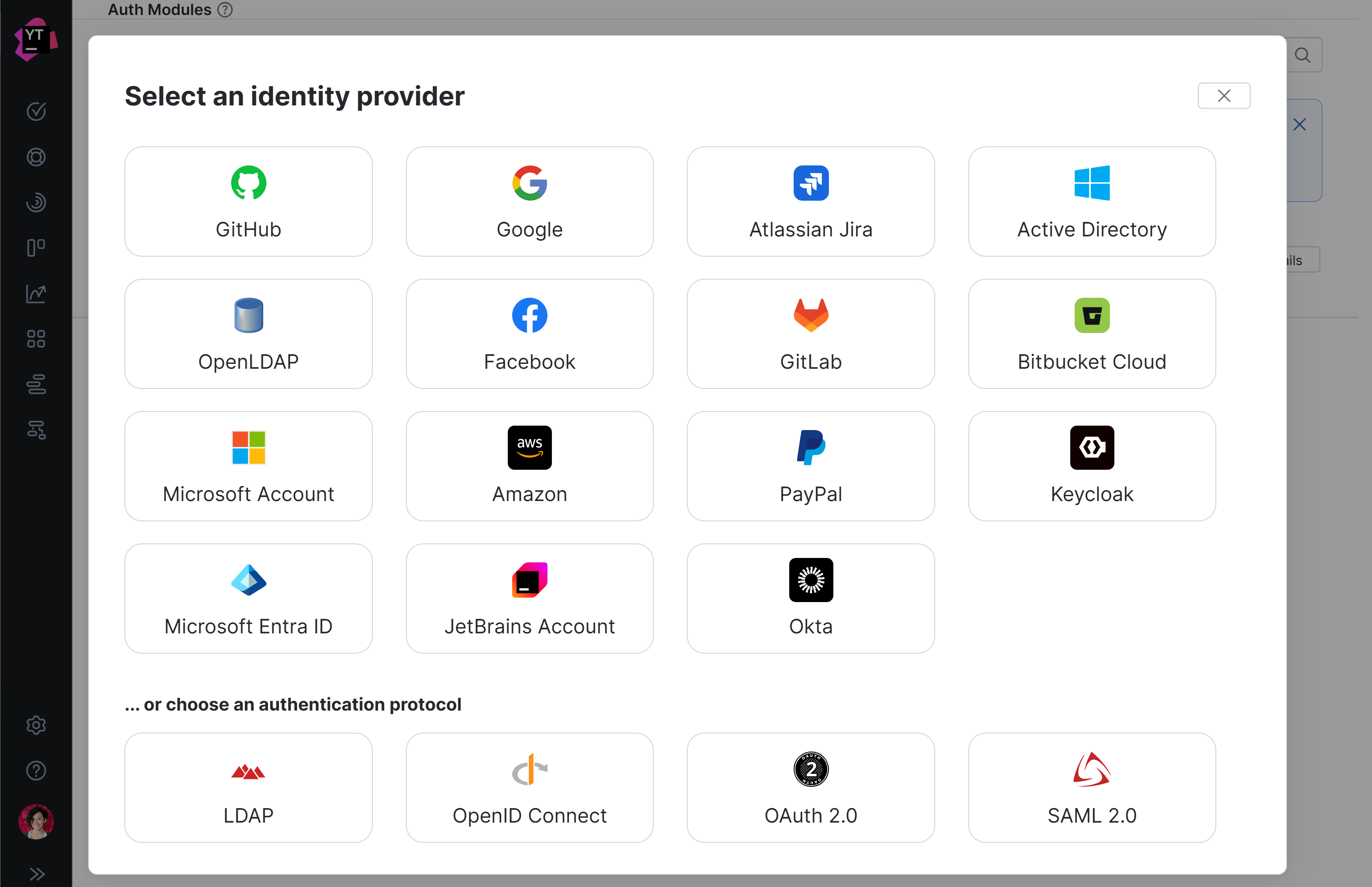
In the Select an identity provider dialog, select Keycloak.
The New Keycloak Auth Module dialog opens.
In the New Keycloak Auth Module dialog, enter values for the following settings:
Setting
Description
Keycloak root URL
Enter the root URL for your Keycloak server.
Keycloak realm
Enter the name of the Keycloak realm where you manage the user accounts that you want to allow access to YouTrack.
Click the Create button.
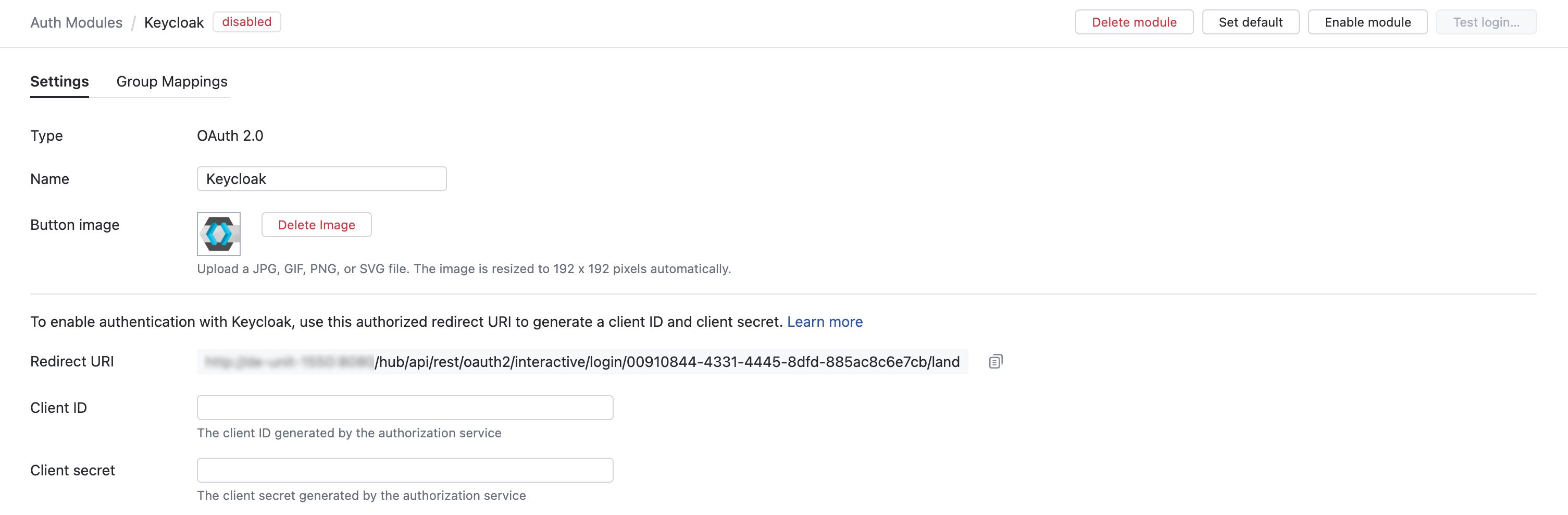
The Auth Modules page displays the settings for a new Keycloak authentication module.
YouTrack generates a redirect URI for you to use in the authorization service.
Generate a Client ID and Secret
The next step is to get a client ID and secret from Keycloak.
Log in to the admin console with your administrator account.
Select your realm from the list.
From the Configure menu, select Clients.
Click the Create button.
The Add Client dialog opens.
Enter values for the following settings:
For the Client ID, enter a value that helps you identify the client application.
For the Client Protocol, select openid-connect.
For the Root URL, enter the base URL for your YouTrack installation.
Click the Save button.
The page that stores the settings for your new client application opens.
On the Settings tab for your client app, change the Access Type to confidential.
Click the Save button.
Use the value stored as the Client ID to enable the authentication module in HUb.
Select the Credentials tab, then use the value that is stored as the Secret to enable the authentication module in YouTrack.
For additional information, please refer to the Keycloak documentation.
Enable the Auth Module in YouTrack
To complete the setup, store the client ID and secret from the authorization service in the Keycloak auth module.
Copy the Client ID from the Settings tab in Keycloak and paste it into the Client ID input field in YouTrack.
Copy the Secret from the Credentials tab in Keycloak and paste it into the Client secret input field in YouTrack.
Configure the optional settings for the authentication module. For more information, see Additional Settings.
Click the Save button to apply the settings.
Click the Enable module button.
The Keycloak authentication module is enabled.
The icon stored in the Button image setting is added to the login dialog window. Users can click this icon to log in to YouTrack with their Keycloak credentials.
Test the Connection
To verify that the Keycloak authentication module is set up correctly, test the connection.
Click the Test login button in the header. This verifies the login process in a new browser tab.
If the authentication module is set up correctly, a success message is shown.
If there are problems with the connection, the authentication service displays an error message. Use the information provided on the error page to investigate the problem.
General Information
In the header of the settings page, you can find the general information about the authentication module.
Setting | Description |
|---|---|
Name | Stores the name of the authentication module. Use this setting to distinguish this module from other authentication modules in the Auth Modules list. You can change the name and icon of the authentication module using the Rename action. For more details, see Actions. |
Type | Displays the type of authorization service that is enabled for third-party authentication in YouTrack. |
Accounts imported to YouTrack | Displays the number of users that have been imported to YouTrack. |
Actions
The following actions are available in the header:
Action | Description |
|---|---|
Enable | Enables the authentication module. This option is only shown when the authentication module is currently disabled. |
Disable | Disables the authentication module. This option is only shown when the authentication module is currently enabled. |
Test login | Lets you test the connection with the authentication service. |
Rename | Lets you update the existing authentication module name and change its default icon. You can find this action in the |
Delete | Removes the authentication module from YouTrack. Use only when you have configured additional authentication modules that let users log into your YouTrack installation. You can find this action in the |

General Settings
On the General Settings tab, you find the general settings for the authentication module. This includes the redirect URI used to register YouTrack in the authorization service and the client credentials generated in the authorization service.
Setting | Description |
|---|---|
Default | Designates the authentication module as the default for your installation. Only one authentication module can be set as the default at any time. If another module is currently set as the default, that state is cleared. If none of the available authentication modules are designated as the default, unauthenticated users are always directed to the YouTrack login page. |
Authentication
The Authentication settings define the core security credentials and parameters required to connect YouTrack with Keycloak's OAuth 2.0 identity provider. By entering the Client ID and Secret generated in Keycloak into the Client ID and Client Secret fields, and defining the required access Scopes, you enable secure identity verification. This section also displays the unique Redirect URI that must be registered in Keycloak to authorize the connection.
Setting | Description |
|---|---|
Redirect URI | Displays the authorized redirect URI used to register the connection to YouTrack in the authorization service. |
Client ID | Stores the identifier that the authorization service uses to validate a login request. You generate this value in the authorization service when you configure the authorization settings for a web application and enter an authorized redirect URI. |
Client Secret | Stores the secret or password used to validate the client ID. You generate this value in the authorization service together with the client ID. |
Scopes | A space-separated list of scopes YouTrack requests from the identity provider. Scopes determine which claim groups the identity provider returns. |
Authorization Service Endpoints
The settings in this section of the page store the OAuth 2.0 endpoints used by Keycloak.
For pre-configured OAuth 2.0 modules, the values that are used by the selected authorization service are set automatically.
Setting | Description |
|---|---|
Authorization URL | Stores the endpoint that YouTrack uses to get authorization from the resource owner via user-agent redirection. |
Token URL | Stores the endpoint that YouTrack uses to exchange an authorization grant for an access token. |
User info URL | Stores the endpoint used to locate profile data for the authenticated user. |
Logout URL | The optional endpoint to invalidate the authorization service session on logout |
Email URL | Stores the endpoint used to locate the email address of the authenticated user. Use only when the email address is not stored in the user profile. |
Avatar URL | Stores the endpoint used to locate the binary file that is used as the avatar for the authenticated user. Use only when the avatar isn’t stored directly in the user profile. |
Attribute Mapping
When a user profile response object is returned by Keycloak, values from the specified field paths are copied to the user profile in YouTrack. Use the following settings to define the endpoint that locates profile data for the authenticated user and map fields that are stored in the authorization service to user accounts in YouTrack.
For the predefined Keycloak module, the User ID, Email, Email verification state, Full name, and Groups are set automatically. If you need to modify these values to suit your needs, you can overwrite them.
To specify paths to fields inside nested objects, enter a sequence of segments separated by the slash character (
/).To reference values that may be stored in more than one location, use the "Elvis operator" (
?:) as a delimiter for multiple paths. With this option, YouTrack uses the first non-empty value it encounters in the specified field.
Field | Description |
|---|---|
User ID | Maps to the field that stores the value to copy to the User ID property in the YouTrack account. |
Username | Maps to the field that stores the value to copy to the Username field in the YouTrack account. |
Full name | Maps to the field that stores the value to copy to the Full name field in the YouTrack account. |
Maps to the field that stores the value to copy to the Email field in the YouTrack account. | |
Email verification state | Maps to the field that stores the value to copy to the verified email property in the YouTrack account. |
Avatar | Maps to the field that stores the image to use as the Avatar in the YouTrack account. |
Image URL pattern | Generates an image URL for avatars that are referenced by an ID. Use the <picture-id> placeholder to reference the field that stores the avatar. |
Groups | Maps to the attribute that stores group membership assignments in the connected authorization service. When this value is specified, you can map and sync group memberships in the authorization service with corresponding groups in YouTrack. For details, see Group Mapping. |
Group Mapping
On the Group Mappings tab, you can map existing groups in the authorization service to the groups in YouTrack.

If you want to map groups in Keycloak to groups in YouTrack, you need to specify the Groups attribute that stores Keycloak group memberships in the Field Mapping section of the settings for this auth module. For the predefined Keycloak module, the Groups attribute and Scopes are set automatically.
When group mappings are configured, YouTrack checks for Keycloak group memberships when users log in with accounts that are managed in the directory service. YouTrack performs the following operations for each Keycloak group that is mapped to a YouTrack group:
Users who are members of a mapped Keycloak group and are not members of the mapped YouTrack group are added to the group in YouTrack.
Users who are not members of a mapped Keycloak group and are members of the mapped YouTrack group are removed from the group in YouTrack.
Changes to group memberships in the authorization service are only applied in YouTrack when users log in using their Keycloak accounts.
You can map multiple Keycloak groups to a single target group in YouTrack. You can't map Keycloak groups to more than one YouTrack group.
To map a group from Keycloak to a group in YouTrack:
Open your Keycloak auth module.
Select the Group Mappings tab.
Click the Add mapping button.
The Add Mapping dialog opens.
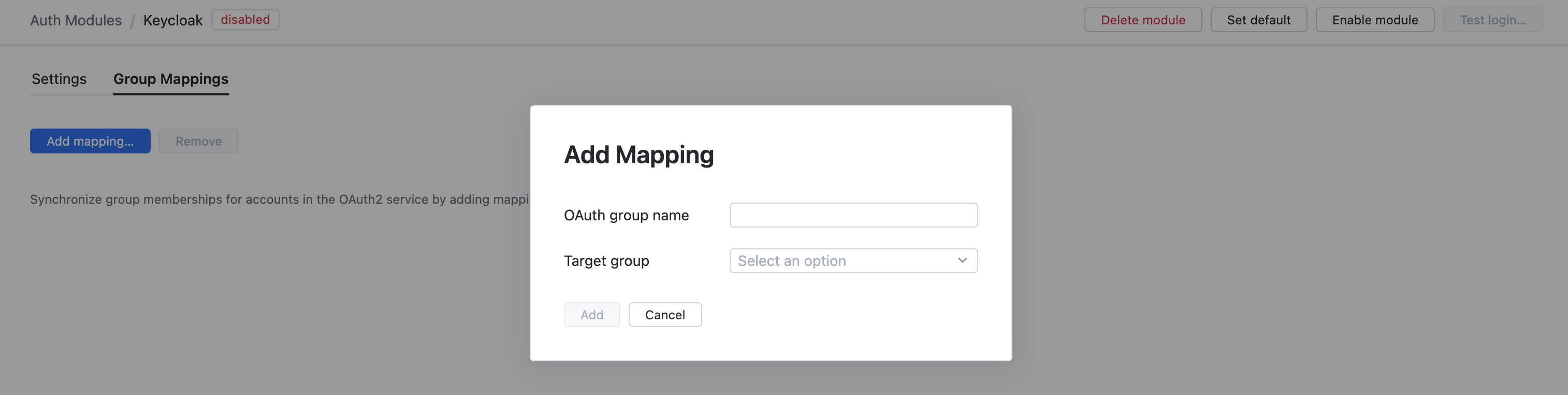
Enter the name of the Keycloak group in the OAuth group name field.
Select a group from the Target group list.
Click the Add button.
The mapping is added to the list.
SCIM 2.0
The tab lets you enable System for Cross-domain Identity Management (SCIM) provisioning for the Keycloak authentication module. When SCIM provisioning is enabled, an external identity provider can create, update, and deactivate Hub user accounts using the SCIM 2.0 protocol.
The Keycloak authentication module synchronizes user data only during login. When a user signs in, YouTrack reads the user attributes and group memberships returned by the identity provider.
Changes made in the identity provider are not synchronized automatically while the user is inactive. For example, updates to user attributes or group memberships are applied only after the user signs in again.
To keep user accounts and groups synchronized automatically, enable SCIM 2.0 provisioning and create a SCIM 2.0 token for the authentication module.
Enable SCIM 2.0 provisioning
To allow an external identity provider to provision users through SCIM:
Open your Keycloak auth module.
Select the SCIM 2.0 tab.
Enable the Enable SCIM 2.0 provisioning option.
YouTrack generates a SCIM 2.0 base URI for this authentication module.
Create a SCIM 2.0 token and copy its value.
Specify both the SCIM 2.0 base URI and SCIM 2.0 token generated in YouTrack when configuring SCIM provisioning in your identity provider. The base URI identifies the provisioning endpoint, while the token authenticates provisioning requests sent by the identity provider.
Create a SCIM 2.0 Token
In the SCIM 2.0 Tokens section, click New Token.
In the New SCIM 2.0 Token dialog, enter a name for the token.
Click Create.
Hub generates the token and displays its value in the SCIM 2.0 Token Created dialog.
Copy the token value and store it in a secure location before closing the dialog. The token value cannot be viewed again after the dialog is closed.
Delete a SCIM 2.0 Token
Select one or more tokens in the SCIM 2.0 Tokens table.
Click Delete and confirm the action in the Delete SCIM 2.0 token dialog.
Additional Settings
The settings on the Additional settings tab let you manage account creation and group membership and reduce the loss of processing resources consumed by idle connections.
For the predefined Keycloak module, the Scopes setting is set automatically. If you need to modify this value to suit your needs, you can overwrite it.
Option | Description |
|---|---|
User creation | Enables creation of YouTrack accounts for unregistered users who log in with an account that is stored in the connected authorization service. YouTrack uses the email address to determine whether the user has an existing account. |
Auto-join groups | Adds users to a group when they log in with an account that is stored in the connected authorization service. You can select one or more groups. New users that auto-join a group inherit all the permissions assigned to this group. We recommend that you add users to at least one group. Otherwise, a new user is only granted the permissions that are currently assigned to the All Users group. |
Authentication | Determines how credentials are passed to the authorization service. |
Email auto-verification | Determines how YouTrack sets the verification status of an email address when the authentication service does not return a value for this attribute. |
Extension grant type | Saves the value used for the To learn how to exchange access tokens using the YouTrack REST API, see Extension Grants. |
Connection timeout | Sets the period of time to wait to establish a connection to the authorization service. The default setting is 5000 milliseconds (5 seconds). |
Read timeout | Sets the period of time to wait to read and retrieve user profile data from the authorization service. The default setting is 5000 milliseconds (5 seconds). |
Changes made to Keycloak | Links to the Audit Events page in YouTrack. There, you can view a list of changes that were applied to this authentication module. |