App Manifest
Each app package must include a manifest.json file at the root of the package directory. The manifest file provides general information about the app, such as the name, description, and the list of modules contained in the app.
Sample Manifest
Here is sample manifest for an app:
Manifest Schema
The schema used to validate the manifest for a YouTrack app is hosted in the SchemaStore. Its web address is included in the sample manifest provided on this page.
Editors that support JSON schemas will provide auto-completion and contextual help based on the schema, so be sure to load the schema in your development environment.
A manifest.json has the following fields:
Field | Type | Description | Required |
|---|---|---|---|
| String | The web address of the schema used to validate the manifest for a YouTrack app. This schema is hosted in the SchemaStore at https://json.schemastore.org/youtrack-app.json Editors that support JSON schemas will provide auto-completion and contextual help based on the schema. This can speed up the process of creating and editing the manifest, so be sure to include this reference in your file. | |
| String | The name of the app. This is used as a unique identifier in YouTrack. If you upload two apps with the same name to your YouTrack site, the existing version of the app with the same name is overwritten. It is also used as a unique id of the app in the JetBrains Marketplace. This field can only contain lowercase alphanumeric characters, hyphens, underscores, and tildes. | ✓ |
| String | The title of the app. This is a user-friendly name that is shown in the JetBrains Marketplace and the YouTrack UI. This field is optional. When empty, the name of the app is shown in its place. |
|
| String | The description of the app. You can see this description in the app details on the Apps administration page. This is also used as the description of the app in the JetBrains Marketplace. |
|
| String | The version number assigned to the app package in |
|
| String | The website for the app. For example, a GitHub page or landing page for your company or product. This value is shown as the Plugin Site in the JetBrains Marketplace. |
|
| String | The name of the file with the app icon. Store this file at the root level of the app package. |
|
| String | The name of the file with the app icon for the dark theme. Store this file at the root level of the app package. If you don't include a separate icon for the dark theme, YouTrack will use the |
|
| String | The minimum YouTrack version with which the app is compatible. If you attempt to upload or install an app in a YouTrack installation that runs a version lower than the value specified in the manifest, the operation fails. The JetBrains Marketplace uses this value to help users find apps that are compatible with their YouTrack Server installations. This field is backward-compatible with the |
|
| String | The maximum YouTrack version with which the app is compatible. If you attempt to upload or install an app in a YouTrack installation that runs a version higher than the value specified in the manifest, the operation fails. |
|
| String | A description of changes available in a specific version of the app. This information is only displayed in the JetBrains Marketplace. Change notes can also be added and updated directly in the marketplace. |
|
| An object that contains the description of the app vendor. This information is only used for apps that have been uploaded to your YouTrack site directly. Apps that are installed from the JetBrains Marketplace take the name, URL, and email from the vendor profile in the marketplace. |
| |
| String | The prefix for a custom MCP tool name. This value is only needed when the app package contains a script for a custom MCP tool. For details, see Tool Prefix. |
|
| Array< YouTrack API Allowed Endpoint > | YouTrack REST API endpoints that an administrator can approve for the app's widgets. Each declaration specifies a method, path, and description. Declaring an endpoint does not approve access or grant user permissions. |
|
| Array< Widget > | An array of widget objects included in the app. Each widget represents a frontend extension. |
|
Widgets
Each widget object represents a particular frontend extension. Each widget is a custom inline frame (iFrame) object you embed into the native YouTrack UI.
A widget has the following fields:
Field | Type | Description | Required |
|---|---|---|---|
| String | The unique identifier of the widget. This is a mandatory field that must be unique within the app. This field can only contain lowercase alphanumeric characters, hyphens, underscores, periods, and tildes. | ✓ |
| String | The user-friendly name of the widget shown in the app settings in YouTrack. Widget names must be unique within one app. |
|
| String | The description of the widget. Required for widgets embedded in the Optional for other extension points. |
|
| String | A condition for the widget to be shown. Use a JavaScript function that returns The guard function always receives the current user as |
|
| String | The location in the YouTrack UI where the widget will be embedded. For the full list of available extension points, see Extension Points for Widgets. | ✓ |
| Boolean | Defines whether YouTrack shows the default page header above the widget. This field is supported for widgets embedded in the When hiding the page header, make sure the widget provides its own header or breadcrumbs where appropriate. |
|
| Boolean | Defines whether YouTrack displays the widget without the surrounding frame, background, and header. Set this field to This field is only supported by widgets that use the When the surrounding rich-text content is being edited, YouTrack keeps the widget header available so users can access the widget controls. |
|
| String | The path to the index.html file that defines the content and structure of the widget. The path is relative to the widgets folder inside the app package. Store the source code in an HTML file named | ✓ |
| String | The relative path to the file with the icon for the widget inside the app package.
|
|
| String | The path to the JSON file that stores the settings schema for Markdown and dashboard widgets. It should be the path to a file somewhere inside the folder that stores the code for this particular widget. This schema defines widget configuration, with its own supported types. For array support and configuration methods, see Widget Configuration. |
|
| Array<String> | A list of permissions used to restrict widget visibility. For a nonempty array, users must have at least one listed permission to pass this visibility check. If the field is omitted or the array is empty, no permission-based visibility restriction is applied. Depending on the app scope, these permissions can be required at the global or project level. This check does not grant permissions for actions performed by the widget. REST requests and HTTP handlers enforce their own access rules. For widget extension points with project scopes, project-category permissions are checked on a per-project basis. For example, if you require the project-category To refer to a permission, use its unique identifier. For permission keys, see App Permissions. |
|
| Object | The expected dimensions of the widget in pixels. YouTrack will try to display the widget according to these dimensions if the monitor settings allow. Supported attributes are This field is supported by all extension points except |
|
| Object | The default width and height of the widget. Supported attributes are This field is only supported by widgets that use the
|
|
YouTrack API Allowed Endpoints
Use the top-level youTrackApiAllowedEndpoints array to declare endpoints used by host.fetchYouTrack() requests.
Administrators review these declarations in the Access tab on the Apps administration page. Approved endpoints let the app's widgets send matching requests without individual user confirmation. Requests still use the current user's permissions.
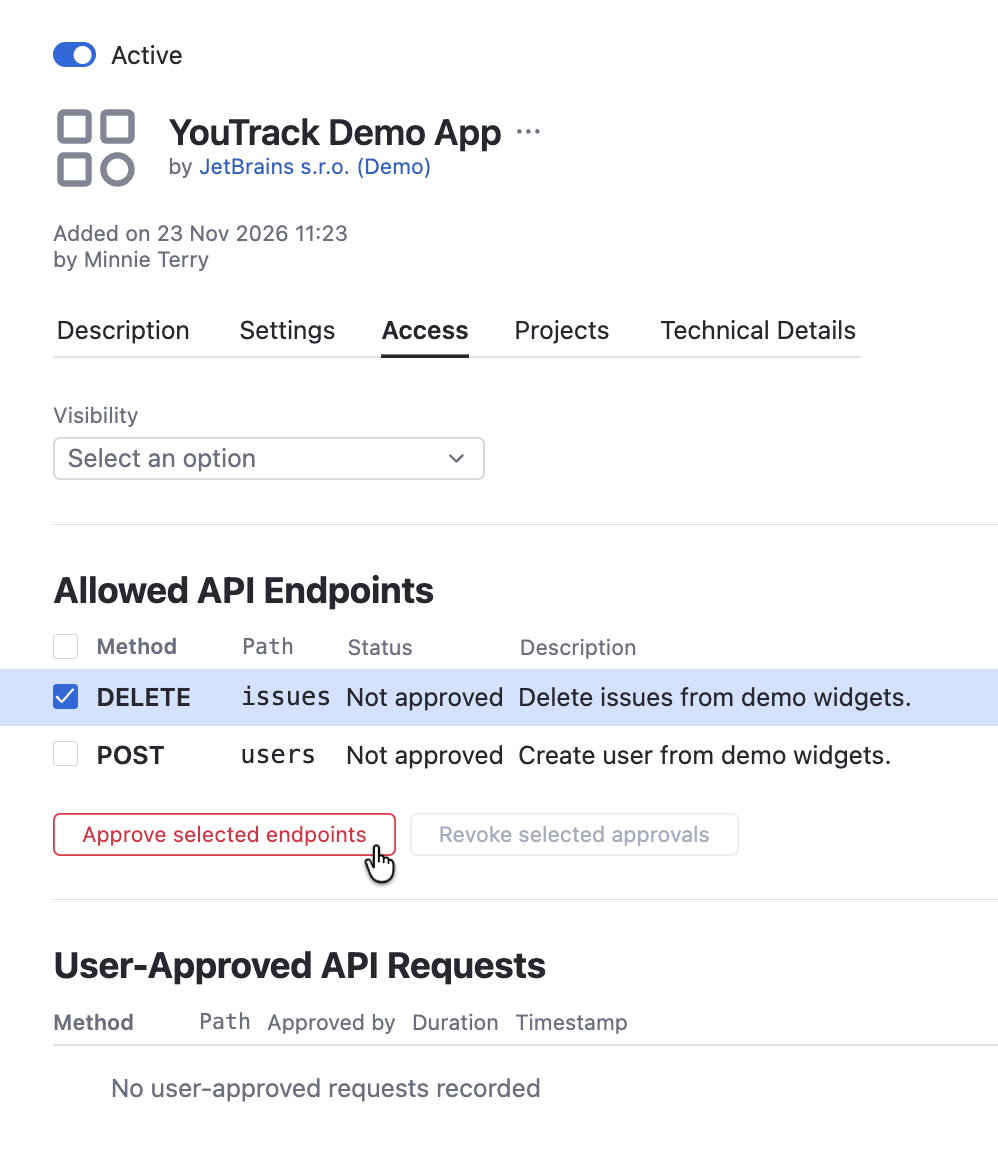
The following example declares an endpoint for requests that delete issues:
Each object in the youTrackApiAllowedEndpoints array has the following fields:
Field | Type | Description | Required |
|---|---|---|---|
| String | The HTTP method: | ✓ |
| String | The endpoint path relative to Omit the leading slash and | ✓ |
| String | A nonempty explanation of why the app needs the endpoint, up to 1000 characters. Administrators see this text when they review the declaration. | ✓ |
Each method and path pair must be unique. Duplicate detection ignores method and path capitalization.
An approval applies to the declared path and its subpaths for the same method throughout the app. For example, approving DELETE issues also covers matching requests under issues/. Declare only the paths and methods the app needs.
Declarations remain subject to administrator approval. Endpoints that affect appPermissions are blocked and cannot be approved.
When an app update changes only a declaration's description, its administrator approval remains. Removing a declaration removes its administrator approval. Additional declarations need administrator approval to suppress user prompts.
For administration instructions, see API Endpoint Approvals.
Vendor
This object stores basic information about the vendor of the app.
A vendor object has the following fields:
Field | Type | Description | Required |
|---|---|---|---|
| String | The name of the vendor. | ✓ |
| String | The URL of the vendor website. |
|