AI Governance for Engineering Teams:
A Complete Guide
FAQ
What is AI governance for engineering teams?
AI governance for engineering teams is the set of policies, processes, and controls that decide which AI tools developers can use and under what conditions. It covers the full lifecycle of AI tools within an engineering organization, from the approved inventory to who has access, what data those tools can see, how costs get tracked by teams, and what the audit trail looks like when something goes wrong. It's different from legal AI compliance, which focuses on regulatory obligations, and different from IT governance, which focuses on procurement and infrastructure. Engineering AI governance is owned operationally by engineering leadership, and it's built around how developers actually work day to day.
What should an AI governance framework include?
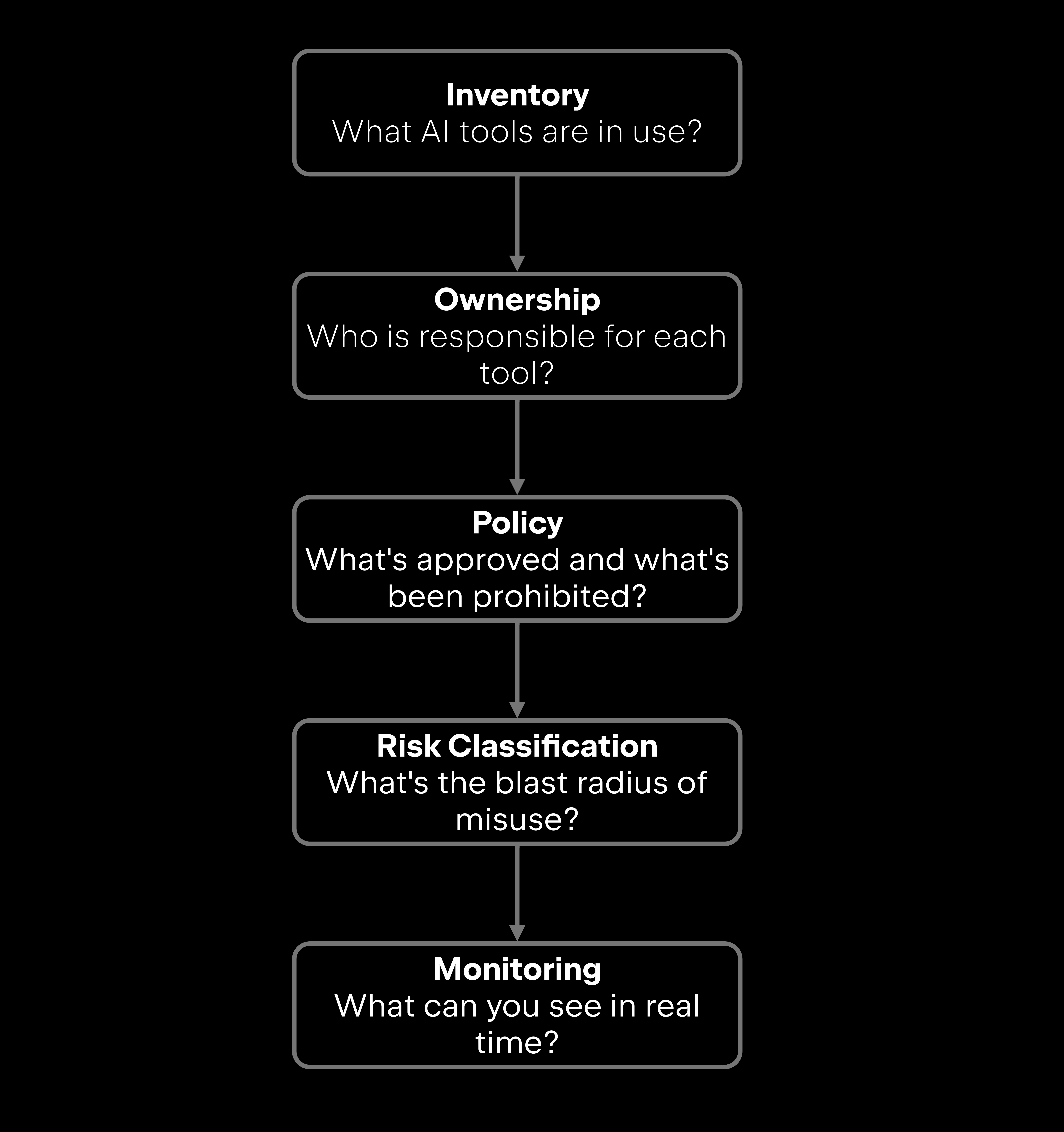
A complete enterprise AI governance framework for engineering includes: (1) a tool and model inventory, a living list of what's approved and in use; (2) named ownership for each tool or category; (3) an approved-use policy covering data handling, prohibited input types, and disclosure rules for AI-generated outputs; (4) a risk classification system that tiers tools and use cases by potential impact of misuse; (5) real-time monitoring of usage patterns and AI credits consumption; and (6) a regular audit process covering policy compliance, access rights, and incident history. More mature frameworks add (7) a formal incident response process specifically for AI-related misuse or failures, something most teams don't think about until they need it.
Does AI governance only matter for large companies?
Every business benefits from AI governance, especially one that's scaling fast, but it becomes most urgent for mid-sized engineering teams, roughly 150 to 1,000 developers. Large enterprises with 1,000+ engineers typically have compliance and security functions that ensure some form of governance exists regardless. Small teams of fewer than 20 developers can often get by with a lighter, more informal approach, since the tool set is small enough to stay visible and the blast radius of any single decision is contained. That said, even a small team benefits from writing down who owns what before it needs to scale. The 150 to 1,000 range is where shadow AI proliferates fastest, where ungoverned AI credits spend spikes without warning, and where informal "I trust my senior engineers" policies stop working. If your organization sits in that range, governance is a current problem.
How does AI governance interact with existing software development policies?
AI governance works alongside your existing code review, security, and vendor management policies. It doesn't replace them. Code review policies need an addendum covering AI-generated code disclosure and review requirements. Vendor management processes need an AI-specific evaluation track that accounts for model providers, data processing terms, and training data policies. Security policies need to address prompt injection risks and output validation for AI-generated artifacts. With a governance framework in place, you can update your AI stack systematically, using a clear inventory and ownership structure, rather than scrambling tool by tool whenever something breaks.
Who owns AI governance in an engineering organization, legal or engineering?
Engineering owns the operational side, deciding which tools are approved, who has access, what the usage policies say, what the monitoring covers, and what happens when a policy is violated. Legal reviews the policies (particularly regarding data-handling obligations, regulatory exposure, and third-party agreements with model providers) and provides sign-off on policy documents. Security typically co-owns risk classification. The mistake most organizations make is reversing this structure, waiting for legal to define how engineering governs its AI stack. Legal can tell you what the constraints are, but engineering has to decide what the framework looks like within those constraints. Frameworks drafted by the legal department without engineering ownership tend to be technically compliant but practically ignored.
How do I start implementing AI governance without disrupting my teams?
Start with your inventory, not policy. Most engineering teams instinctively jump straight to "what are the rules" before they know "what's actually running". This approach produces policies written for an imaginary environment. Audit first: Ask your developers directly which tools they're using, check your billing systems and expense reports, and review OAuth grants and API key usage across your infrastructure. You'll find tools nobody officially approved, and that's fine. It's just data. Once you have a realistic picture of what's actually in use, you can write a policy that fits the real environment.
Then assign ownership. A policy document with no named owner responsible for enforcing it is documentation, not governance. Get the sequence right. Inventory first, then owners, then policy. That order keeps the framework grounded in how your team actually works, rather than how you think it works.
What risks does shadow AI create for engineering teams?
Shadow AI creates three categories of risk. The first is data exposure. A developer debugging with an unapproved LLM may paste stack traces containing customer IDs, credentials, or proprietary logic into a model with which your organization has no data processing agreement. The second is cost exposure. Ungoverned AI tool adoption means spending accumulates across personal accounts and expense reports with no team-level visibility until finance flags it. The third is compliance exposure. Regulated industries, such as healthcare and finance, have specific rules about what data can leave your environment and where it can be processed. Shadow AI use in those contexts can create regulatory exposure that your legal team won't discover until an audit.
What's the difference between AI governance and AI compliance?
AI governance is the operational framework your engineering org runs internally: Which tools are approved, who can use them, how usage gets monitored, and what the escalation path looks like when something goes wrong. AI compliance is different. It's the set of external obligations you're accountable to, whether that's GDPR data-processing requirements, HIPAA rules on protected health information, or emerging AI-specific regulations. Governance is what you build yourself. Compliance is what you get measured against. A well-built governance framework makes demonstrating compliance a lot easier, since the audit trail, access controls, and policy documentation are already in place.
Use AI agents in your development workflow
Explore JetBrains AI solutions that help you build, use, and scale AI agents across the software development lifecycle.
Air Gateway
Run terminal agents through one JetBrains account, with access, models, and usage governed centrally.
Junie
Plan, code, debug, and automate tasks with a coding agent that works across your terminal, IDE, GitHub, and GitLab.
Air in IDEs
Orchestrate AI agents and verify their output directly in JetBrains IDEs, with full control over how changes are reviewed.
Air Teams
Automate software delivery workflows, coordinate agentic work across teams, identify bottlenecks affecting delivery.
Air Governance
Govern AI usage, models, policies, and costs across your organization, including JetBrains and third-party tools.
Air Context
Give agents shared organizational memory and context that carries across tools, workflows, and execution environments.
JetBrains Air
An open system of AI products for developers, teams, and organizations – from coding with agents to automating workflows and governing AI at scale.