Shadow AI in Engineering Teams: Risks, Costs, and How to Regain Control
FAQ
What is shadow AI in engineering teams?
Shadow AI refers to developers’ use of AI tools, services, or API integrations without organizational approval or visibility. This includes personal subscriptions to tools like ChatGPT or GitHub Copilot used on company code, third-party LLM API calls embedded directly in production services, and autonomous AI agents running outside approved infrastructure. The defining characteristic is the absence of oversight, not malicious intent.
Is shadow AI always a problem, or is some of it acceptable?
Exposure determines risk, not the tool itself. A developer using an AI code assistant on internal documentation carries a different risk profile than one using the same tool on customers' personally identifiable information (PII). The goal is to understand what's happening well enough to assess risk accurately, and to route high-risk usage through approved channels. Most shadow AI starts as someone solving a real productivity problem. Addressing that underlying need removes most of the incentive to work around official channels.
What data is most at risk when developers use shadow AI tools?
Production code, customer PII, and internal architecture documentation carry the highest risk when processed by unapproved external LLMs. Free-tier and consumer AI products have historically used inputs to improve their models. That means any sensitive data pasted into an unapproved tool may leave your control permanently. Regulated industries like fintech, healthcare, or defense-adjacent sectors face the sharpest exposure, since a single incident can trigger GDPR, HIPAA, or SOC 2 findings.
How do I find out which AI tools developers are using without permission?
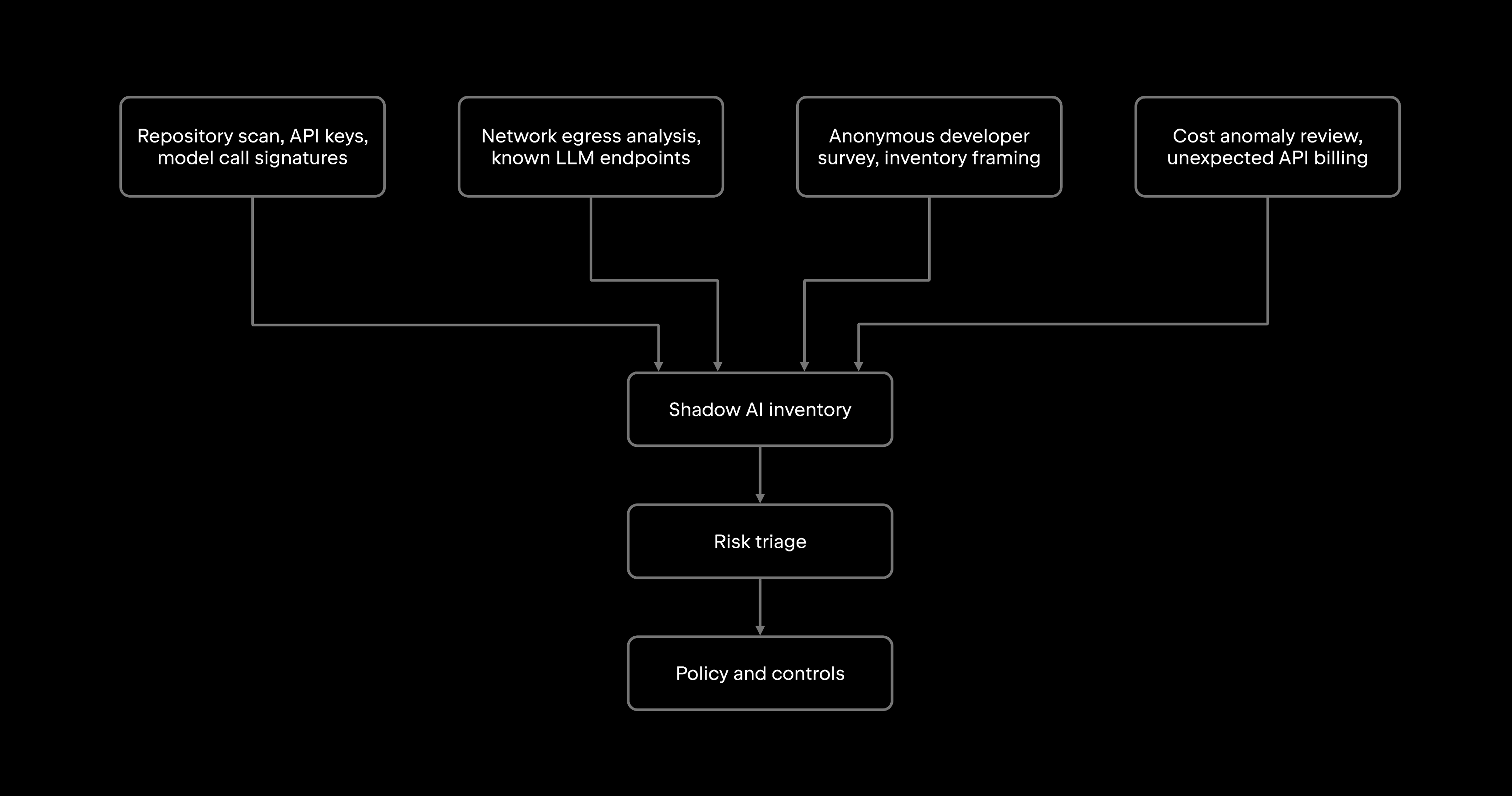
The following four methods work well in combination. First, scan your repositories for API key patterns tied to major LLM providers. Second, review network egress logs for traffic to known AI endpoints. Third, run an anonymous developer survey framed as an inventory exercise rather than an audit. Fourth, pull billing data for unexpected charges from AI providers. Starting with the survey often produces the most actionable data fastest. It also tells you why developers chose the tools they did, and that context is essential for building a policy that actually works.
How do I create a policy for AI tool usage without alienating my engineering team?
Involve engineers from the start, from technology leaders to junior developers, regardless of title. Frame the policy as enabling faster access to better tools. Use your usage inventory to anchor it in reality rather than hypothetical risk, and make the approved list generous enough to cover legitimate use cases. Establish a fast-track review path for new tools, and revisit the policy every quarter as the tooling changes. Engineers will comply with policies they helped shape and can see the logic of.
How quickly can shadow AI spending become a significant budget problem?
Shadow AI describes tooling that was never sanctioned by the organization in the first place. An approved tool used incorrectly (for example, feeding customer PII into a coding assistant that's only approved for internal documentation) is a different problem: policy compliance rather than shadow usage. Both carry risk, but they call for different responses. Shadow AI requires detection and inventory, while misuse of approved tools requires clearer policy guardrails and usage monitoring.
Use AI agents in your development workflow
Explore JetBrains AI solutions that help you build, use, and scale AI agents across the software development lifecycle.
Air Gateway
Run terminal agents through one JetBrains account, with access, models, and usage governed centrally.
Junie
Plan, code, debug, and automate tasks with a coding agent that works across your terminal, IDE, GitHub, and GitLab.
Air in IDEs
Orchestrate AI agents and verify their output directly in JetBrains IDEs, with full control over how changes are reviewed.
Air Teams
Automate software delivery workflows, coordinate agentic work across teams, identify bottlenecks affecting delivery.
Air Governance
Govern AI usage, models, policies, and costs across your organization, including JetBrains and third-party tools.
Air Context
Give agents shared organizational memory and context that carries across tools, workflows, and execution environments.
JetBrains Air
An open system of AI products for developers, teams, and organizations – from coding with agents to automating workflows and governing AI at scale.