Schedule notebook runs
Schedule notebooks to run automatically at regular intervals — hourly, daily, weekly, or monthly — so your data is always processed and your reports stay up to date.
Set up a schedule for notebook runs
Open the notebook in the editor.
In the main menu, select .
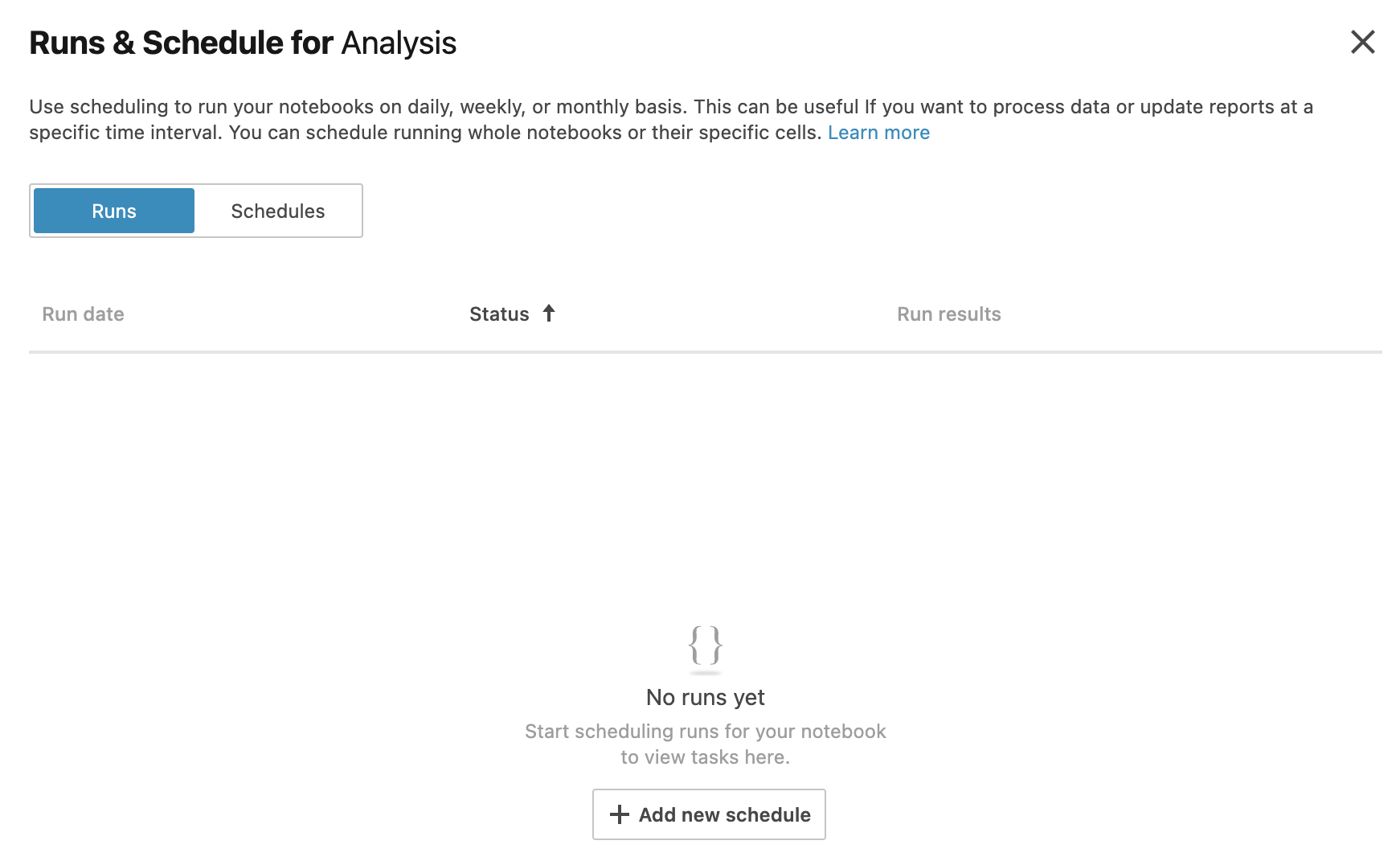
Click
 Add new schedule.
In the Create schedule... dialog, choose how often the notebook should run.
Under Interval, select one of the available options.
Hourly: Enter the minute of each hour when the notebook should run.
Daily: Enter the run time and select a time zone.
Weekly: Select the day of the week, enter the run time, and select a time zone.
Monthly: Enter the day of the month the run time, and select a time zone.
Click Switch to cron string.
Enter the cron expression.
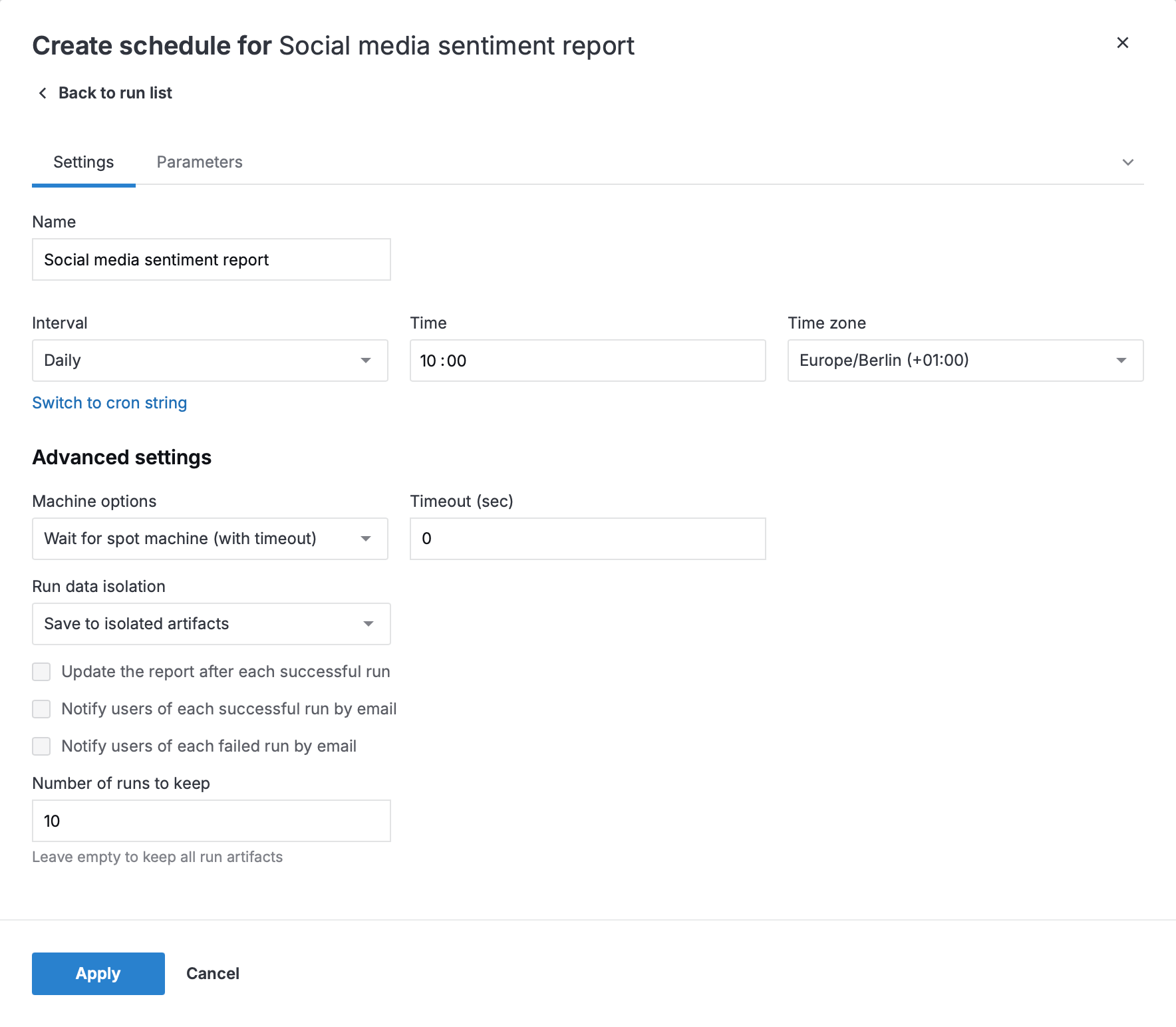
Under Advanced settings, select one or more of the following options:
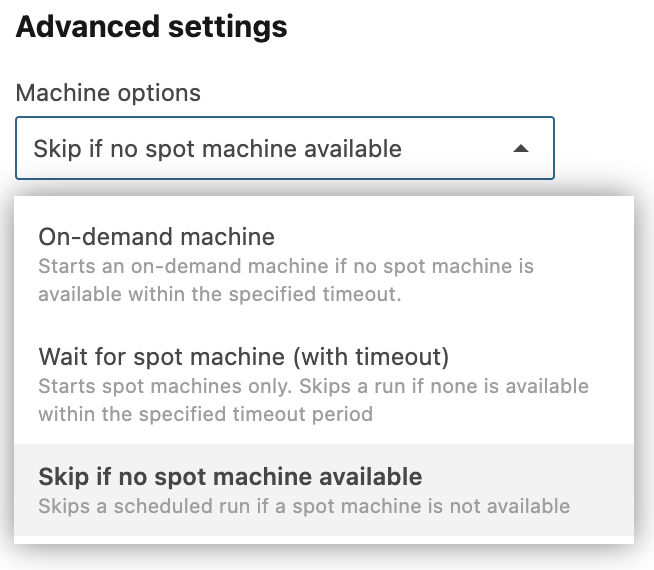
Under Machine options, choose a behavior for situations when no spot machine is available. The default option is skipping the run. Alternatively, you can choose to wait for an available spot machine within a specified timeout or use an on-demand machine (if you have Datalore credits). Find more details on spot and on-demand machines in Choose CPU and GPU machines.
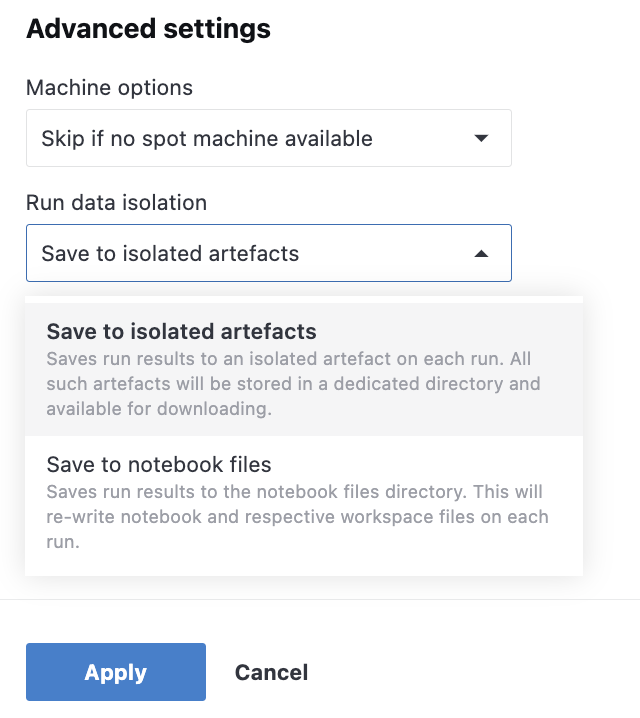
In Run data isolation, select where you want to save the run artifacts.
The default option Save to isolated artifacts saves run results to isolated artifacts, which are stored in a dedicated directory and available for downloading.
Select Save to notebooks files if you want run artifacts to be saved to the notebook files directory. Keep in mind that with this option selected, the files of the notebook and the respective workspace will be re-written on each run.
Update the report after each successful run (available for already published reports)
Notify users of each successful run by email. You can choose from the list of invited collaborators.
Notify users of each failed run by email. You can choose from the list of invited collaborators.
Under Number of runs to keep, enter the number of run artifacts you want to keep. If left blank, all artifacts are kept. Keeping all artifacts may eventually take up a lot of disk space.
(Optional) Provide parameters for your schedule based on the variables used in the Make your output interactive:
Switch to the Parameters tab.
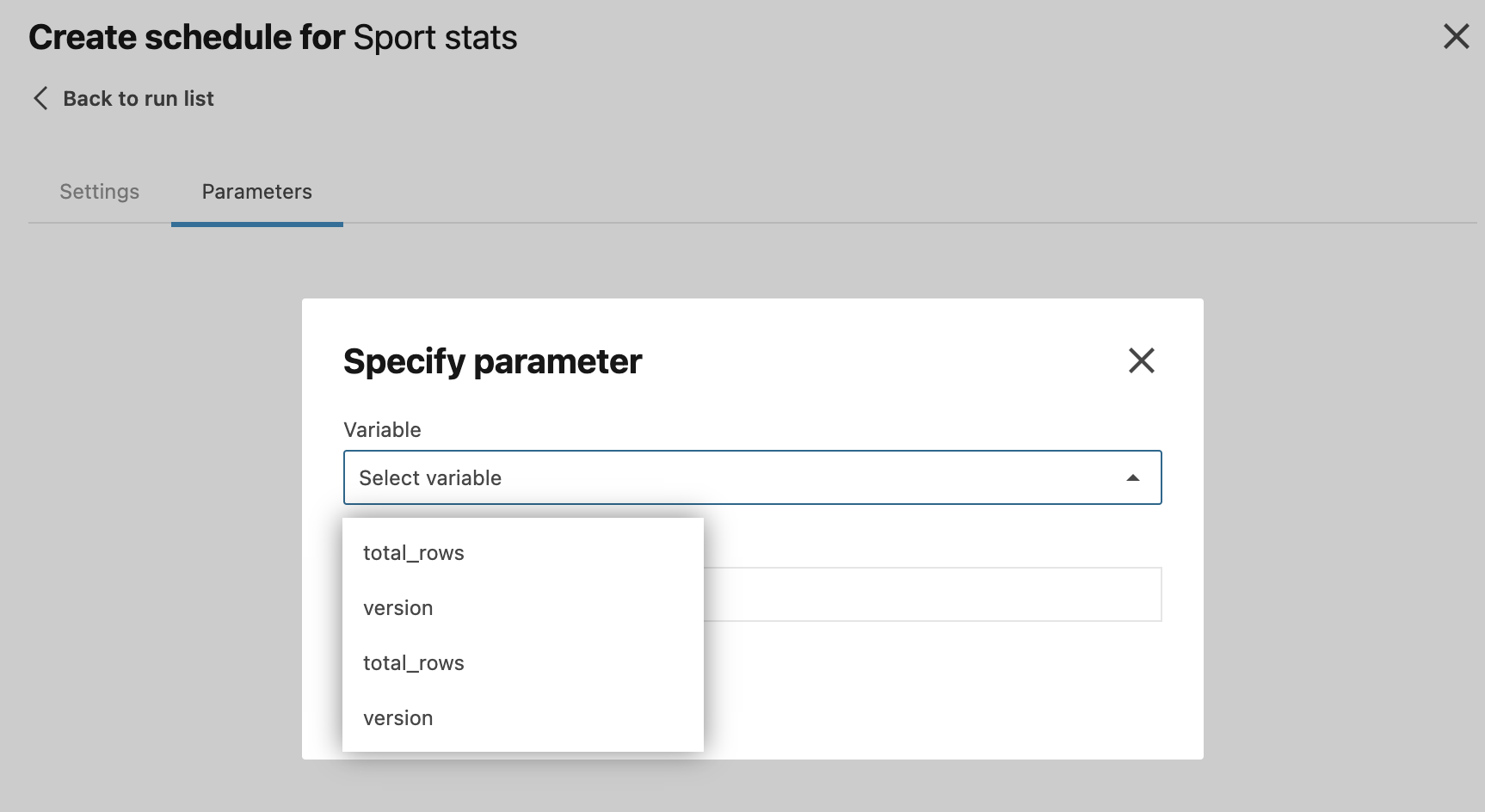
Click the Add new parameter. You will see the Specify parameter dialog.
Click Select variable to expand the dropdown. This list contains all the variables used in the interactive controls for this notebook.
Select a variable and provide a value. Depending on the interactive control using this value, you can either enter a value or select one of the provided options.
Click Specify to add the parameter and close the dialog.
(Optional) Repeat the steps above to add another parameter.
Click Apply to save the created schedule.
View or manage scheduled runs
Open the Run & Schedule for [notebook_name] notebook dialog:
From the Home page: select the workspace, go to from the left-hand side menu, and select the notebook that you want to view.
From the editor: open the notebook that you want to view and go to .
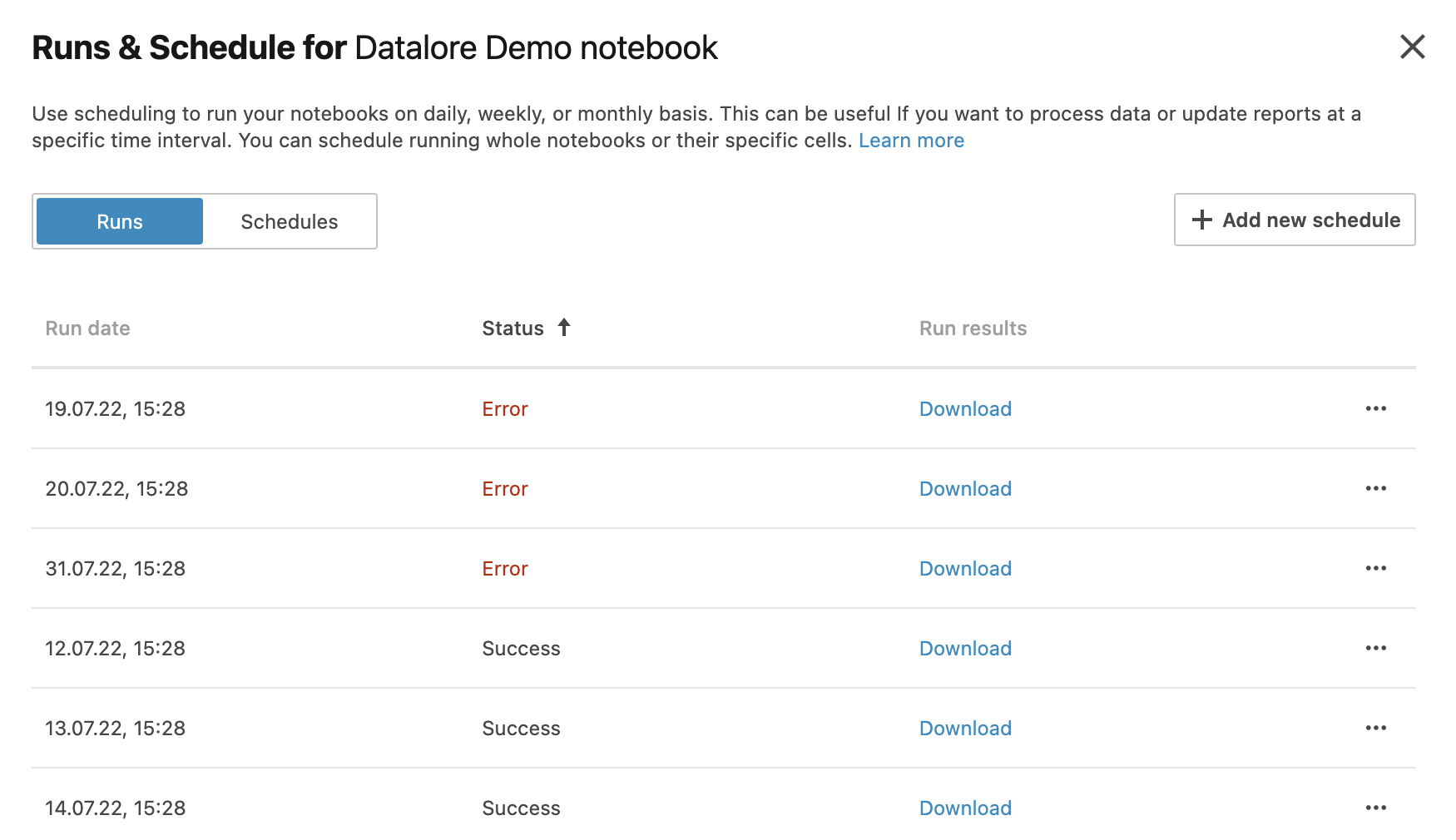
You can do the following:
To sort run records by run date or status, click the respective column header.
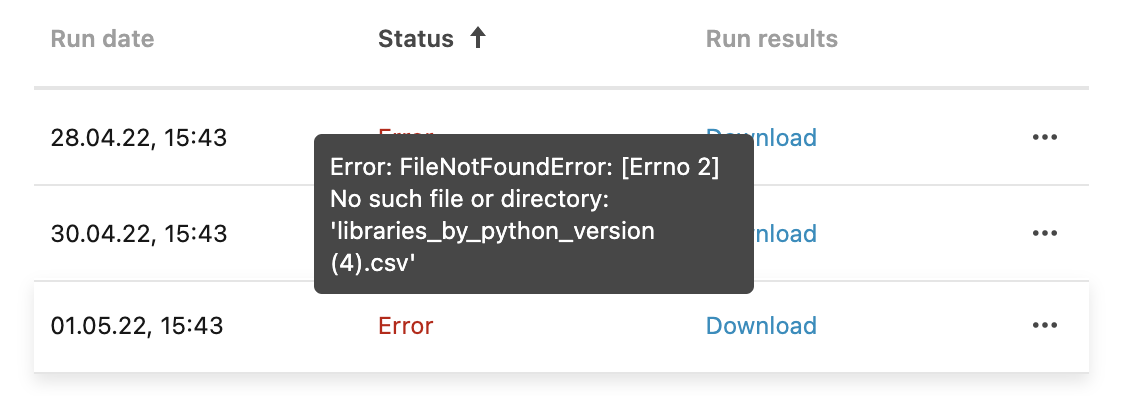
To view errors in failed runs, hover over Error for the respective run.
To view the static representation of a run in Datalore, click the ellipsis for the respective run and select View run.
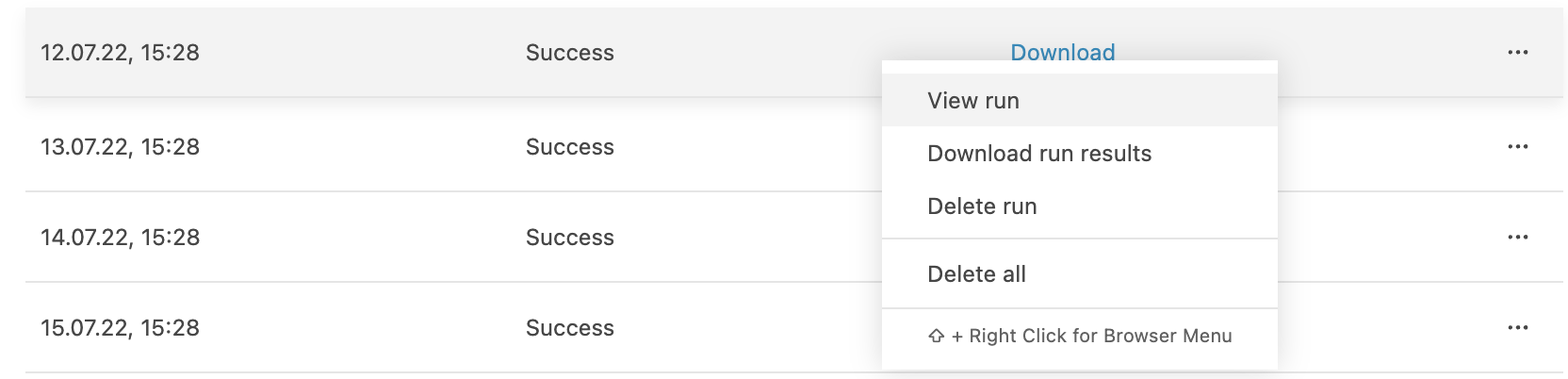
To delete a run, click the ellipsis for the respective record and select Delete run. This will stop the respective computation immediately without waiting for it to finish.
To delete all runs, right-click any run in the list and select Delete all from the menu.
To get a .zip file with run artifacts, click Download in the Run results column. The downloaded file contains the notebook version that was run and the attachments (files generated by code).
Manage schedules
To edit, turn off, or delete a schedule, do the following:
Open the Run & Schedule for [notebook_name] notebook dialog as instructed in the procedure above.
Switch to the Schedules tab. You will see the list of the schedules created for this notebook.
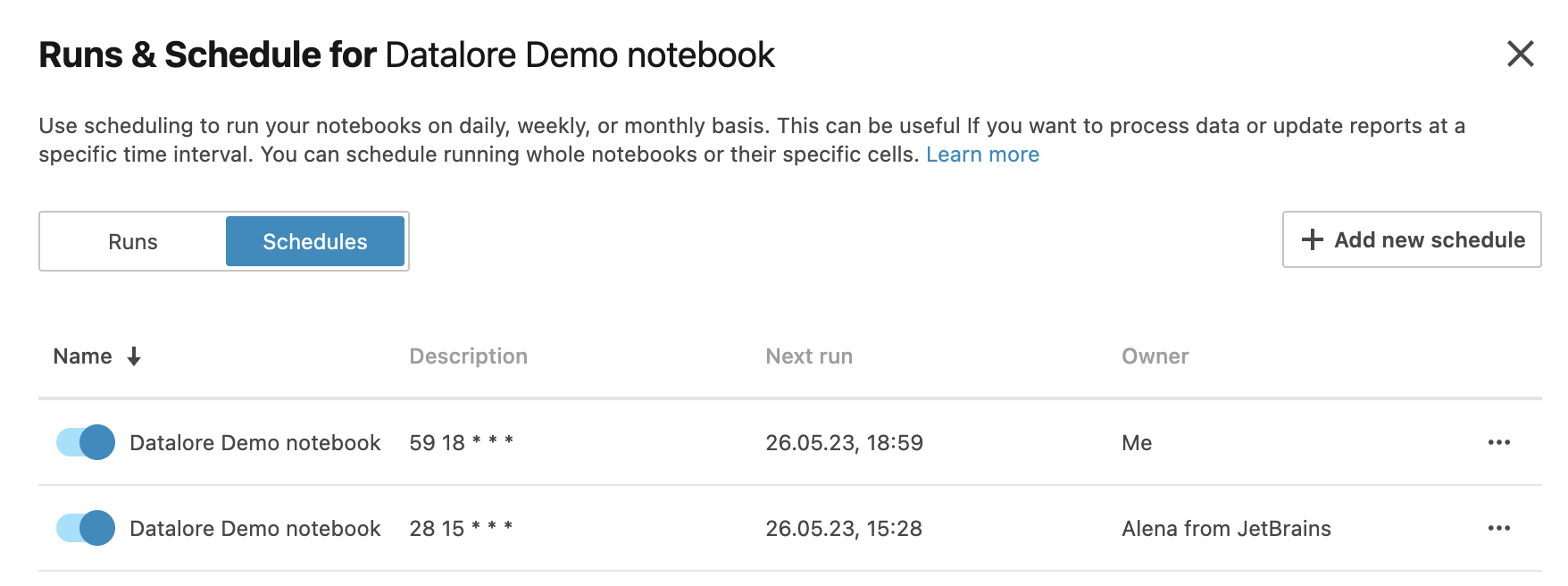
To turn off a schedule, use the toggle next to the schedule name.
To edit a schedule, click the respective item on the list to open the Change schedule for [notebook_name] notebook dialog, make the required changes, and click Apply.
To delete a schedule, click
 (More) next to it and select Delete schedule.
View errors
You can find errors that took place during scheduled notebook runs in the issue center.
Stop a scheduled run
You can explicitly stop the machine for a scheduled run.
Click your avatar at the top right and select Running machines.
Click Stop for the scheduled run you want to stop.
Turn off all schedules for a notebook
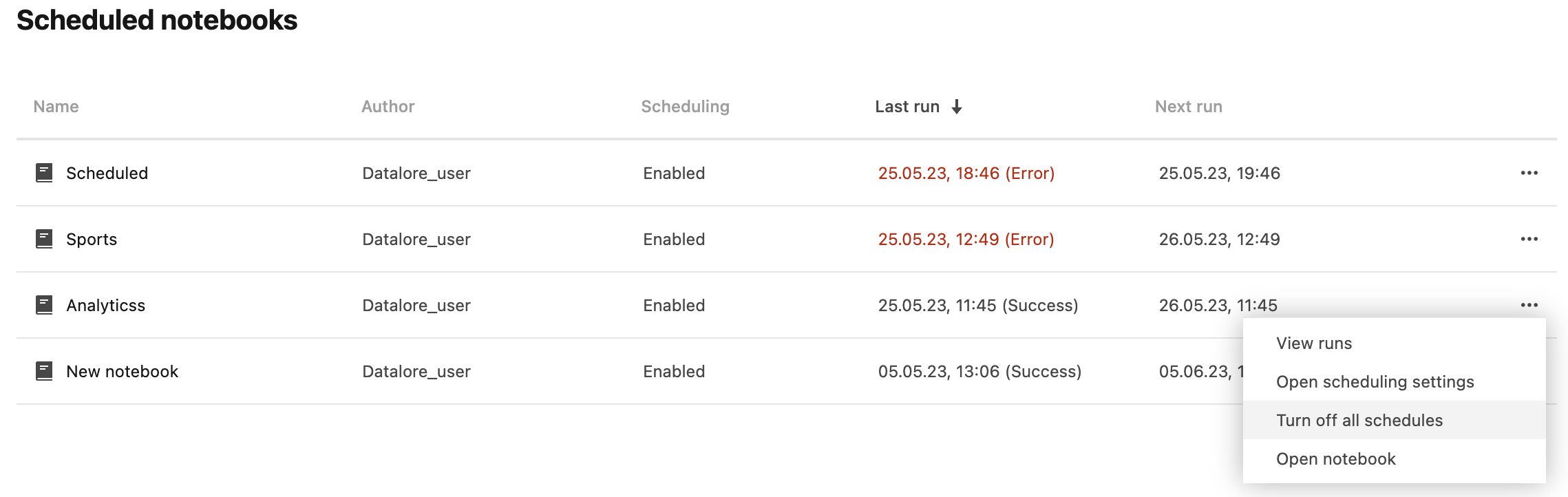
On the Home page, select Scheduled notebooks on the left-hand side menu.
On the list, click the ellipsis in the row containing the required notebook.
Select Turn off all schedules from the popup menu.
Keywords
execute code, run code, scheduled execution, execution schedule, running schedule, notebook schedule