Enterprise AI Governance Framework for Engineering Teams

FAQ
What should an enterprise AI governance framework include?
An enterprise AI governance framework for engineering should include five layers. First, a strategy and principles layer that provides specific decision rules to define your risk appetite and guide every other governance decision. Second, an ownership-and-accountability layer that names roles with real authority. Third, a policies-and-standards layer covering an approved model list, data classification rules, and agent permission scopes. Fourth, an operational controls layer that provides technical mechanisms including centralized access management, model allowlists, per-team AI credit budgets, and agent isolation environments. Fifth, a measurement and improvement layer that delivers defined KPIs, a review cadence, and a process for updating policy when the data shows the current rules aren't working. A framework with the first three layers but without the fourth or fifth will degrade over time as the AI environment evolves and enforcement drifts.
Who should own AI governance in an engineering team?
The VP of Engineering should be accountable for the overall AI governance framework, meaning they answer for whether it works and have the authority to change direction if it doesn't. Engineering managers are responsible for implementing the framework within their teams: communicating policy, ensuring compliance, and flagging when the approved model list doesn't meet their team's needs. Legal and compliance teams should be consulted on policy content to identify regulatory or IP risk, but they shouldn't own the framework, since their role is review rather than operation. Platform engineering is responsible for building and maintaining the technical infrastructure that enforces governance controls. In short, the VP of Engineering owns the outcome, managers put the framework into practice, legal reviews it for risk, and platform engineering builds the tools that enforce it.
How long does it take to implement an enterprise AI governance framework?
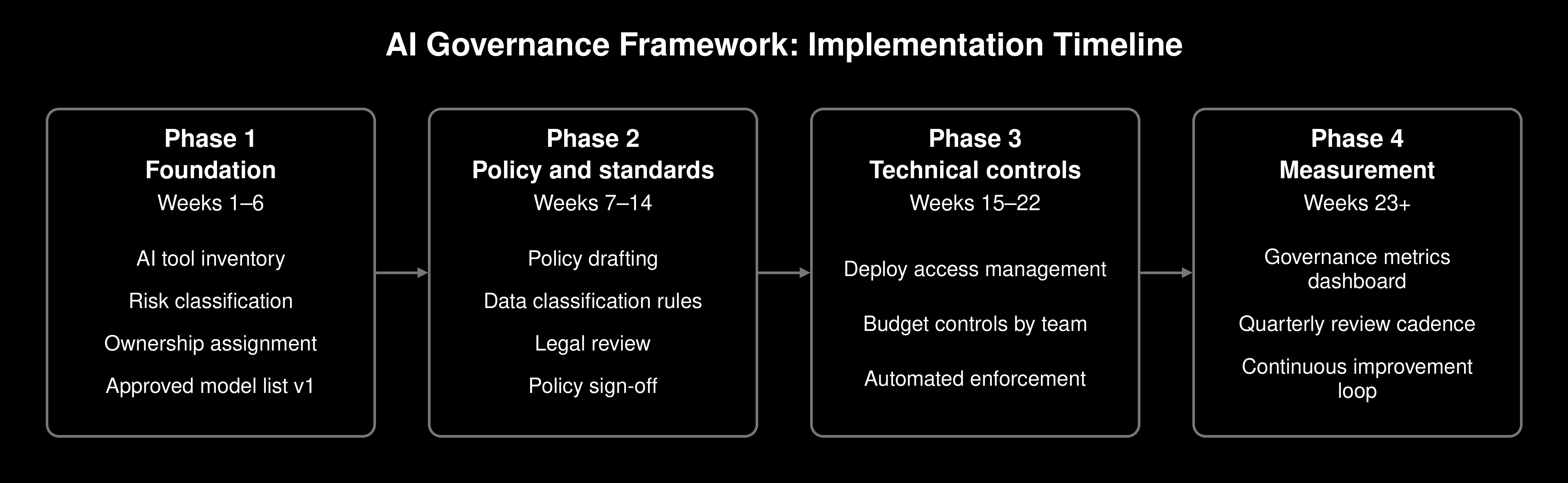
Phase 1, building visibility through a complete AI tool inventory, risk classification, and ownership assignment, takes four to six weeks for most engineering teams. The full four-phase framework, from initial inventory to automated controls and a functioning measurement system, typically takes three to six months. The range depends on team size, the current state of AI adoption, and whether platform engineering has the capacity to run Phase 3 alongside other infrastructure work. The single biggest factor that accelerates implementation is having a named governance owner from day one. Without that, Phase 2 policy sign-off stalls, and Phase 3 deprioritization becomes almost inevitable.
What is shadow AI, and why does it create governance risk for engineering teams?
Shadow AI refers to AI tools that developers use without centralized visibility, approval, or access controls. In engineering teams, shadow AI creates three concrete risks: intellectual property exposure when proprietary code reaches external model APIs without review, ungoverned consumption that accumulates across individual subscriptions with no budget ceiling, and unknown dependencies on models or tools that may not meet your security or compliance bar. A rising shadow AI rate in your governance metrics is the clearest signal that your approved model list is too narrow or your approval process is too slow. For a deeper treatment of shadow AI patterns and detection approaches, the Shadow AI in Engineering article covers this in full.
How do I build an AI governance framework for my engineering team?
Start with visibility, not policy. The most common mistake is writing an AI policy before completing an AI tool inventory. In Phase 1 (Weeks 1–6), conduct a full inventory of every AI tool in use, classify each by risk level, and assign a named framework owner. Phase 2 (Weeks 7–14) converts that inventory into a formal policy, covering an approved model list, data classification rules, and an agent permission framework, all reviewed by legal and signed off at the VP level. Phase 3 (Weeks 15–22) deploys the technical controls that make policy enforceable: centralized access management, budget controls by team, and automated allowlists. Phase 4 (Weeks 23+) builds the measurement and review cadence that keeps the framework current. The full implementation takes roughly three to six months. The highest-impact first step is naming a governance owner before anything else.
How is AI governance different from data governance?
Data governance and AI governance address distinct risk surfaces with distinct tooling and ownership. Data governance focuses on data quality, lineage, cataloging, and access controls. It covers who can read which data, how it flows between systems, and whether it's accurate. It's typically owned by data teams or a Chief Data Officer. AI governance in engineering focuses on models, tools, agents, prompts, and outputs: which models developers can use, what context can reach external APIs, what agents are permitted to do, and how AI consumption is attributed. The primary risks differ, too. Data governance manages data quality and regulatory compliance (GDPR and CCPA), while AI governance in engineering manages IP exposure, shadow AI, agent permission scope, and ungoverned consumption. The two frameworks should inform each other, particularly on data classification, where data governance defines sensitivity tiers that AI governance uses to determine model access rules, but they need separate ownership and separate operational infrastructure.
How do I know how mature our AI governance actually is?
Run through the four maturity stages and answer the diagnostic questions honestly.
Stage 1 (Ad Hoc): Can you list every AI tool your developers used last week? Do you know which models accessed your codebase in the last 30 days? If not, you're at Stage 1.
Stage 2 (Developing): Do at least 80% of your developers know an AI policy exists? Can you name three approved tools and explain the rationale for their approval? If your standards are team-level rather than organization-wide, you're at Stage 2.
Stage 3 (Managed): Is there a single named owner accountable for the governance framework? Are all AI tool expenditures attributable to specific teams? If compliance monitoring is manual rather than automated, you're at Stage 3.
Stage 4 (Optimized): Do automated controls prevent access to unapproved models before the violation happens? Can you produce a governance metrics dashboard covering the last quarter? If both answers are yes and you review that dashboard quarterly, you're operating at Stage 4.
What agent permission scopes should engineering teams define?
Agent permission scopes should be defined across at least three tiers. Read-only access allows an agent to inspect repository content, read logs, and query documentation without modifying any state. Write access allows an agent to create or edit files and open pull requests, but not merge or deploy. Deploy access allows an agent to trigger CI/CD pipelines or push to production environments. Each tier carries a materially different risk profile, and most teams should require explicit human approval before granting any agent write or deploy access. Running agents in isolated Git worktrees or containerized Docker environments adds a technical boundary that limits blast radius if an agent exceeds its intended scope.
Use AI agents in your development workflow
Explore JetBrains AI solutions that help you build, use, and scale AI agents across the software development lifecycle.
Air Gateway
Run terminal agents through one JetBrains account, with access, models, and usage governed centrally.
Junie
Plan, code, debug, and automate tasks with a coding agent that works across your terminal, IDE, GitHub, and GitLab.
Air in IDEs
Orchestrate AI agents and verify their output directly in JetBrains IDEs, with full control over how changes are reviewed.
Air Teams
Automate software delivery workflows, coordinate agentic work across teams, identify bottlenecks affecting delivery.
Air Governance
Govern AI usage, models, policies, and costs across your organization, including JetBrains and third-party tools.
Air Context
Give agents shared organizational memory and context that carries across tools, workflows, and execution environments.
JetBrains Air
An open system of AI products for developers, teams, and organizations – from coding with agents to automating workflows and governing AI at scale.