What Is an AI Agent Loop?
Source: Preliminary findings from the JetBrains Developer Ecosystem Survey 2026 • 15,000+ developers worldwide
FAQ
Can an AI agent loop be useful instead of harmful?
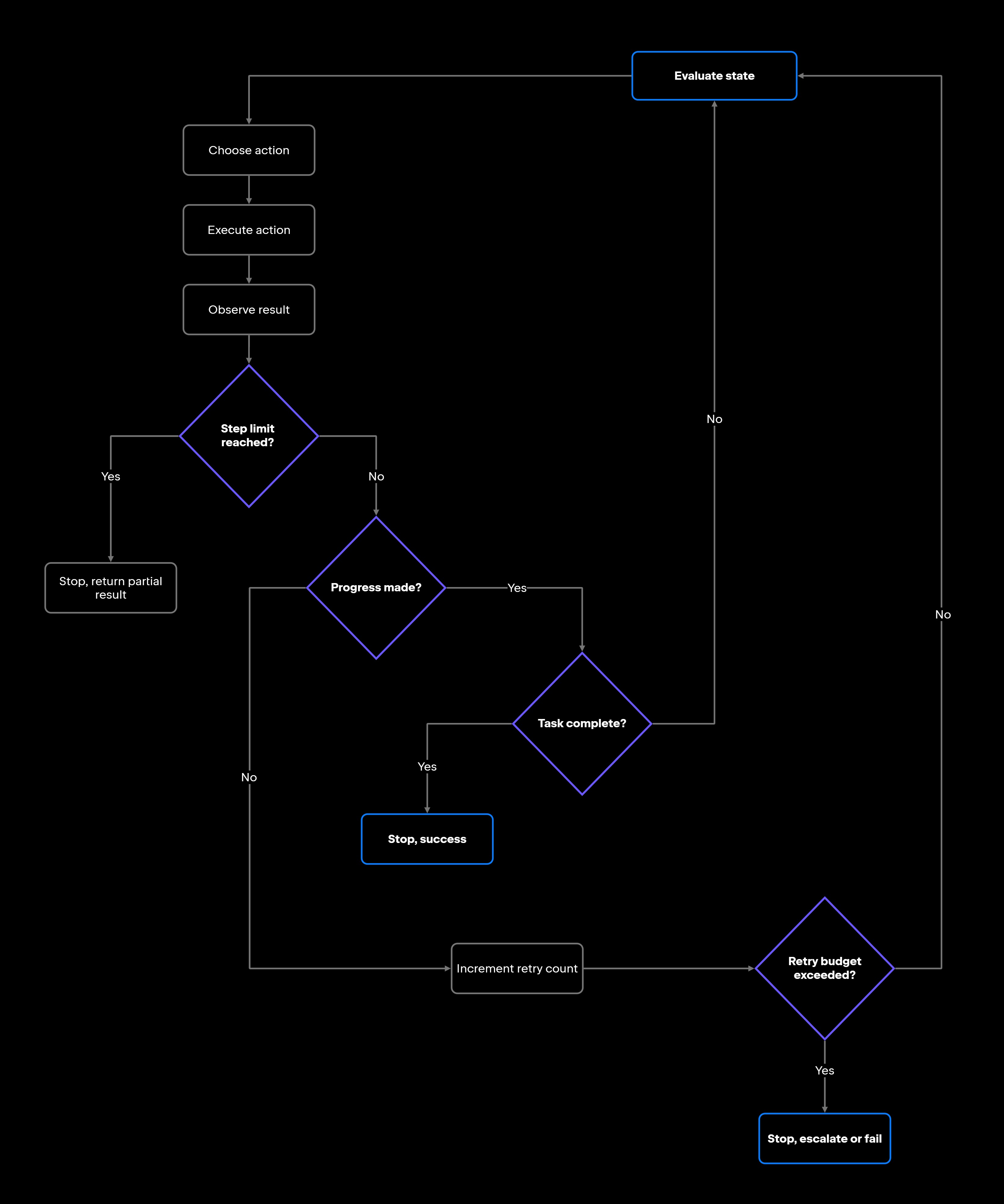
An AI agent loop is how agents accomplish anything non-trivial. Loops let agents run tests, retry after failures, apply fixes and revalidate, and search repositories while refining queries based on results. The risk appears when loops run without progress checks, retry budgets, or termination conditions. Without those guardrails, a useful cycle becomes a runaway one.
Can infinite loops happen even when an agent has correct instructions?
They can. More precise instructions reduce the risk, though runtime conditions still produce loops. A well-specified task can loop if the environment shifts in ways the instructions didn't anticipate – a tool that starts returning unexpected errors, a file changed by a concurrent process, or a flaky test suite that never reliably passes. Instructions lower the odds; runtime controls catch what gets through.
How do loop limits differ between low-risk and high-risk workflows?
Low-risk workflows, such as formatting or documentation updates, can run a generous step limit, since overshooting wastes a little budget and nothing else. High-risk workflows (database migrations, production deployments, API-modifying tasks) should run tight limits paired with human checkpoints. At the ceiling, the default should be to require explicit approval before going further.
What should happen after an AI agent reaches its loop limit?
Treat the output as a hand-off. Whoever picks the task up needs the stop reason, the iteration count, and the state of any work in progress, with enough context to see what the agent was attempting when it hit the ceiling. What the agent should not do is restart quietly or raise its own limit.
Damaso Sanoja is an engineer who is passionate about helping others make data-driven decisions to achieve their goals. This has motivated him to write numerous articles on the most popular relational databases, customer relationship management systems, enterprise resource planning systems, master data management tools, and, more recently, data warehouse systems used for machine learning and AI projects. You can blame this fixation on data management on his first computer being a Commodore 64 without a floppy disk.
Use AI agents in your development workflow
Explore JetBrains AI solutions that help you build, use, and scale AI agents across the software development lifecycle.
Air Gateway
Run terminal agents through one JetBrains account, with access, models, and usage governed centrally.
Junie
Plan, code, debug, and automate tasks with a coding agent that works across your terminal, IDE, GitHub, and GitLab.
Air in IDEs
Orchestrate AI agents and verify their output directly in JetBrains IDEs, with full control over how changes are reviewed.
Air Teams
Automate software delivery workflows, coordinate agentic work across teams, identify bottlenecks affecting delivery.
Air Governance
Govern AI usage, models, policies, and costs across your organization, including JetBrains and third-party tools.
Air Context
Give agents shared organizational memory and context that carries across tools, workflows, and execution environments.
JetBrains Air
An open system of AI products for developers, teams, and organizations – from coding with agents to automating workflows and governing AI at scale.

Continue Exploring the AI Agents for Developers Guide
Explains agentic workflows, how AI agents plan and execute multistep tasks, and the patterns that make autonomous workflows reliable and scalable.
Learn how AI agent orchestration works, from planning and task routing to state management, multi-agent coordination, and reliable workflow execution.
Explores AI agent architecture, including core components, planning, memory, tool use, orchestration, and design patterns for building reliable AI agents.