How AI Agent Orchestration Works
Source: Preliminary findings from the JetBrains Developer Ecosystem Survey 2026 • 15,000+ developers worldwide
Challenge
Why It Matters
Mitigation Approach
State consistency
Concurrent agents can read or write conflicting workflow state
Use a centralized state store with atomic writes or optimistic locking
Synchronization complexity
Dependent tasks can deadlock or race if dependencies aren't explicit
Define dependency graphs before execution; gate tasks on predecessor completion
Workflow latency
Sequential bottlenecks compound across agent hops
Parallelize independent subtasks; set per-task execution timeouts
Debugging difficulty
Failures occur deep in multihop execution traces
Emit structured logs with correlation IDs across every agent call
Coordination failures
Handoffs drop context or create orphaned tasks
Enforce explicit handoff contracts; validate input and output schemas at handoff points
Permission management
Agents may access resources or models beyond their intended scope
Scope permissions per agent role; enforce access centrally
Scalability
Centralized orchestrators become throughput bottlenecks under high concurrency
Partition workflows; move high-concurrency coordination toward distributed patterns
Observability
Workflow state and agent behavior are invisible without instrumentation
Emit spans and traces per task; LangSmith and OpenTelemetry help at scale
Pattern
Strengths
Limitations
Centralized
Easy to debug; consistent state; single point of control
Bottleneck at scale; single point of failure
Distributed
Massively parallel workloads; independent agent tasks
High throughput; fault-tolerant; no central bottleneck
Hierarchical
Planner-reviewer-executor systems; multiphase SDLC workflows
Balances control with specialization; maps well to complex objectives
Ideal For
Linear pipelines; audit-sensitive workflows
Complex to debug; harder to enforce ordering guarantees
Coordination overhead at each layer boundary; failures harder to trace
FAQ
How do orchestration systems coordinate AI agent execution flows?
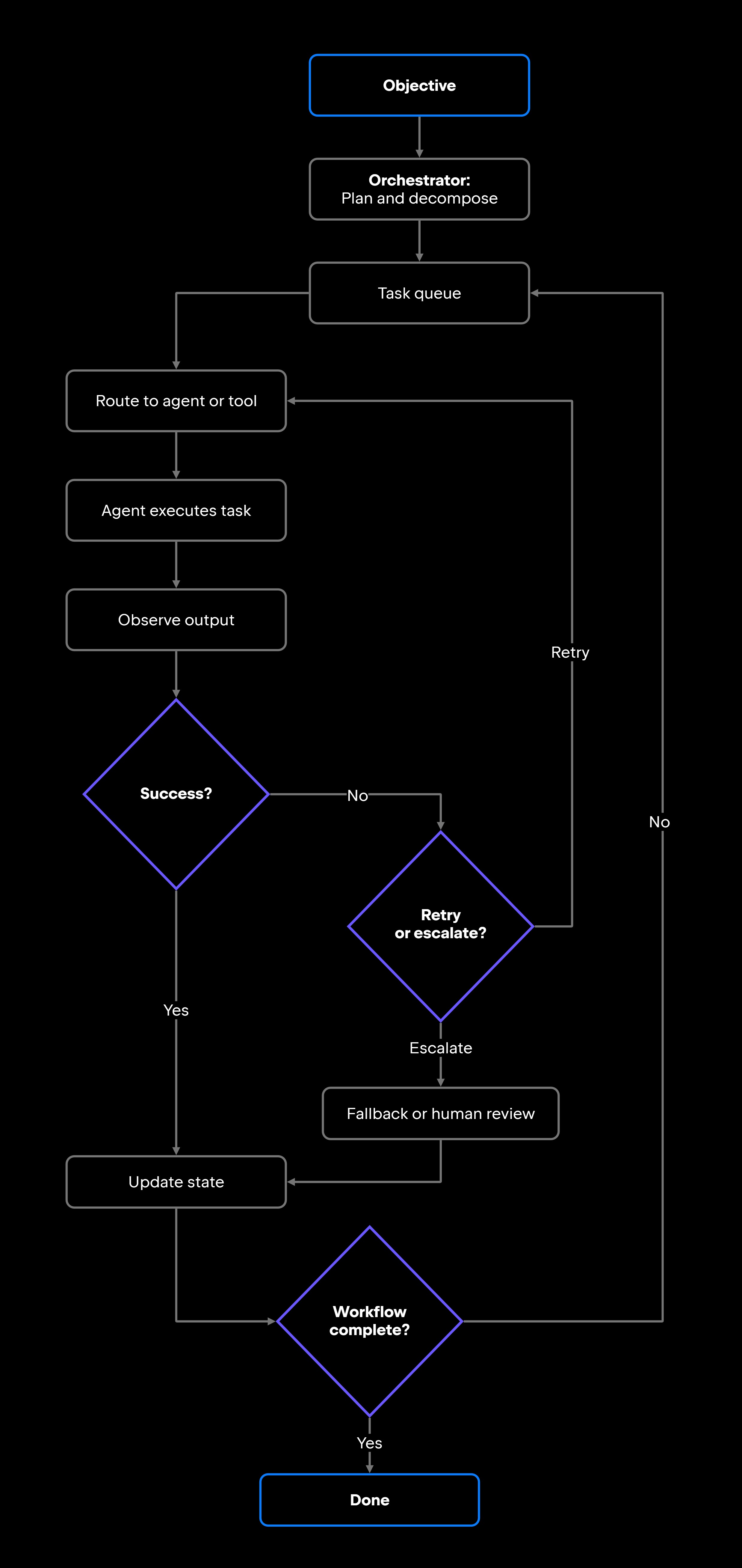
The orchestrator maintains a task queue built from the decomposed objective. It evaluates each task's dependencies, routes each task to the appropriate agent or tool, and waits for a result before updating workflow state. After each step, it checks output validity and decides whether to proceed, retry, or escalate. The loop continues until the workflow reaches a terminal condition: success, failure, or escalation.
How do developers scale orchestration across large AI systems?
Scaling usually means moving from a single centralized orchestrator toward distributed coordination for high-concurrency tasks, while keeping centralized control for workflow-level decisions. In practice, that means using message queues or event streams (like Amazon SQS or Apache Kafka) for task distribution, separate state stores for workflow tracking, and per-agent execution environments that scale independently. The orchestration layer itself stays thin, handling routing and policy, while the infrastructure underneath absorbs the throughput.
How do orchestration layers improve reliability in multi-agent workflows?
Orchestration improves reliability by making failures explicit and recoverable. The orchestrator catches failures at the boundary of each step and decides how to respond: retry with different parameters, route to a fallback agent, or surface the failure for human review. It also enforces handoff contracts between agents, which keeps downstream agents from operating on invalid inputs.
What happens when multiple AI agents depend on the same workflow state?
The orchestration layer manages write access to shared state, coordinating updates to prevent concurrent conflicts. In well-designed systems, agents don't write directly to a shared store simultaneously; the orchestrator serializes updates or uses atomic operations. When multiple agents need the same information as input, the orchestrator coordinates state access to keep it consistent, rather than letting agents read concurrently from a store that may be in the middle of an update.
What are the biggest failure points in AI agent orchestration?
The failures that hurt most are the silent ones. Explicit failures, such as timeouts, schema validation errors, and tool call exceptions, announce themselves and are straightforward to catch. Silent degradation is the hard case: it surfaces later in the workflow, far from the step that caused it, so the defenses have to be structural rather than reactive. Structured logging with correlation IDs, output validation at every handoff, and explicit stopping conditions matter more here than retry logic alone.
Damaso Sanoja is an engineer who is passionate about helping others make data-driven decisions to achieve their goals. This has motivated him to write numerous articles on the most popular relational databases, customer relationship management systems, enterprise resource planning systems, master data management tools, and, more recently, data warehouse systems used for machine learning and AI projects. You can blame this fixation on data management on his first computer being a Commodore 64 without a floppy disk.
Use AI agents in your development workflow
Explore JetBrains AI solutions that help you build, use, and scale AI agents across the software development lifecycle.
Air Gateway
Run terminal agents through one JetBrains account, with access, models, and usage governed centrally.
Junie
Plan, code, debug, and automate tasks with a coding agent that works across your terminal, IDE, GitHub, and GitLab.
Air in IDEs
Orchestrate AI agents and verify their output directly in JetBrains IDEs, with full control over how changes are reviewed.
Air Teams
Automate software delivery workflows, coordinate agentic work across teams, identify bottlenecks affecting delivery.
Air Governance
Govern AI usage, models, policies, and costs across your organization, including JetBrains and third-party tools.
Air Context
Give agents shared organizational memory and context that carries across tools, workflows, and execution environments.
JetBrains Air
An open system of AI products for developers, teams, and organizations – from coding with agents to automating workflows and governing AI at scale.

Continue Exploring the AI Agents for Developers Guide
Discover what AI agents are, how they work, their architecture, types, use cases, and how developers can build intelligent autonomous systems.
Learn how multi-agent systems coordinate AI agents, compare architecture patterns, solve complex workflows, and improve software development.
Learn what autonomous AI agents are, how they execute workflows, their levels of autonomy, key guardrails, risks, and software development use cases.