Multi-Agent Systems
for Developers
Source: Preliminary findings from the JetBrains Developer Ecosystem Survey 2026 • 15,000+ developers worldwide
Pattern
Coordination cost (tokens and latency)
Adapts at runtime
Planner-Executor
Low: plan once, replan only on failure
Low: executors follow a fixed plan
Supervisor-Worker
High: the supervisor reasons on every hop
High: re-routes after each result
Specialized Collaborative
Medium: routing by task type, no central reasoner per step
Medium: routing adapts, but no replanning
Hierarchical
High: multiple coordination layers
Most complex: many failure surfaces and state to keep in sync
Long, well-structured tasks whose steps are knowable up front
Limitations
Work that needs runtime adaptation and a single point of control and visibility
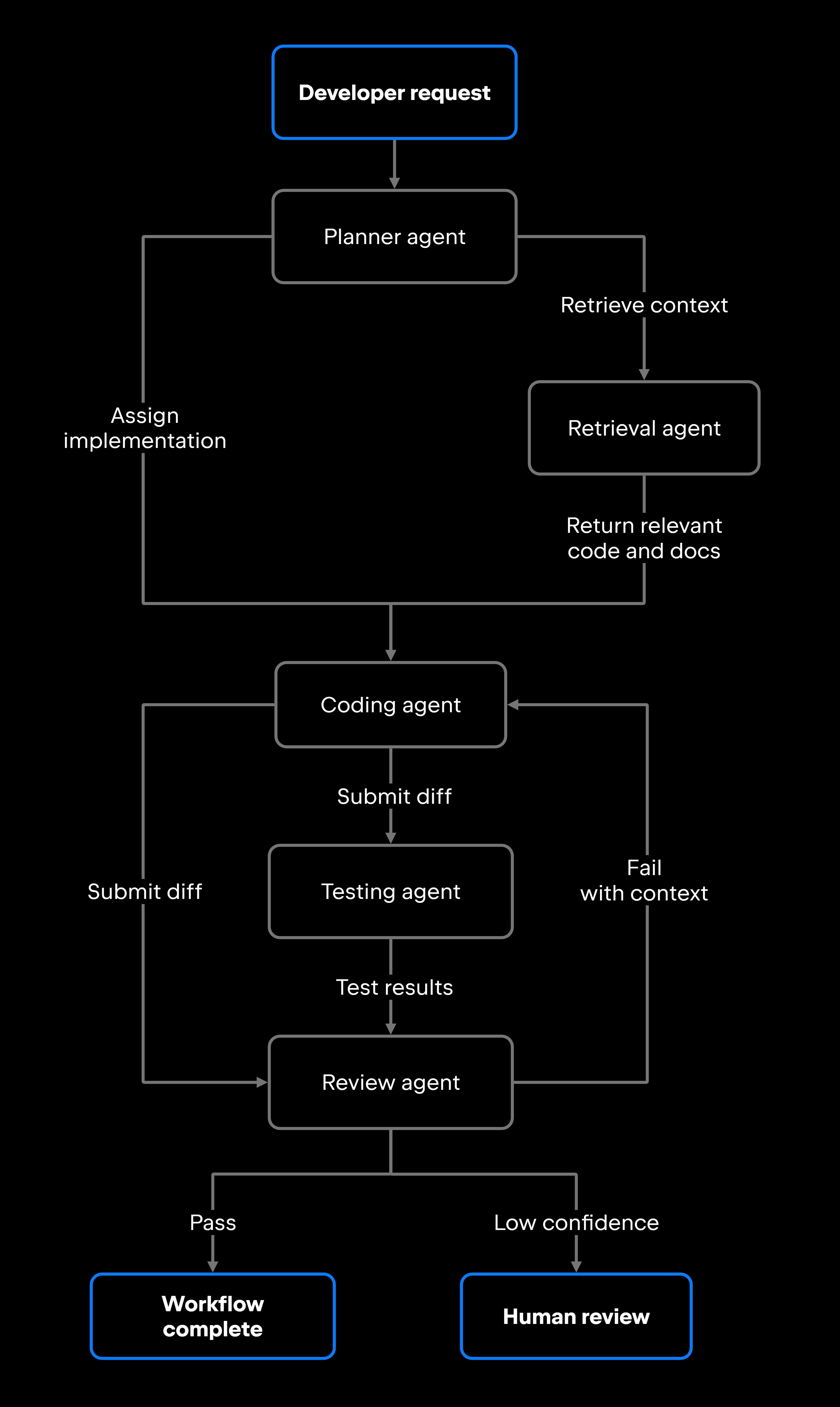
Tasks are split across distinct expertise: retrieval, coding, testing, and review
Large workflows spanning several domains, each needing its own coordination
Best for
Rigid: must stop and replan when a step diverges from the plan
The supervisor is a per-step bottleneck and single point of failure
No central visibility or replanning
Medium: within each layer, with more moving parts
FAQ
How do developers test communication between multiple AI agents?
Start with each agent in isolation and confirm it produces well-structured output from well-formed input. Then test handoffs in pairs: mock the adjacent agent and check that the receiver handles upstream output correctly. End-to-end tests that run the full workflow against a controlled dataset catch the coordination failures that only appear when every agent runs together. Capturing each agent's inputs and outputs at the boundary is what lets you localize a failure to the agent that caused it.
Can multi-agent systems operate without centralized orchestration?
Yes. Decentralized designs route tasks through peer-to-peer communication or event-driven messaging instead of a central coordinator: agents publish outputs to a shared event stream, and downstream agents subscribe to the events they care about. That removes the single point of failure that a central orchestrator introduces. The cost is visibility, since no one component tracks the full workflow state, which makes debugging harder. Teams usually accept the visibility trade-off only when availability requirements rule out central coordination.
Do all agents in a multi-agent system need access to the same tools and context?
In a well-designed system, no. Giving each agent only the tools and context its role requires improves security, lowers the risk of unintended actions, and keeps the system easier to reason about. A test execution agent needs to run code in a sandbox but never production credentials; a documentation agent needs to read the codebase but does not need permission to change it.
What causes synchronization failures in multi-agent workflows?
They happen when an agent acts before the state it depends on is ready. The usual culprits are missing dependency declarations in the orchestration layer, race conditions where two parallel agents write shared state without locking, and timeout-based progression that advances the workflow before a slow agent has returned. Declaring those dependencies explicitly, so the orchestration layer can enforce them before it advances, prevents most synchronization failures at design time.
When should developers choose multi-agent systems over simpler architectures?
Default to the simplest design that can do the job, and add agents only when you hit a concrete wall: context-window saturation, a capability no single agent covers, or sequential latency you cannot accept. The wall is the signal, not the ambition to run more agents. Until you reach it, one well-equipped agent is cheaper to build, test, and debug than a coordinated set of agents.
Damaso Sanoja is an engineer who is passionate about helping others make data-driven decisions to achieve their goals. This has motivated him to write numerous articles on the most popular relational databases, customer relationship management systems, enterprise resource planning systems, master data management tools, and, more recently, data warehouse systems used for machine learning and AI projects. You can blame this fixation on data management on his first computer being a Commodore 64 without a floppy disk.
Use AI agents in your development workflow
Explore JetBrains AI solutions that help you build, use, and scale AI agents across the software development lifecycle.
Air Gateway
Run terminal agents through one JetBrains account, with access, models, and usage governed centrally.
Junie
Plan, code, debug, and automate tasks with a coding agent that works across your terminal, IDE, GitHub, and GitLab.
Air in IDEs
Orchestrate AI agents and verify their output directly in JetBrains IDEs, with full control over how changes are reviewed.
Air Teams
Automate software delivery workflows, coordinate agentic work across teams, identify bottlenecks affecting delivery.
Air Governance
Govern AI usage, models, policies, and costs across your organization, including JetBrains and third-party tools.
Air Context
Give agents shared organizational memory and context that carries across tools, workflows, and execution environments.
JetBrains Air
An open system of AI products for developers, teams, and organizations – from coding with agents to automating workflows and governing AI at scale.

Continue Exploring the AI Agents for Developers Guide
Discover what AI agents are, how they work, their architecture, types, use cases, and how developers can build intelligent autonomous systems.
Learn what autonomous AI agents are, how they execute workflows, their levels of autonomy, key guardrails, risks, and software development use cases.
Understand the difference between AI agents and AI assistants, their architectures, capabilities, use cases, and how to choose the right approach for development workflows