AI Agents vs.
AI Assistants:
Key Differences
Source: Preliminary findings from the JetBrains Developer Ecosystem Survey 2026 • 15,000+ developers worldwide
Dimension
AI assistant
AI agent
Interaction model
Prompt–response
Goal, plan, execute, observe, iterate
User involvement
Every step
Goal-setting and review
Primary output
Actions and results
Suggestions, generated content
Tool use
Optional, user-directed
Core to operation
Multistep execution
No (or minimal)
Yes
State management
Within conversation
Across workflow steps
Workflow coordination
No
Yes
Autonomy scope
Bound to prompt
Bounded by permissions and runtime rules
Failure handling
You correct the output in the next prompt
Retry, escalate, or halt per configured strategy
Setup complexity
Low: installs as an IDE plugin
High: requires a permission model, approval gates, and observability design
FAQ
Are AI assistants and AI agents the same thing?
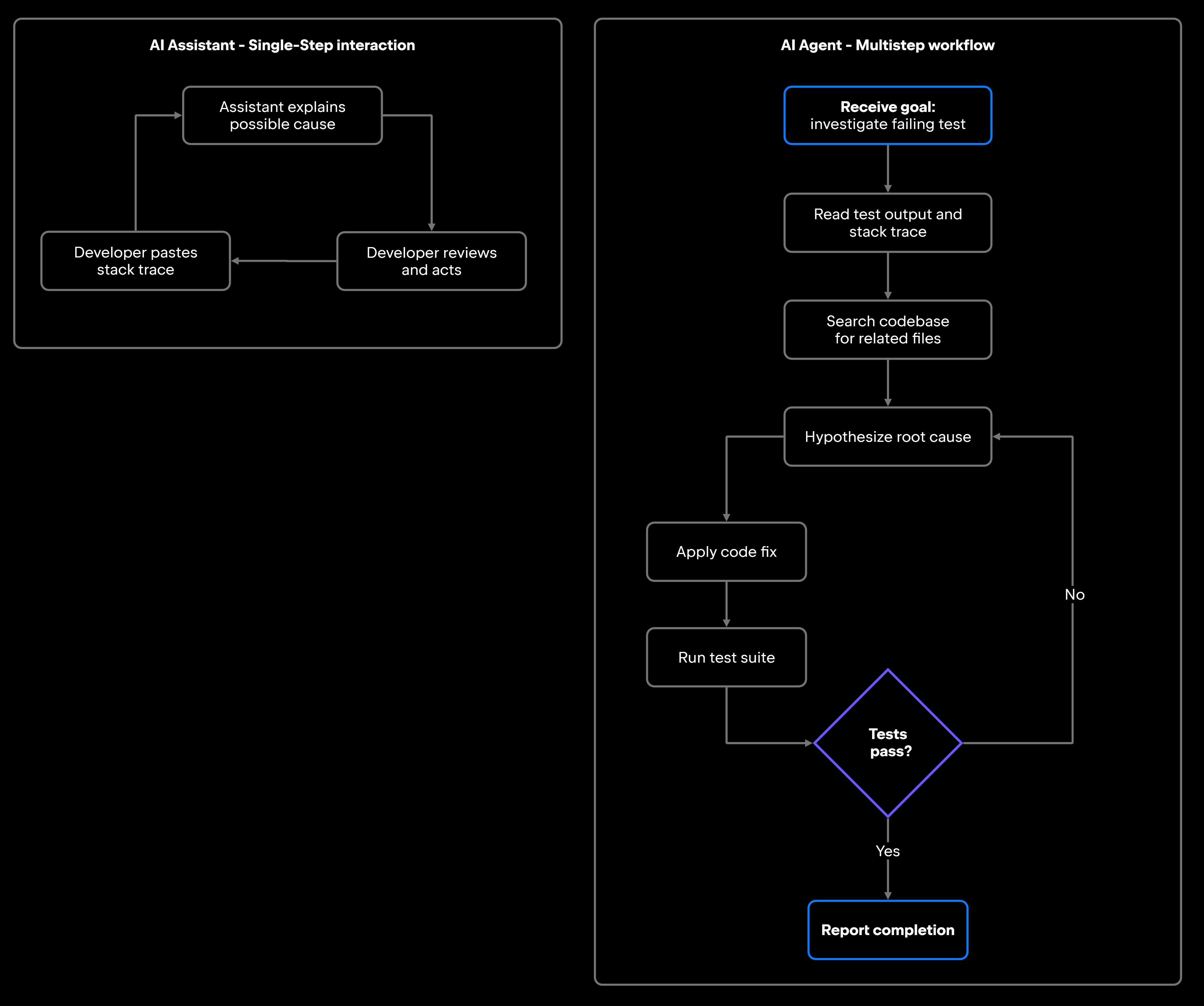
No. The cleanest way to tell them apart is by looking at who drives the loop. With an assistant, you do: It responds to your prompt and waits for the next one. With an agent, the system does: It pursues a goal across multiple steps, using tools and tracking state, and comes back to you only at the goal-setting and review phase.
When should developers use AI agents instead of AI assistants?
Use an agent when the task involves multiple sequential steps, requires interaction with external tools or systems, and would benefit from running without manual intervention at each step. Bug investigation pipelines, CI triage automation, dependency management workflows, and support ticket routing are all strong fits. Use an assistant when you need fast help with discrete tasks (generating code, explaining behavior, and writing tests) and want to stay in the review loop throughout. If the cost of a wrong autonomous action outweighs the cost of a manual handoff, stay with the assistant.
What is an example of an AI agent in software development?
Koog, JetBrains' open-source JVM-native framework, is a concrete example. Pointed toward a goal like "update our outdated dependencies", a Koog agent can scan the build manifest, read each package's changelog for breaking changes, apply the compatible upgrades, run the test suite, and open a pull request that explains what changed, deciding each step from the result of the last one. JetBrains Air extends this by letting you assign an agent (Claude Agent, OpenAI Codex, Gemini CLI, or Junie) to each task and run several tasks in parallel, each in its own isolated execution environment.
How do AI agents handle failures and retries in workflows?
Well-designed agent frameworks like JetBrains’ open-source Koog include built-in retry logic, agent state persistence for recovery, and execution tracing. When a step fails (a tool call returns an error, a test does not pass, or an API times out), the agent can retry with adjusted parameters, escalate to a fallback strategy, or halt and surface the failure for human review, depending on how the workflow is configured. Structured logs and step-level traces make these failure paths auditable after the fact.
Can an AI assistant become an AI agent?
In some cases, yes, though it depends on the tooling and configuration. When an AI assistant gains the ability to take actions autonomously across multiple steps, coordinate tools, and manage state between those steps, it has effectively crossed into agent territory. GitHub Copilot's workspace features follow a similar logic, extending what looks like a chat interface into something that performs multistep file operations.
What is an example of an AI assistant workflow in software development?
A developer opens an unfamiliar class and asks the AI chat in JetBrains IDEs to explain how it works, then to draft documentation for its public methods. The assistant returns an explanation and a javadoc; the developer reviews it, corrects a detail the model got wrong, and commits the result. Every step needs developer judgment: the assistant generates and explains, but the loop is human-driven. This is the right fit when you want control over each decision, or when the work needs context that the assistant cannot reach on its own, such as a production database, a private API, or a proprietary CI system.
What is the difference between agentic AI and generative AI?
Generative AI refers to models that produce content (text, code, and images) in response to a prompt. Agentic AI uses those generative capabilities inside an autonomous execution loop: planning steps, calling tools, observing results, and iterating toward a goal. All agentic AI systems use generative AI under the hood, but generative AI systems are not agentic by default.
Damaso Sanoja is an engineer who is passionate about helping others make data-driven decisions to achieve their goals. This has motivated him to write numerous articles on the most popular relational databases, customer relationship management systems, enterprise resource planning systems, master data management tools, and, more recently, data warehouse systems used for machine learning and AI projects. You can blame this fixation on data management on his first computer being a Commodore 64 without a floppy disk.
Use AI agents in your development workflow
Explore JetBrains AI solutions that help you build, use, and scale AI agents across the software development lifecycle.
Air Gateway
Run terminal agents through one JetBrains account, with access, models, and usage governed centrally.
Junie
Plan, code, debug, and automate tasks with a coding agent that works across your terminal, IDE, GitHub, and GitLab.
Air in IDEs
Orchestrate AI agents and verify their output directly in JetBrains IDEs, with full control over how changes are reviewed.
Air Teams
Automate software delivery workflows, coordinate agentic work across teams, identify bottlenecks affecting delivery.
Air Governance
Govern AI usage, models, policies, and costs across your organization, including JetBrains and third-party tools.
Air Context
Give agents shared organizational memory and context that carries across tools, workflows, and execution environments.
JetBrains Air
An open system of AI products for developers, teams, and organizations – from coding with agents to automating workflows and governing AI at scale.

Continue Exploring the AI Agents for Developers Guide
Understand the difference between agentic AI and AI agents, including their roles, capabilities, relationship, and practical applications.
Understand the difference between LLMs and AI agents, including how they work, their capabilities, limitations, and roles in building intelligent autonomous systems.
Discover what AI agents are, how they work, their architecture, types, use cases, and how developers can build intelligent autonomous systems.