LLMs vs. AI Agents: What Is the Difference?
Source: Preliminary findings from the JetBrains Developer Ecosystem Survey 2026 • 15,000+ developers worldwide
Dimension
LLM
AI Agent
What it is
A model
A system
Primary function
Output generation
Workflow execution
Input
Prompt and context
Goal or task
Coordination
None (single inference)
Orchestration layer
State
Stateless per request
Stateful across steps
Output type
Generated text or code
Actions plus final output
Tool access
None (model only)
Calls APIs, IDEs, terminals, databases
Failure handling
None (generates or fails)
Retries, fallbacks, monitoring
FAQ
Are AI agents just LLMs?
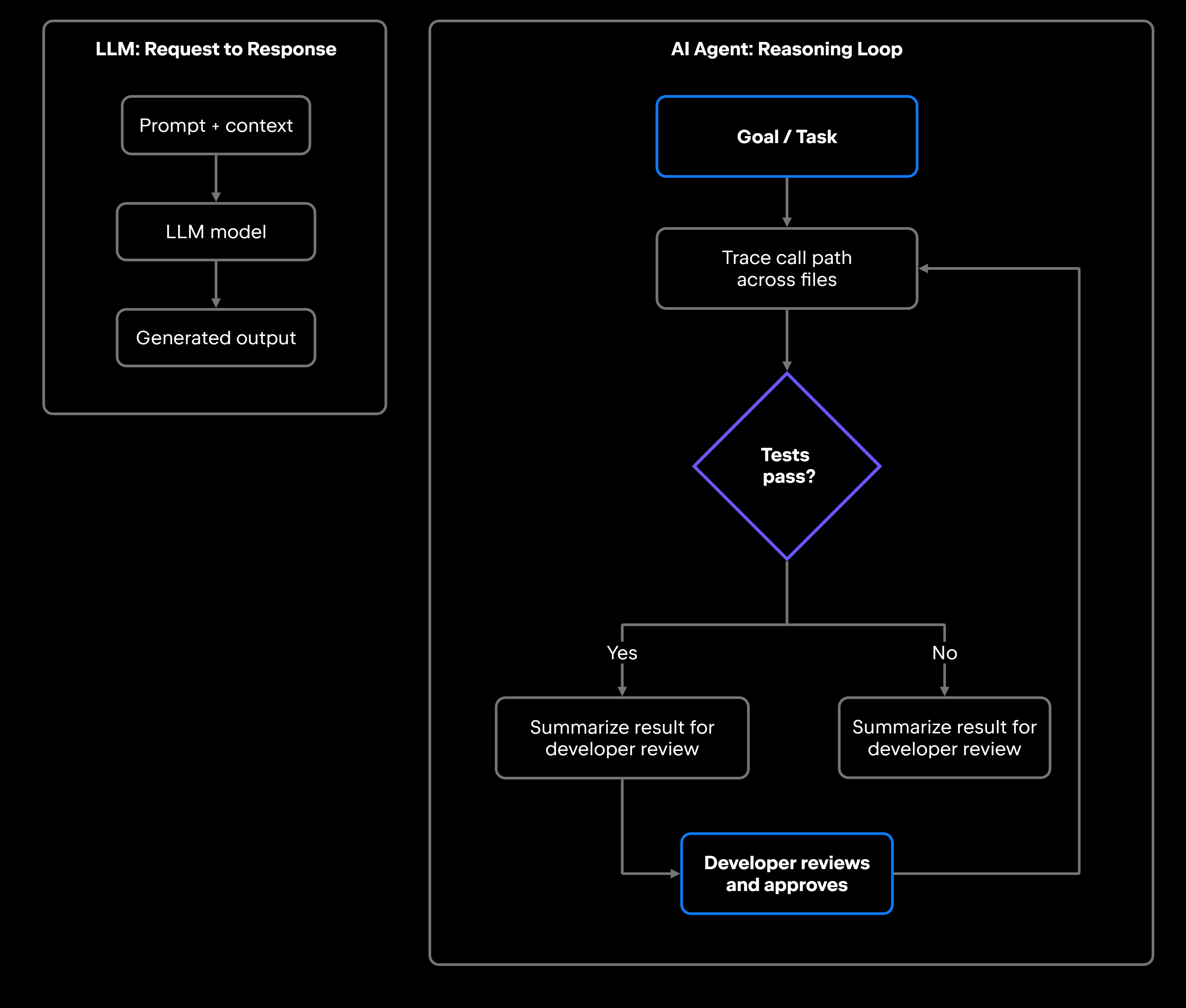
No. An LLM is usually one component of an agent, its reasoning layer, but the model alone does not make an agent. What makes it an agent is the system around the model: the part that calls tools, holds state across steps, and drives the reason-act-observe loop. Strip that system away, and you are left with a model that generates text and stops.
Can an AI agent work without an LLM?
Yes, though most modern agents use LLMs as their reasoning layer. Rule-based agents, classical planning systems, and reinforcement learning agents can operate without a language model. LLMs have become the dominant reasoning mechanism in software development agents because they handle ambiguous natural language instructions and unstructured tool output better than rigid rule systems. An agent's architecture requires a reasoning mechanism, tools, and orchestration, but not specifically an LLM. The LLM is currently the most practical choice for that reasoning layer in development workflows.
When should developers use AI agents instead of standalone LLMs?
Use an LLM directly when the task is a single generation step: write this function, explain this error, summarize this PR, generate these tests. Use an agent when the task requires multiple steps, tool access, or persistent state: Investigate and fix a bug across multiple files, coordinate a deployment pipeline, or maintain a living documentation system. The cleaner signal is whether you would otherwise need to manually coordinate multiple model calls and stitch their outputs together. If yes, an agent is the right abstraction. If the task fits in a single well-constructed prompt, a direct model call is simpler and faster.
Which AI agent frameworks should developers know about?
The most widely adopted open-source agent frameworks include LangGraph for stateful, graph-based multiagent orchestration (built on LangChain, the broader framework for composing LLM applications), AutoGen from Microsoft for multiagent conversation patterns, and CrewAI for role-based agent collaboration. For development-environment-native workflows, JetBrains offers agent capabilities across its tooling, with AI agents integrated into the IDEs, the Junie coding agent available both in the IDEs and as a CLI, and JetBrains Air providing a dedicated agentic development environment that sits alongside the IDE rather than requiring external third-party infrastructure. The right choice depends on whether you need a standalone orchestration layer or an agent system embedded in your existing tooling.
What is the difference between an AI agent and an LLM?
An LLM is a stateless model that takes a prompt and returns generated output, with no memory between calls, no tool access, and no ability to act in external systems. An AI agent is a system built around such a model, adding persistent memory, access to external tools (APIs, terminals, and file systems), orchestration logic, and runtime state management so it can run multistep workflows and adapt based on what it observes.
Do AI agents always use tools and memory?
Most production agents do, but not all. A minimal agent might use an LLM in a reasoning loop without external tool calls, for example, an agent that iteratively refines code by critiquing and rewriting its own output without reading from a file system. Most useful development agents call at least some external tools (terminal, file system, and APIs) and maintain some form of short-term memory across steps. Long-term memory persisted across sessions becomes important for agents handling complex, ongoing workflows like multisprint refactoring or long-running investigation tasks.
How do LLMs and AI agents handle memory differently?
LLMs are stateless. Each inference request starts fresh with only the context you explicitly provide in the prompt, and there is no carryover between separate API calls. AI agents maintain memory at two levels: short-term (the active context window accumulating actions and observations during a session) and long-term (structured storage like vector databases that persist project knowledge, user preferences, and past decisions across sessions). That memory layer is what lets an agent carry context through a long-running investigation or a migration that touches hundreds of files, work that would overflow any single prompt.
Damaso Sanoja is an engineer who is passionate about helping others make data-driven decisions to achieve their goals. This has motivated him to write numerous articles on the most popular relational databases, customer relationship management systems, enterprise resource planning systems, master data management tools, and, more recently, data warehouse systems used for machine learning and AI projects. You can blame this fixation on data management on his first computer being a Commodore 64 without a floppy disk.
Use AI agents in your development workflow
Explore JetBrains AI solutions that help you build, use, and scale AI agents across the software development lifecycle.
Air Gateway
Run terminal agents through one JetBrains account, with access, models, and usage governed centrally.
Junie
Plan, code, debug, and automate tasks with a coding agent that works across your terminal, IDE, GitHub, and GitLab.
Air in IDEs
Orchestrate AI agents and verify their output directly in JetBrains IDEs, with full control over how changes are reviewed.
Air Teams
Automate software delivery workflows, coordinate agentic work across teams, identify bottlenecks affecting delivery.
Air Governance
Govern AI usage, models, policies, and costs across your organization, including JetBrains and third-party tools.
Air Context
Give agents shared organizational memory and context that carries across tools, workflows, and execution environments.
JetBrains Air
An open system of AI products for developers, teams, and organizations – from coding with agents to automating workflows and governing AI at scale.

Continue Exploring the AI Agents for Developers Guide
Discover what AI agents are, how they work, their architecture, types, use cases, and how developers can build intelligent autonomous systems.
Learn what agentic AI is, how it works, its core components, real-world use cases, benefits, challenges, and how it differs from other AI systems.
Understand the difference between agentic AI and AI agents, including their roles, capabilities, relationship, and practical applications.