Agentic AI vs
AI Agents:
Key Differences
Source: Preliminary findings from the JetBrains Developer Ecosystem Survey 2026 • 15,000+ developers worldwide
Dimension
Agentic AI
AI agents
What it describes
A behavioral capability
A system or component
Core concept
Behavior: planning, adaptation, and goal pursuit
Architecture: a harness around a model (tools, memory, and control loop)
Task scope
Multistep, goal-oriented workflows
Typically, a single, well-defined task
Execution style
Adaptive, context-driven execution
Structured, bounded perceive-reason-act loop
Orchestration vs. autonomy
Autonomous: self-directs across steps within a bounded scope
Orchestrated: invoked and sequenced by a developer or a controlling layer
Human oversight
Typically with workflow boundaries and escalation rules
Typically, with task invocation and results review
Dependency
Typically implemented through one or more AI agents
Can exist without agentic behavior
JetBrains example
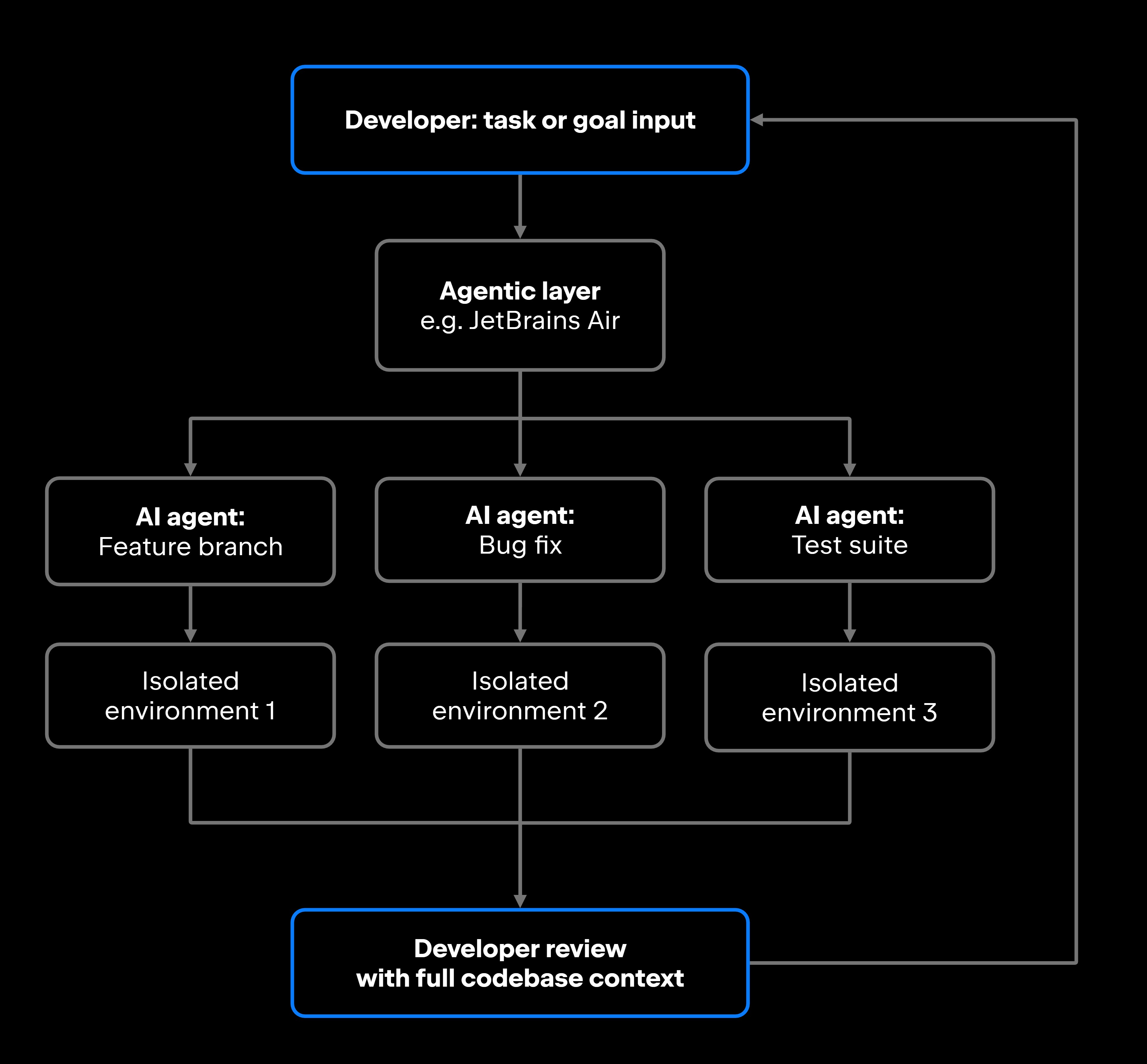
Air Teams: orchestrates several agents in parallel environments
Air in IDEs: A single agent working on a task
FAQ
Are agentic AI and AI agents the same?
They are related but distinct. Agentic AI is a behavioral description covering the capacity to pursue goals across multiple steps, adapt to feedback, and operate with bounded autonomy. An AI agent is the system that delivers it: a harness around a model that combines tools, memory, and a control loop to handle a category of task. Most modern AI development tools implement both at once, which is why the terms get used interchangeably. The distinction matters when you are reasoning about how a system executes work versus what the system is.
Are agentic AI systems fully autonomous?
No. Production agentic systems operate within defined permission boundaries and human approval checkpoints. The goal is bounded autonomy: enough independent execution to cut manual interruptions, with clear limits on what the system can change. In JetBrains Air Teams, for example, an agent's work stays in its isolated environment until you review and integrate it.
When should developers use AI agents instead of simpler AI assistants?
Use an AI agent when the task involves multiple sequential steps, requires coordination across tools (file system, test runner, version control, external APIs), or benefits from maintaining state between actions. A simple AI assistant, a completion model generating a snippet or answering a one-off question, is the right tool for single-turn tasks. The practical signal is the manual loop described above: if you are shuttling output between the model and your tools by hand, that is the work an agentic agent is built to automate.
How does agentic AI differ from traditional automation?
Traditional automation executes a fixed, predefined sequence of steps. Agentic AI adapts that sequence based on intermediate results. If a step fails or produces unexpected output, an agentic system revises its plan rather than stopping or erroring out. This distinction matters in development workflows where conditions vary: Tests fail unexpectedly, APIs return edge-case responses, or code changes introduce downstream effects that were not anticipated when the task was defined.
Can an AI agent exist without agentic behavior?
Yes, and it is common. A rule-based ticket classifier with a thin language-model wrapper follows the basic perceive-reason-act structure, so it may qualify as a simple AI agent, though most definitions also expect some goal-directed reasoning. If it cannot plan a multistep approach, adapt when classification confidence is low, or pursue a broader goal without a human prompt for each input, it is not behaving agentically. Single-step, single-tool agents frequently fall into this category, and that is fine. Not every automation problem requires adaptive, multistep execution.
Can agentic AI systems work inside IDEs and developer tools?
Yes. AI agents in JetBrains IDEs are a working example: They run in the IDEs you already use, on a JetBrains AI subscription or your own API key, handling multi-step tasks under developer supervision. For work that spans multiple agents in parallel, JetBrains Air extends this idea into a multi-agent system that spans IDEs, the browser, and the cloud.
What is the PRAR cycle in AI agent development?
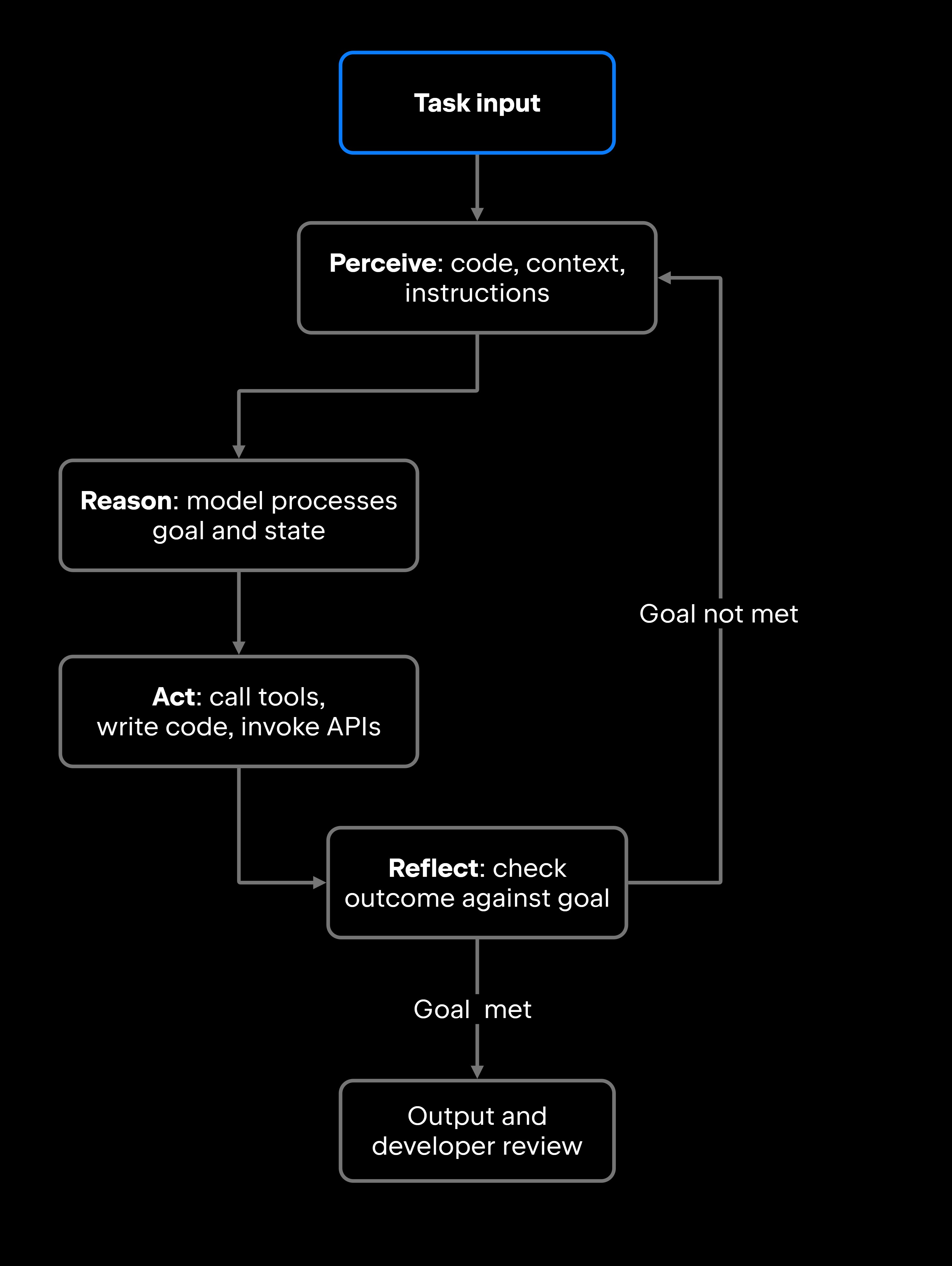
PRAR stands for “perceive, reason, act, reflect”, a well-documented control loop for AI agents. The agent perceives its environment (reads files, checks test results), reasons about the goal and current state, acts by calling tools or writing code, then reflects on whether the action moved it closer to the goal. If not, the loop repeats. This cycle is what gives an agent the ability to handle multistep tasks without a human prompt between each step.
Damaso Sanoja is an engineer who is passionate about helping others make data-driven decisions to achieve their goals. This has motivated him to write numerous articles on the most popular relational databases, customer relationship management systems, enterprise resource planning systems, master data management tools, and, more recently, data warehouse systems used for machine learning and AI projects. You can blame this fixation on data management on his first computer being a Commodore 64 without a floppy disk.
Use AI agents in your development workflow
Explore JetBrains AI solutions that help you build, use, and scale AI agents across the software development lifecycle.
Air Gateway
Run terminal agents through one JetBrains account, with access, models, and usage governed centrally.
Junie
Plan, code, debug, and automate tasks with a coding agent that works across your terminal, IDE, GitHub, and GitLab.
Air in IDEs
Orchestrate AI agents and verify their output directly in JetBrains IDEs, with full control over how changes are reviewed.
Air Teams
Automate software delivery workflows, coordinate agentic work across teams, identify bottlenecks affecting delivery.
Air Governance
Govern AI usage, models, policies, and costs across your organization, including JetBrains and third-party tools.
Air Context
Give agents shared organizational memory and context that carries across tools, workflows, and execution environments.
JetBrains Air
An open system of AI products for developers, teams, and organizations – from coding with agents to automating workflows and governing AI at scale.

Continue Exploring the AI Agents for Developers Guide
Learn what agentic AI is, how it works, its core components, real-world use cases, benefits, challenges, and how it differs from other AI systems.
Discover what AI agents are, how they work, their architecture, types, use cases, and how developers can build intelligent autonomous systems.
Compare agentic AI and generative AI, understand their key differences, capabilities, use cases, and when to use each approach.