Agentic AI vs. Generative AI: Key Differences
Dimension
Agentic AI
Generative AI
Primary purpose
Complete goals through planned, multistep execution
Create outputs (code, docs, tests, explanations)
Workflow scope
Multistep workflows with planning and adaptation
Single task per prompt
Autonomy
Goal-directed (initiates and sequences actions)
Reactive (responds to prompts)
Context
Project-wide: repo, terminal, test results, documentation
Current file, selected code, or prompt
Tool access
May read, write, or execute tools when permitted
Produces suggestions
Human role
Reviews plans, approvals, and final results
Reviews each output
Typical tasks
Debugging, migrations, refactoring, and issue investigation
Code completion, doc generation, unit tests, and commit messages
Primary risks
Unintended file changes, cascading errors, and permission over-scoping (agent granted broader access than the task requires)
Hallucinated code, weak test coverage
FAQ
Is agentic AI always autonomous?
Agentic AI operates within developer-defined boundaries and approval gates. Tools like Junie and JetBrains Air Teams do not execute arbitrary actions: they work within scoped permissions, run tasks in sandboxed environments, like Docker containers or Git worktrees, and present results for human review before anything merges. The autonomy covers workflow execution, leaving deployment decisions to you.
What kinds of development tasks are best suited for agentic AI?
Tasks that require planning, cross-file context, tool execution, and iterative feedback. Debugging a failing test, migrating from one API version to another, performing a large-scale refactoring, investigating a CI failure, and coordinating code changes with test updates are all strong fits. If the task needs multiple steps that depend on each other's results, agentic AI handles the sequencing.
Can developers use generative AI and agentic AI together?
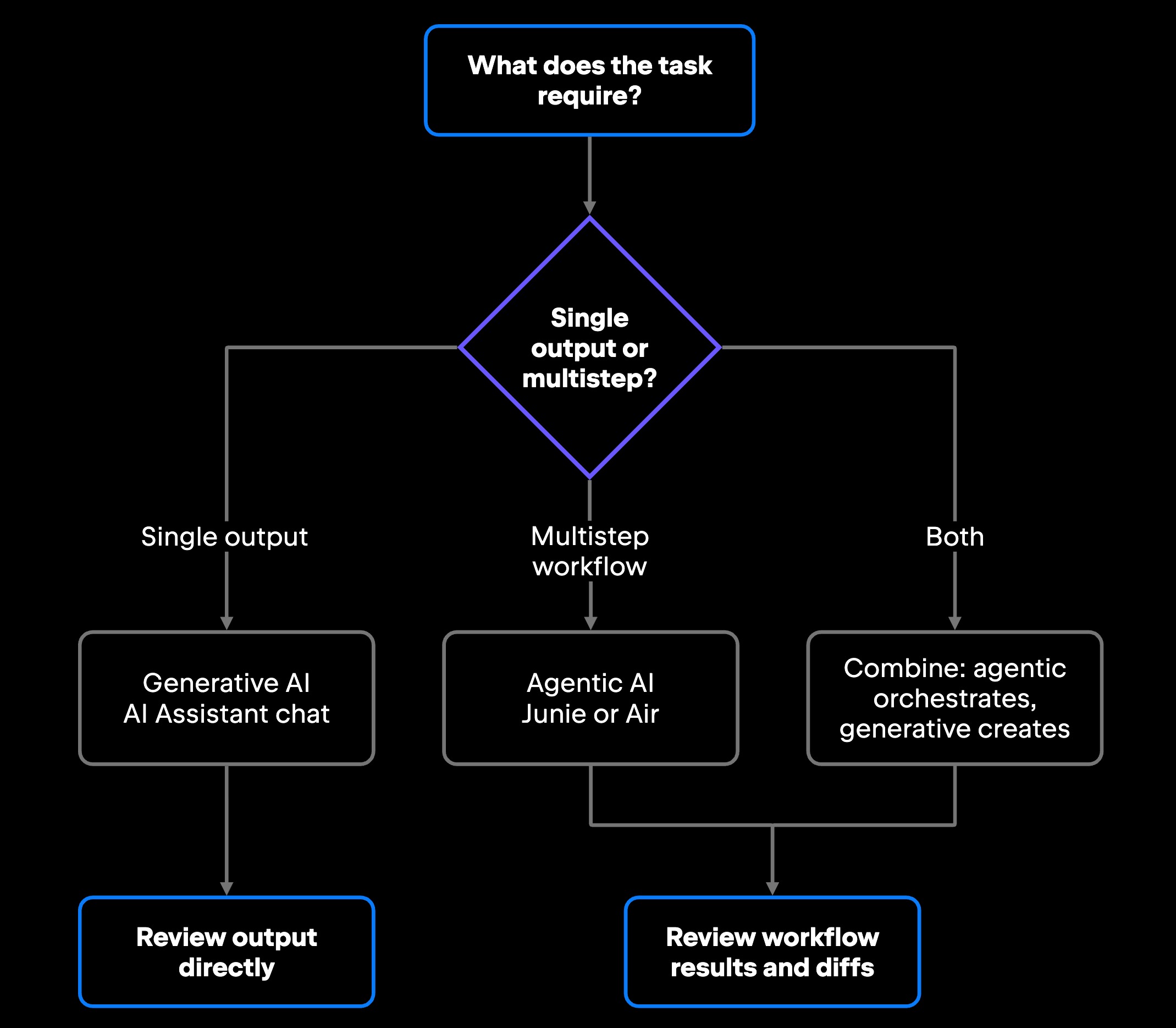
The normal pattern combines both. The AI chat in JetBrains IDEs handles immediate output tasks (code completion, documentation, and commit messages), while Junie or JetBrains Air Teams handles workflow-level tasks like debugging, refactoring, and test coordination. The two run alongside each other in modern JetBrains IDEs, each suited to a different scope of work.
How does agentic AI maintain context across a multistep workflow?
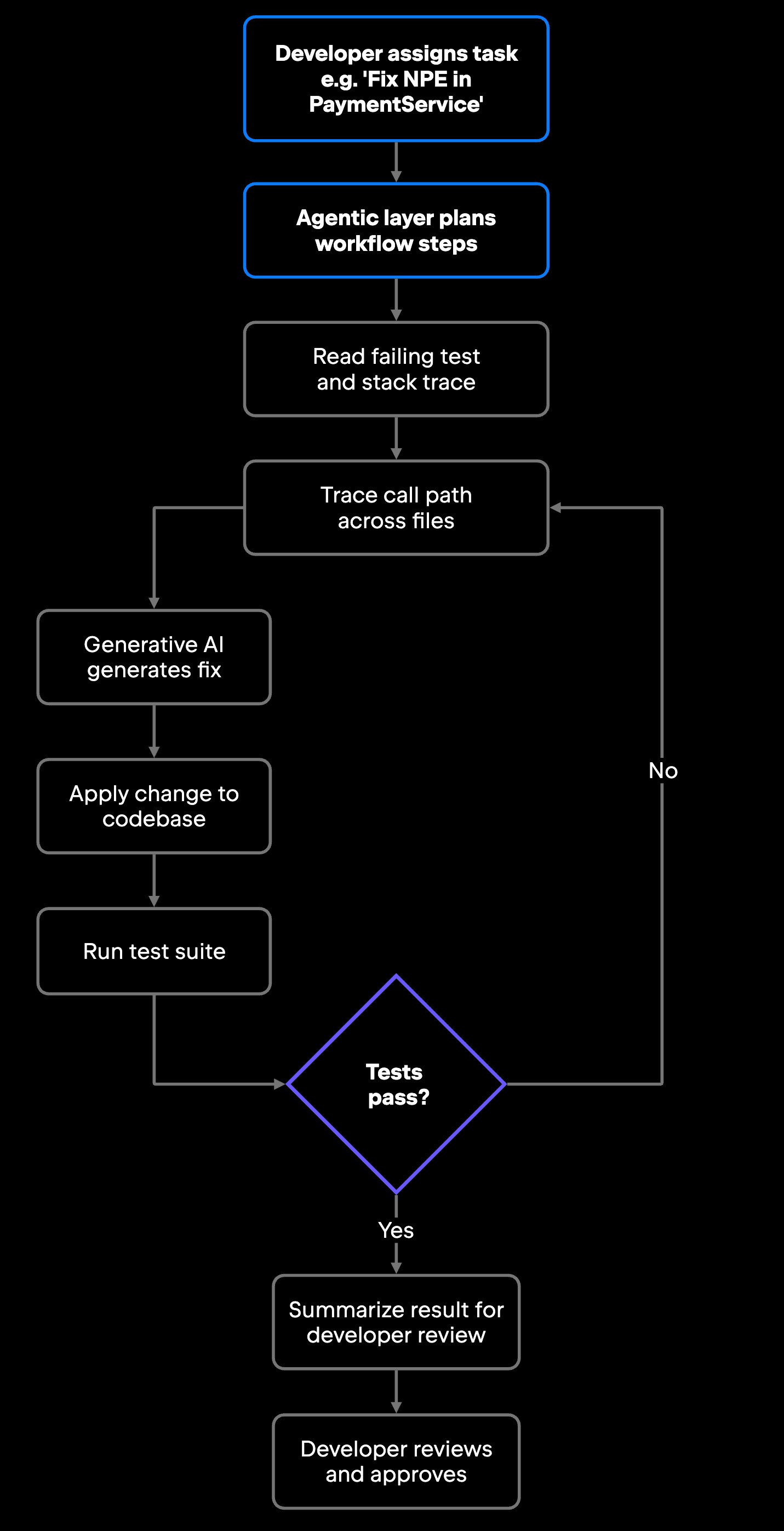
Agentic systems maintain state across steps by tracking intermediate results, tool outputs, and progress toward the goal between each action. Unlike a generative model, which starts fresh with each prompt, an agent carries forward what it learned from each step (a test result, a file read, and a build error) and uses that accumulated context to decide what to do next.
Can generative AI complete multistep workflows?
Generative AI produces outputs in response to prompts. It does not maintain workflow state, execute tool commands, or adapt based on test results unless an agentic layer orchestrates those steps. You can chain prompts manually to approximate a workflow, but that is the developer doing the agentic work, not the AI.
Do agentic AI systems need access to IDEs and external tools?
Yes, to be effective. Agentic AI relies on tool access to do anything beyond text generation. Junie integrates with the JetBrains IDE's project intelligence (file system, build state, and test runner). JetBrains Air Teams bundles terminal access, Git, and browser previews. Without those integrations, an agentic system is a generative model with a planning layer and nowhere to act.
What is the main risk difference between generative AI and agentic AI?
Generative AI risks center on output quality: hallucinated methods, weak test coverage, or inaccurate explanations that you catch during review. Agentic AI introduces operational risks because it executes actions before you see results – cascading errors across files, unintended writes, or permission scope violations. Sandboxed environments and approval gates address agentic risk; careful output review addresses generative risk.
Damaso Sanoja is an engineer who is passionate about helping others make data-driven decisions to achieve their goals. This has motivated him to write numerous articles on the most popular relational databases, customer relationship management systems, enterprise resource planning systems, master data management tools, and, more recently, data warehouse systems used for machine learning and AI projects. You can blame this fixation on data management on his first computer being a Commodore 64 without a floppy disk.
Use AI agents in your development workflow
Explore JetBrains AI solutions that help you build, use, and scale AI agents across the software development lifecycle.
Air Gateway
Run terminal agents through one JetBrains account, with access, models, and usage governed centrally.
Junie
Plan, code, debug, and automate tasks with a coding agent that works across your terminal, IDE, GitHub, and GitLab.
Air in IDEs
Orchestrate AI agents and verify their output directly in JetBrains IDEs, with full control over how changes are reviewed.
Air Teams
Automate software delivery workflows, coordinate agentic work across teams, identify bottlenecks affecting delivery.
Air Governance
Govern AI usage, models, policies, and costs across your organization, including JetBrains and third-party tools.
Air Context
Give agents shared organizational memory and context that carries across tools, workflows, and execution environments.
JetBrains Air
An open system of AI products for developers, teams, and organizations – from coding with agents to automating workflows and governing AI at scale.

Continue Exploring the AI Agents for Developers Guide
Learn what agentic AI is, how it works, its core components, real-world use cases, benefits, challenges, and how it differs from other AI systems.
Learn how multi-agent systems coordinate AI agents, compare architecture patterns, solve complex workflows, and improve software development.
Learn how AI agent orchestration works, from planning and task routing to state management, multi-agent coordination, and reliable workflow execution.