AI Agents for Developers Guide / A Complete Guide to Agentic AI

A Complete Guide to
Agentic AI

The industry is shifting from systems that answer questions to systems that complete tasks. Agentic AI is what that shift looks like for development teams, and it changes what "using AI" means day to day. Where a prompt-based assistant waits for your next instruction, agentic AI pursues a goal on its own: Iit plans a sequence of steps, uses tools to interact with other systems, and adapts as it goes, without a prompt at every turn. A chat assistant gives you advice; an agentic system executes a delegated task, reading code, running tests, and adjusting based on what it finds until the work is done or it needs your input.

This guide covers what agentic AI is, how it works step by step, the core characteristics that distinguish it from basic AI assistants, the practical benefits for development teams, and the real limitations you need to plan around. The focus throughout is on concrete software development workflows rather than abstract AI theory.

What is agentic AI?

The simplest agentic AI definition is behavioral: A system behaves agentically when it pursues a defined goal across multiple steps through autonomous decision-making, tool use, and feedback-driven adaptation, rather than generating a single response and waiting for the next prompt. Agentic AI describes that behavior, not a specific architecture.

Take "implement the caching layer for UserService" as an example. A traditional AI assistant handles that as a series of exchanges: You ask for the implementation, it writes it; you ask it to add error handling, it adds it; you tell it the tests failed, it suggests a fix. Each step requires your input. An agentic system takes the same goal and works through the sequence on its own, reading the existing code, checking dependencies, writing the implementation, running the tests, and adjusting based on what it finds, until the task is done or it needs your input on something it cannot resolve on its own.

Agentic AI is built on AI agents, the systems that let a model act on its environment, pairing it with the tools, memory, and control loop it needs to carry out steps. An agentic system may be a single capable agent or an orchestrator that coordinates several specialized agents: one reading code, another running tests, and another summarizing results. Either way, the structure is an implementation detail; what makes it agentic is the behavior, the system carrying the task forward on its own.

In software development, this is clear. A generative model helps you write a SQL query. An agentic system can investigate a slow endpoint, query the database schema, identify a missing index, generate the migration, run the existing test suite, and open a PR, treating the investigation as a connected workflow rather than a series of isolated questions.

For deeper comparisons, see agentic AI vs. generative AI and agentic AI vs. AI agents.

Why agentic AI matters?

Agentic AI matters because today, the overhead of coordinating multistep workflows falls on developers. Reading code, running tests, checking dependencies, fixing failures, and updating documentation are each straightforward on their own; the cost is in moving between them, tracking what is already done, and re-gathering context after every interruption. Agentic systems absorb that coordination as part of execution.

The practical result is time returned to judgment-level work. Instead of switching between your IDE, terminal, CI dashboard, and documentation to gather context yourself, you delegate the investigative sequence and come back to a summary of what was found and what changed. Agentic AI software connected to your repository, test runner, and build system handles the repetitive coordination, so you spend more time on decisions that actually need your judgment. This is also where agentic AI automation becomes practical: Multistep actions run across tools without manual handoffs between them, and the same workflow scales from a single task to a repeatable process the whole team can reuse.

Teams that have adopted agentic workflows often report fewer interruptions from mechanical coordination, alongside faster individual outputs. Understanding where those gains come from means looking at how an agentic system actually moves from goal to finished task.

How does agentic AI work?

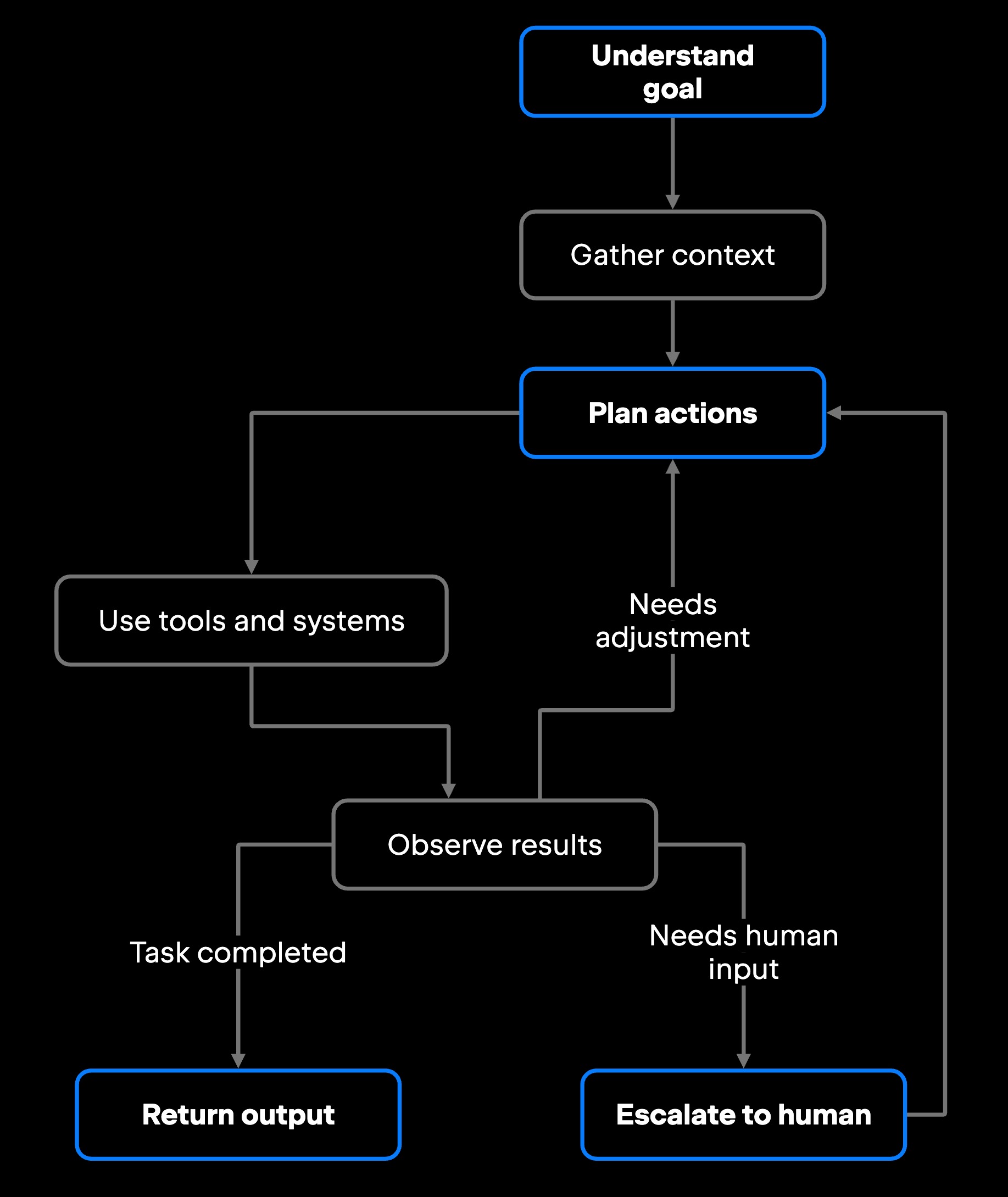
Agentic AI works through a repeating loop: The system interprets a goal, gathers context, plans a sequence of actions, executes those actions using available tools, observes the results, and adapts, looping back through planning when something needs to change. The AI agent architecture behind this loop is what makes multistep execution possible, and it is what distinguishes agentic systems from simple prompt-response models and fixed-path automation scripts.

Understanding the goal

Every agentic workflow starts with interpreting the objective. Goals arrive as natural-language prompts, workflow triggers, embedded business rules, or structured API calls. The system aims at the outcome the request implies, not its literal wording.

A well-formed goal includes enough context for the agent to recognize when it is done: a clear description of the desired end state ("all tests in the UserService module pass after the caching layer is added"), any constraints on scope ("do not modify the database schema"), and an explicit stopping condition ("stop and escalate if existing tests break"). A vague goal like "improve performance" gives the agent no signal for when to stop and nothing to validate its output against.

Gathering context

Before acting, the system gathers the context relevant to the task: source files, test output, documentation, a database schema, or recent Git commits. Agentic AI software connected to your repository and CI system can pull from these sources programmatically, gathering what the goal needs rather than the entire codebase.

One caveat: The system does not always have complete context. If the relevant code lives in a service that it cannot read, or if the documentation is outdated, the context it builds will have gaps, and those gaps affect the quality of everything that follows.

Planning actions

Given a goal and gathered context, a capable reasoning model decomposes the work into an ordered sequence: what to do first, which tools to invoke, where human review is needed before proceeding, and how to validate that each step succeeded. Agentic AI models treat the plan as a starting point, not a fixed script, adjusting it as new information arrives.

For a task like "migrate the user table to use UUIDs", the plan might look like this: Read the current schema, identify all foreign key references, generate the migration script, generate updated tests, run the migration against a test database, verify the tests pass, then flag for human review before touching production. The model handles the decomposition; you define the constraints.

Using tools and systems

Agentic AI acts, not just reasons. When permitted, it can interact with IDEs, terminals, test runners, version control systems, REST APIs, browsers, CI/CD pipelines, databases, and project management tools. Connecting a sequence of reasoning steps to real system actions, rather than text output alone, is where agentic AI automation becomes tangible.

Tool access is deliberately scoped, not unlimited. An agent working in a development context might read files, run tests, and commit to a feature branch on its own, yet still pause for explicit approval before merging or deploying. The tools it can reach, and the permissions attached to them, define how far it can act.

Observing results and adapting

After each action, the system evaluates what happened. Test results, error messages, API responses, and compiler output all feed back into the agent's understanding of where the task stands. When a test fails, the system reads the failure message, revisits the relevant code, and makes an adjustment. When the problem falls outside its scope or requires a decision the agent cannot make on its own, it escalates to a human rather than guessing.

This feedback loop (act, observe, and adapt) is what gives agentic execution its advantage over scripted automation. Scripts follow a fixed path; agents respond to what they find.

Core characteristics of agentic AI

The core characteristics of agentic AI are easiest to read as a checklist. Not every tool that claims the label has all of them: tool use without adaptive replanning, for example, describes scripted automation more than a true agentic system. With agentic AI explained as a set of traits rather than a single feature, the line between it and a basic assistant or chatbot becomes clear:

  • Goal-directed behavior: The system works toward a defined outcome and tracks progress toward it.
  • Multistep execution: Tasks unfold as sequences of actions rather than single exchanges, and the agent manages the sequence itself.
  • Tool use: The system can invoke external tools (APIs, terminals, databases, IDEs, etc.) to gather information and take action in connected systems.
  • Context retention: The agent carries state across steps, so each action is informed by what it already knows about the task and environment.
  • Adaptive replanning: When results don't match expectations, agentic AI models adjust the plan rather than continuing unquestioningly or stopping entirely.
  • Selective human escalation: The system identifies when it has reached a decision it shouldn't make unilaterally (ambiguous requirements, destructive operations, external dependencies, etc.) and pauses for input.
  • Bounded autonomy: Agentic systems operate within defined constraints, providing self-directed execution within the boundaries you set.

Taken together, these properties make the benefits of agentic AI tangible and define its failure modes when any one of them is missing or misconfigured.

Benefits of agentic AI

The benefits of agentic AI show up for development teams in three areas: automating multistep workflows that cross tool boundaries, reducing mechanical coordination overhead, and scaling repeatable processes without scripting every decision point.

Automating multistep workflows

Agentic AI handles tasks that require intermediate decisions, the kind of work that is tedious to do by hand but genuinely complex to script. This is where agentic AI process automation differs from a simple macro: Each step depends on the result of the last. Bug investigation is a good example. A developer asks the system to diagnose a production error, and it pulls the stack trace, identifies the relevant code path, checks recent commits in that area, proposes a fix, and runs the related test suite.

This differs from tools like GitHub Actions, which follow a predetermined script. Agentic workflows can branch, adapt, and recover from unexpected outputs because they reason about what to do next instead of following a fixed sequence. That makes them viable for tasks where the exact steps are not known in advance, from migration scaffolding to CI failure analysis and deployment preparation.

Improving developer productivity

The productivity gain from agentic AI comes from reducing time spent on mechanical coordination: gathering context, running diagnostics, writing boilerplate, and chasing failures across disconnected tools.

JetBrains Junie, a coding agent that runs inside JetBrains IDEs such as IntelliJ IDEA, PyCharm, and WebStorm, illustrates this in practice. Junie offers two distinct interaction modes. In Code mode, it works autonomously, breaking a task into a multistep plan and then writing code, running tests, reading the codebase, and iterating on the results while reporting progress as it goes. In Ask mode, it stays read-only, exploring files, analyzing the codebase, and helping you shape a plan before any changes are made. Code mode surfaces that plan with step-by-step progress, so you stay in control without having to supervise every action.

Scaling repeatable processes

Beyond individual tasks, agentic AI solutions can standardize repeatable workflows across a team, including onboarding checks, dependency audits, drafting release notes, and test generation for legacy code. Scaling them reliably takes a lightweight governance layer, not automation alone:

  • Monitoring: Audit logs that record every tool call and output.
  • Permission boundaries: Least-privilege access grants per workflow.
  • Validation checkpoints: Automated test assertions that gate each output before the next step runs.
  • Human sign-off: A defined PR or ticket review for anything that touches production.

A team running an agentic workflow for the first time usually starts with one process under full logging, reviews outputs by hand for the first couple of weeks, then relaxes supervision as confidence grows. The agentic system handles execution; the team handles governance.

Those gains come with trade-offs worth planning around.

Agentic AI challenges and limitations

The main agentic AI challenges (hallucination-driven actions, tool misuse, context gaps, and permission creep) come from the same properties that make these systems powerful. Multistep autonomy and broad tool access create failure modes that simpler AI tools do not have, and most of them surface in production rather than in a demo.

Challenge

Why it matters

Mitigation

Hallucinations

The model may generate plausible but incorrect code, commands, or reasoning, and then act on it.

Use validation gates and treat test results as a key indicator of correctness

Tool misuse

An agent can call the right tool with incorrect parameters or choose the wrong tool for the job.

Define precise tool schemas and limit available tools to least-privilege sets.

Context quality

Incomplete or stale context produces incorrect plans.

Pass targeted, task-relevant context rather than entire repositories.

Evaluation difficulty

Multistep outputs are harder to assess than single responses.

Define success criteria upfront, and use automated test results as evaluation checkpoints.

Latency and cost

Multistep chains consume far more tokens and time than single completions.

Set step budgets (a cap on tool calls or reasoning iterations per task, after which the agent pauses and reports status), cache stable context, and use smaller models for subtasks where appropriate.

Permission creep

Agents with broad tool access can make changes beyond the intended scope.

Enforce role-based permissions, and require explicit approval before destructive operations.

These agentic AI challenges call for careful system design, not avoidance of agentic systems altogether. A system that runs tests before committing, operates in a sandboxed environment (an isolated container with restricted filesystem and network access), requests human approval for changes beyond a defined scope, and logs every tool call is meaningfully safer than one that does not. The discipline required to deploy agentic AI responsibly is the same discipline you would apply to any automated system that touches production.

Final thoughts

Agentic AI is the behavior of systems that plan and execute across multiple steps, use tools to act on other systems, and adapt based on what they find. The benefits are real, and so are the failure modes. The discipline that makes the difference is the same one you bring to any system that touches production: Design the guardrails before you scale the autonomy, and let evidence, not enthusiasm, decide how far to extend an agent's reach.

Agentic AI earns its place on a specific shape of work: multistep tasks with clear success criteria, where the system can check itself as it goes – such as investigating a bug, scaffolding a migration, generating tests, or working through a CI failure. It is a weaker fit, for now, on open-ended or high-stakes work where goals are ambiguous or a wrong action is expensive and hard to reverse. That boundary is why human oversight still matters: Aa developer sets the goal, approves the consequential steps, and judges the result. The agent carries the work; you stay accountable for it.

FAQ

What makes an AI system "agentic"?

An AI system is agentic when it pursues a goal through a sequence of self-directed actions – interpreting objectives, gathering information, using tools, evaluating results, and adjusting its approach, without requiring a human prompt at each step. The key distinguishing behaviors are multistep execution, tool use, and adaptive replanning based on feedback.

Can agentic AI complete tasks without constant user prompts?

Yes, within defined boundaries. An agentic system handles the intermediate steps of a task on its own, surfacing for human input only when it reaches a decision it is not authorized to make, encounters genuine ambiguity, or hits a configured approval step. How often it pauses depends on how you have scoped its permissions and escalation rules.

What are the risks of giving AI systems tool access?

Tool access is what turns a wrong decision into a wrong action, so the risk scales with the reach you grant. An agent that can only read files and run tests can waste time; one that can merge, deploy, or call external APIs can do real damage when its reasoning is off. The lever that controls this is scope: Grant least-privilege access, require explicit sign-off before irreversible operations, and validate each result against defined criteria before the agent moves on.

How should a team get started with agentic AI?

Start with a single bounded workflow, like generating tests for one module or triaging a flaky CI job, and evaluate what the system handles well before expanding its scope. Junie's Ask mode is a practical low-risk entry point: Use it to plan a workflow and review the proposed steps before committing the agent to autonomous execution. Define success criteria upfront, set permission boundaries before the first run, and treat the test suite as your primary Indicator of correctness throughout.

How does agentic AI differ from generative AI?

Generative AI produces a single output in response to a prompt – a code snippet, a summary, an answer. Agentic AI pursues an outcome across multiple steps and tool interactions, maintaining state and adapting its plan based on what it finds along the way. The difference is between generating a response and completing a task.

What kinds of workflows are best suited for agentic AI?

Multistep, context-dependent tasks with defined success criteria work best. Strong examples include bug investigation and diagnosis, migration scaffolding, test generation for existing code, dependency audits, and CI failure analysis. Workflows with ambiguous goals, unpredictable tool availability, or high-stakes operations that need human judgment at every step are harder fits without careful design.

Can agentic AI systems work with IDEs, APIs, and developer tools?

Yes. Agentic AI is built for integration with development environments, APIs, terminals, version control systems, CI/CD pipelines, databases, and project management tools. The range of integrations depends on the specific system and the permissions you grant it. JetBrains Junie, for example, integrates directly with JetBrains IDEs and can use the built-in test runner, debugger, refactoring tools, and version control integration as part of its agentic execution.

Damaso Sanoja

Damaso Sanoja is an engineer who is passionate about helping others make data-driven decisions to achieve their goals. This has motivated him to write numerous articles on the most popular relational databases, customer relationship management systems, enterprise resource planning systems, master data management tools, and, more recently, data warehouse systems used for machine learning and AI projects. You can blame this fixation on data management on his first computer being a Commodore 64 without a floppy disk.

JetBrains AI Solutions

Optimize your workflow. With AI built for you.

Junie

The AI coding agent with deep IDE integration that plans before it writes, then codes and tests while you stay in flow.

JetBrains AI in IDEs

Set of AI-powered capabilities built into JetBrains IDEs for software developers. It is not a standalone product or service, but an IDE-native experience composed of AI features, LLMs, agents, and integrations.

AIR

The Agentic Development Environment where Codex, Claude Agent, Gemini CLI, and Junie execute independent task loops without interfering with each other.

AI for Teams and Organizations

An open system for agentic software development. Govern AI access across your engineering org, manage agents and models, and keep costs under control.