What is a ReAct agent?
Characteristic
Traditional prompting
ReAct agent
Workflow behavior
Single-pass, stateless
Iterative, stateful
Feedback loop
None (open loop)
Adaptability
Closed loop, observation-driven
Adapts based on observations
Fixed at prompt time
Tool use
None (or separate integration)
Native, multistep
Maintained across iterations
None
State management
High
Low
Operational complexity
FAQ
Why do production AI agents commonly use the ReAct pattern?
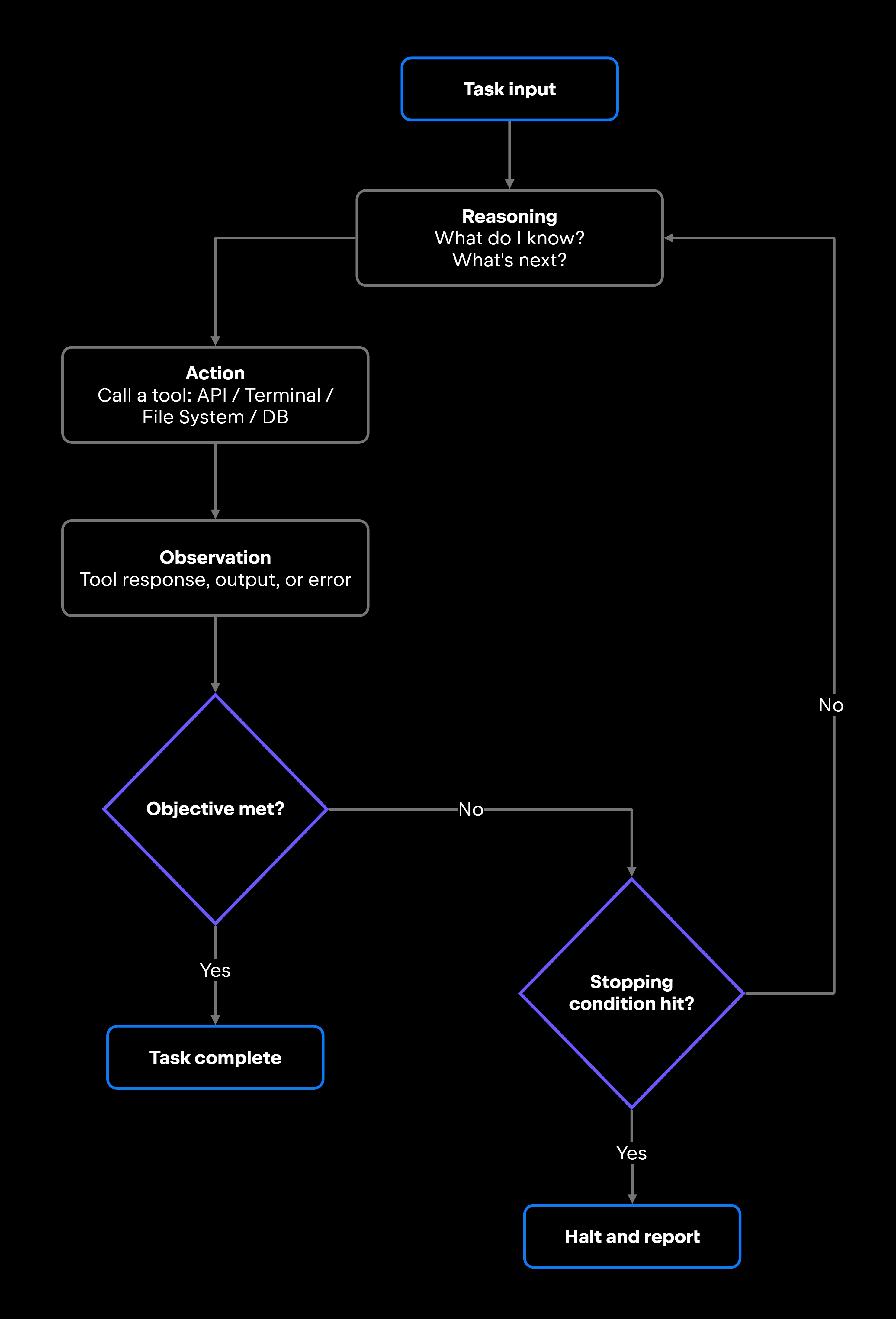
ReAct runs planning and execution together in one loop instead of as separate phases. The agent revises its plan based on what each tool returns, so it doesn’t ever get locked into an upfront plan that real conditions break. For workflows that involve tool use, intermediate decisions, and variable data, that adaptability is what makes the difference. It is also straightforward to implement on top of any LLM that supports function calling, which is why frameworks like LangChain and LlamaIndex support ReAct-style agent patterns.
What kinds of tasks are inefficient for ReAct workflows?
Classification, template generation, single-function documentation, code formatting, and other narrow tasks with well-defined inputs and outputs do not benefit from iterative observation. The agent has nothing to observe that would change what it produces. A structured prompt with a defined output schema is faster, cheaper, and more predictable than a ReAct loop for these cases.
Can ReAct workflows scale across multiple coordinated agents?
Yes. Multiple ReAct agents can be chained so that one agent's observations feed another's inputs. A planning agent breaks a task into subtasks, specialized agents run each subtask with their own loops, and the results get aggregated back. LangGraph and CrewAI can support this kind of orchestration; AutoGen coordinates agents as a conversational team, collaborating through message exchange rather than explicit observation-chaining. The trade-off is higher orchestration complexity: debugging a multi-agent system means tracing reasoning chains across agent boundaries, and that tracing demands structured logging at every level and a clear model of which agent owns which part of the workflow state.
When should developers avoid using ReAct agent architectures?
Avoid ReAct when the task is narrow, deterministic, and does not require tools or intermediate decisions. Adding an iterative reasoning loop to a task that a single prompt handles correctly introduces latency, token cost, and new failure modes without improving the result. ReAct also adds debugging complexity and makes output reproducibility harder to guarantee, which matters when you need consistent, auditable results across runs.
How do ReAct agents affect latency and token usage?
They can increase both significantly. Each reasoning step, action, and observation adds at least one LLM call and potentially one external tool call. A 10-iteration ReAct loop can consume substantially more tokens than a single prompt, because each step appends the full prior context, and wall-clock latency scales with both the iteration count and tool response times. You can cut this cost by setting tight iteration caps and routing routine intermediate steps through a smaller, faster model while reserving a frontier model for the decisions that need it, where your frameworks support that routing.
How does the ReAct pattern differ from chain-of-thought prompting?
Chain-of-thought prompting generates reasoning steps as text but takes no external actions. The model reasons entirely from its training data and whatever context is in the prompt. ReAct extends the chain of thought by pairing each reasoning step with a real tool call, so observations from the external world feed back into subsequent reasoning. That feedback is the whole difference: on multistep tasks, external observations help to keep reasoning errors from compounding unchecked, which a text-only chain of thought has no way to do.
Damaso Sanoja is an engineer who is passionate about helping others make data-driven decisions to achieve their goals. This has motivated him to write numerous articles on the most popular relational databases, customer relationship management systems, enterprise resource planning systems, master data management tools, and, more recently, data warehouse systems used for machine learning and AI projects. You can blame this fixation on data management on his first computer being a Commodore 64 without a floppy disk.
Use AI agents in your development workflow
Explore JetBrains AI solutions that help you build, use, and scale AI agents across the software development lifecycle.
Air Gateway
Run terminal agents through one JetBrains account, with access, models, and usage governed centrally.
Junie
Plan, code, debug, and automate tasks with a coding agent that works across your terminal, IDE, GitHub, and GitLab.
Air in IDEs
Orchestrate AI agents and verify their output directly in JetBrains IDEs, with full control over how changes are reviewed.
Air Teams
Automate software delivery workflows, coordinate agentic work across teams, identify bottlenecks affecting delivery.
Air Governance
Govern AI usage, models, policies, and costs across your organization, including JetBrains and third-party tools.
Air Context
Give agents shared organizational memory and context that carries across tools, workflows, and execution environments.
JetBrains Air
An open system of AI products for developers, teams, and organizations – from coding with agents to automating workflows and governing AI at scale.

Continue Exploring the AI Agents for Developers Guide
Learn what AI agents are, how they work, their core architecture, common use cases, and how developers build systems that reason, use tools, and complete multistep tasks.
Understand how AI agents extend large language models with tools, memory, planning, and iterative execution, and when an agent is a better fit than a standalone LLM.
Explore how multiple AI agents coordinate tasks, share context, divide responsibilities, and work together to execute complex developer workflows.