What Is Model Context Protocol?
Source: Preliminary findings from the JetBrains Developer Ecosystem Survey 2026 • 15,000+ developers worldwide
Factor
Traditional integration
MCP
Integration style
Custom adapter per client-tool pair
Standardized protocol, reusable across clients
Scalability
Can grow with every client-tool pair
Server deployed once, used by many clients
Any MCP-compliant client can connect, given compatible versions, transports, and auth
Single protocol surface to monitor
Dynamic discovery at runtime
Client-specific, hard to reuse
Per-integration maintenance
Static tooling, hardcoded at build time
Interoperability
Operational complexity
Workflow flexibility
FAQ
What problem does MCP solve for AI developers?
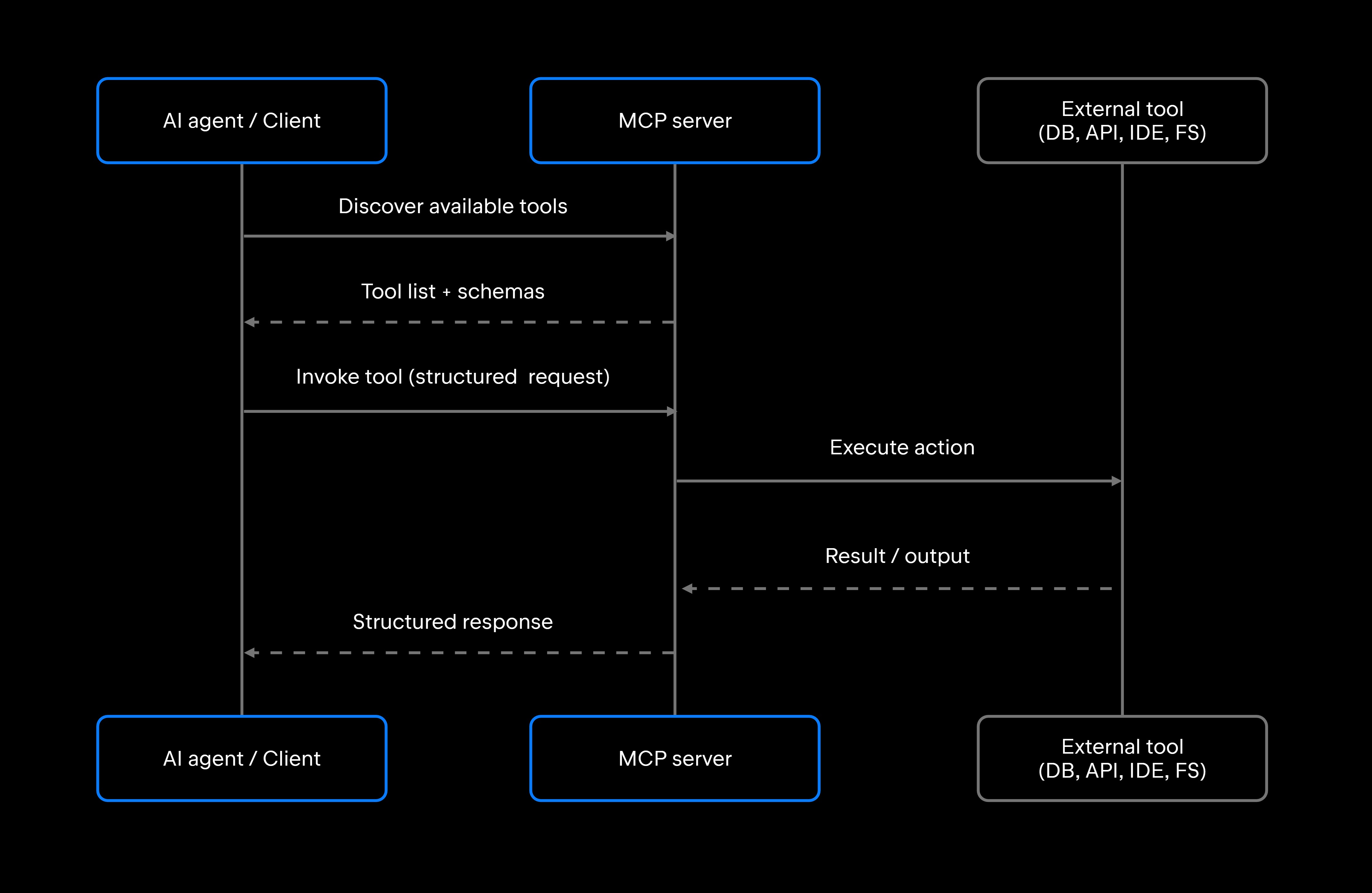
It removes the integration tax that scales with your tool count. Every AI client you add would otherwise need its own adapter to every tool you already run, and each of those adapters carries an auth flow, a schema, and an owner. Expose the tool through MCP instead, and that work happens once, no matter how many clients arrive later or which vendors they come from.
Can MCP work with existing AI agent frameworks?
Yes. MCP functions as an integration layer alongside orchestration frameworks, memory systems, and agent runtimes. Any framework that can make structured requests to an MCP server, including LangChain, LangGraph, BeeAI, LlamaIndex, and crewAI, can use MCP-exposed tools.
When does MCP make sense over a direct API connection?
MCP becomes worth the setup cost when you're connecting more than one AI client to more than one external tool, or when you expect that set to change over time. For a single, static integration between one model and one tool, a direct API connection is simpler.
Does MCP replace APIs?
MCP typically runs on top of existing APIs and services. An MCP server for a database still calls the database's API internally and exposes that capability through the MCP protocol to AI clients. MCP standardizes the AI-to-tool interface. The tool's internal implementation typically stays unchanged, since MCP wraps the existing API rather than replacing it.
Is MCP only useful for AI agents?
The protocol itself isn't agent-specific, but it is designed primarily for AI applications: assistants, IDE integrations, and model-driven workflows. Nothing in the spec assumes a model sits behind the request; AI agent tooling is simply where the demand first accumulated.
Damaso Sanoja is an engineer who is passionate about helping others make data-driven decisions to achieve their goals. This has motivated him to write numerous articles on the most popular relational databases, customer relationship management systems, enterprise resource planning systems, master data management tools, and, more recently, data warehouse systems used for machine learning and AI projects. You can blame this fixation on data management on his first computer being a Commodore 64 without a floppy disk.
Use AI agents in your development workflow
Explore JetBrains AI solutions that help you build, use, and scale AI agents across the software development lifecycle.
Air Gateway
Run terminal agents through one JetBrains account, with access, models, and usage governed centrally.
Junie
Plan, code, debug, and automate tasks with a coding agent that works across your terminal, IDE, GitHub, and GitLab.
Air in IDEs
Orchestrate AI agents and verify their output directly in JetBrains IDEs, with full control over how changes are reviewed.
Air Teams
Automate software delivery workflows, coordinate agentic work across teams, identify bottlenecks affecting delivery.
Air Governance
Govern AI usage, models, policies, and costs across your organization, including JetBrains and third-party tools.
Air Context
Give agents shared organizational memory and context that carries across tools, workflows, and execution environments.
JetBrains Air
An open system of AI products for developers, teams, and organizations – from coding with agents to automating workflows and governing AI at scale.

Continue Exploring the AI Agents for Developers Guide
Explores AI agent architecture, including core components, planning, memory, tool use, orchestration, and design patterns for building reliable AI agents.
Learn how AI agent orchestration works, from planning and task routing to state management, multi-agent coordination, and reliable workflow execution.
Discover what AI agents are, how they work, their architecture, types, use cases, and how developers can build intelligent autonomous systems.