How to Evaluate AI Agents
Metrics, Challenges, and Best Practices
Source: Preliminary findings from the JetBrains Developer Ecosystem Survey 2026 • 15,000+ developers worldwide
Want to see how project instructions and runtime context work together on a real codebase?
Try JetBrains Junie with a representative development task and compare its results against your team's acceptance criteria.
Metric
How to measure
Data source
Task completion rate
Successful tasks / evaluated tasks
Acceptance checks, test results
Reliability
Success rate across repeated runs of the same task
Repeated evaluation runs
Structured tool traces
Human review, automated tests, LLM judges
Agent traces, error logs
Developer feedback
Valid, appropriate calls and interpretation of results
Rubric scores and executable checks
Successful recovery after a failure or escalation
Acceptance, edits, overrides, reviewer ratings
Tool-use quality
Output quality
Recovery quality
Human usefulness
Evaluating AI adoption across engineering teams?
Explore Air Governance to learn how organization-wide visibility into AI usage and costs can complement your agent evaluation process.
FAQ
What metrics are most useful for evaluating AI agents?
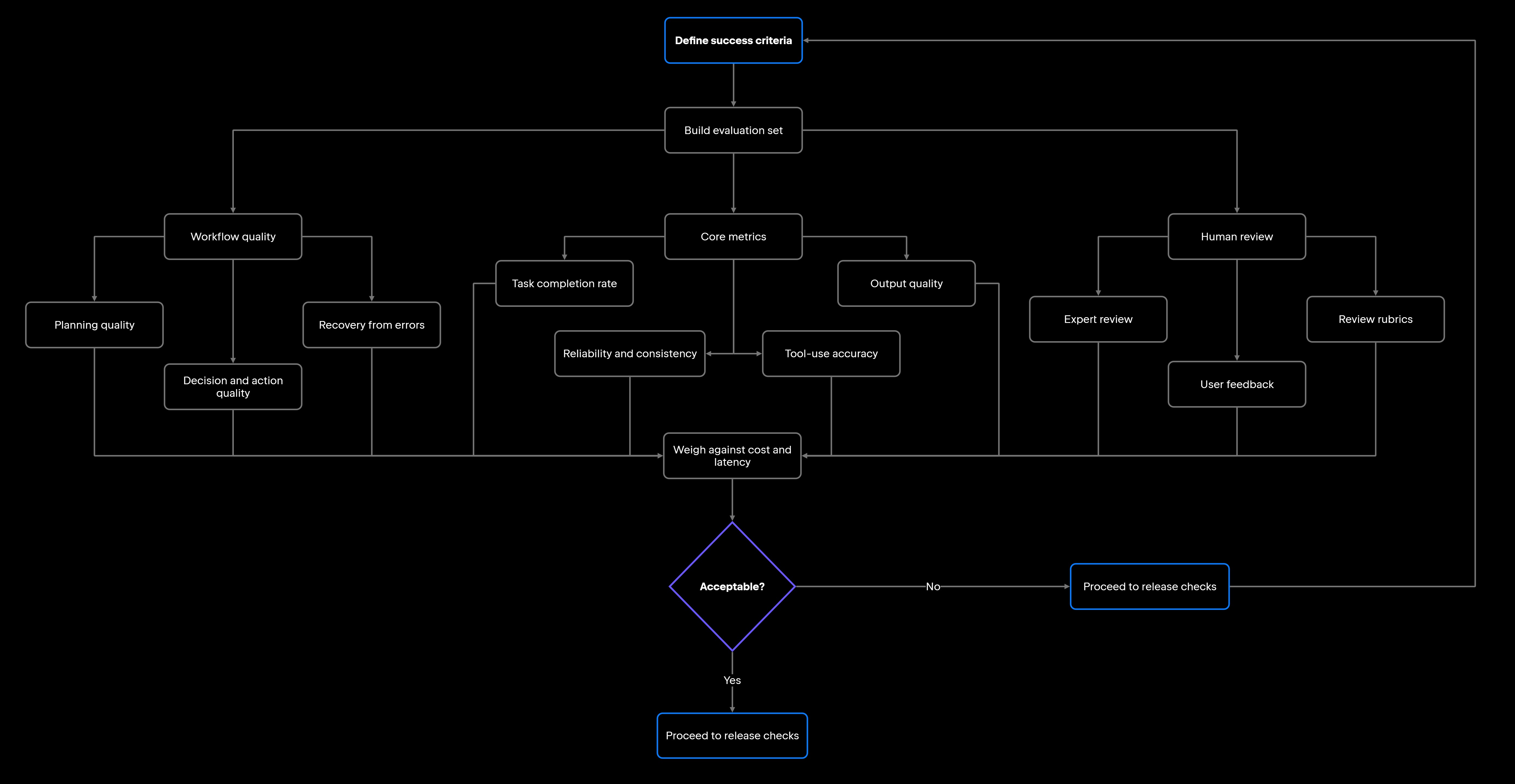
The most useful metrics depend on your agent's role, but a balanced framework covers task completion rate, tool-use accuracy, reliability, output quality, and human usefulness, collected roughly in that order. Track cost and latency alongside quality so trade-offs between agent versions stay visible.
What is the difference between AI agent testing and AI agent evaluation?
Testing is a release gate that checks whether specific behaviors work correctly before deployment. Evaluation measures how well the agent performs across a range of tasks, dimensions, and conditions over time. Testing asks whether it works. Evaluation asks how well it works and where it falls short. Evaluation is ongoing, while testing is periodic.
How do developers compare two versions of the same AI agent?
Hold the task set constant and score both versions on the stable dimensions above, so the comparison measures the change rather than the sample. The trap is a task set too small to tell a real gain from noise.
How do teams evaluate AI agents when outputs are non-deterministic?
Evaluate outcomes and process dimensions instead of comparing exact outputs. Repeat each task several times and check whether the agent consistently achieves the intended outcome, follows constraints, and uses appropriate tools. Rubric-based scoring gives reviewers a stable framework for judging runs that differ in wording but match in quality.
How should human reviewers score AI agent performance?
Use the rubric dimensions set out above, scoring each one separately against anchored scale descriptions. Reviewers should also flag cases where the agent reached the right answer through a poor process, since a review that stops at the final output tends to pass those. Calibrate reviewers against shared examples before scoring begins to reduce drift across sessions.
Should AI agent evaluation include cost and latency?
Yes. Better outputs bought with more tool calls, longer prompts, or slower workflows may not be the better deal for your deployment context. Tracking both makes the trade-off visible while you can still act on it, well before you scale the wrong approach.
Damaso Sanoja is an engineer who is passionate about helping others make data-driven decisions to achieve their goals. This has motivated him to write numerous articles on the most popular relational databases, customer relationship management systems, enterprise resource planning systems, master data management tools, and, more recently, data warehouse systems used for machine learning and AI projects. You can blame this fixation on data management on his first computer being a Commodore 64 without a floppy disk.
Use AI agents in your development workflow
Explore JetBrains AI solutions that help you build, use, and scale AI agents across the software development lifecycle.
Air Gateway
Run terminal agents through one JetBrains account, with access, models, and usage governed centrally.
Junie
Plan, code, debug, and automate tasks with a coding agent that works across your terminal, IDE, GitHub, and GitLab.
Air in IDEs
Orchestrate AI agents and verify their output directly in JetBrains IDEs, with full control over how changes are reviewed.
Air Teams
Automate software delivery workflows, coordinate agentic work across teams, identify bottlenecks affecting delivery.
Air Governance
Govern AI usage, models, policies, and costs across your organization, including JetBrains and third-party tools.
Air Context
Give agents shared organizational memory and context that carries across tools, workflows, and execution environments.
JetBrains Air
An open system of AI products for developers, teams, and organizations – from coding with agents to automating workflows and governing AI at scale.

Continue Exploring the AI Agents for Developers Guide
Explains agentic workflows, how AI agents plan and execute multistep tasks, and the patterns that make autonomous workflows reliable and scalable.
Explores AI agent architecture, including core components, planning, memory, tool use, orchestration, and design patterns for building reliable AI agents.
Learn prompt engineering techniques for AI agents, including planning, tool use, reasoning, and prompt patterns that improve agent performance.