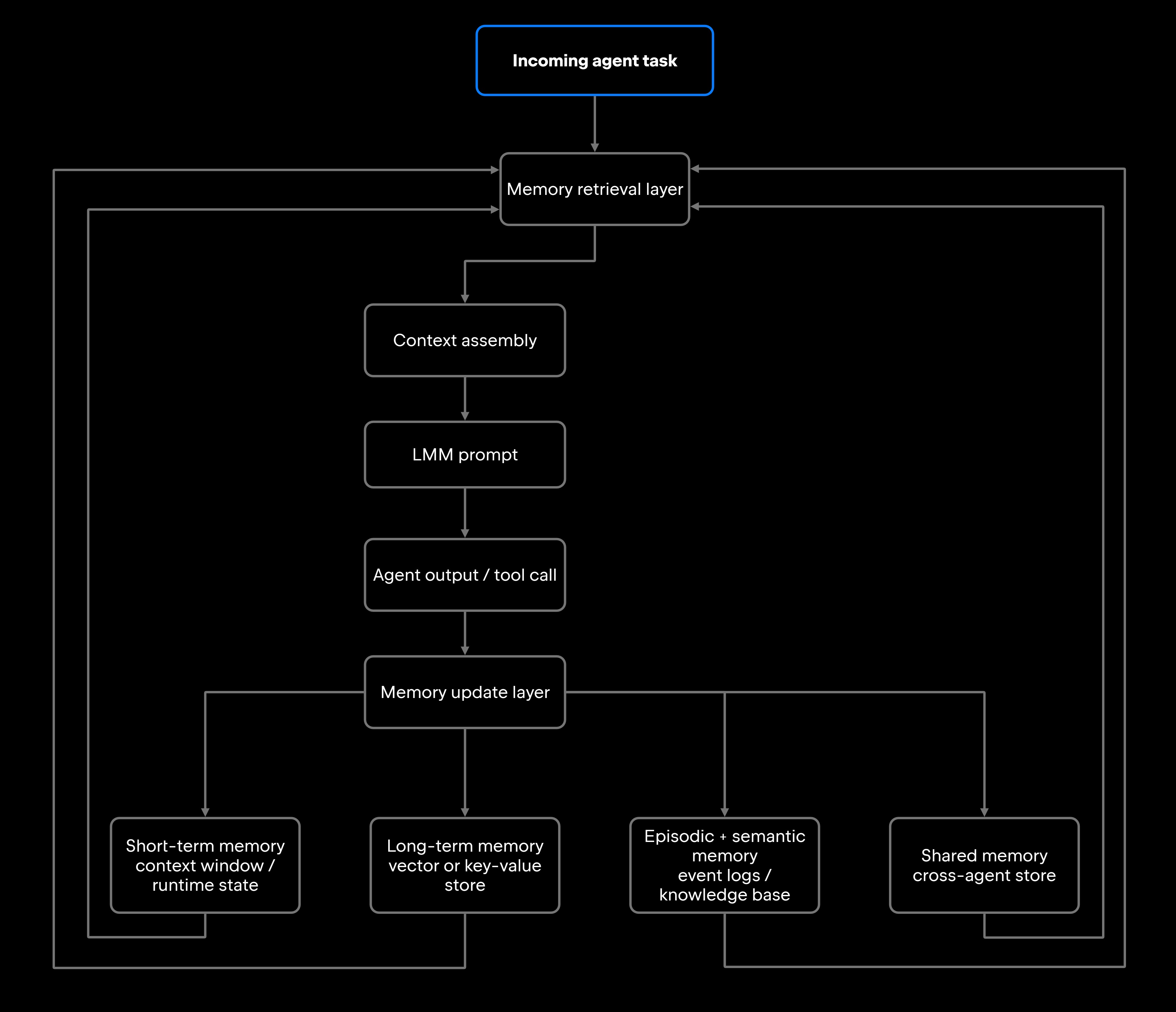
Memory in AI Agents: Types and Implementation
Source: Preliminary findings from the JetBrains Developer Ecosystem Survey 2026 • 15,000+ developers worldwide
Challenge
Consequence
Mitigation approach
Stale memory
Outdated entries retrieved as current truth
TTL-based expiration, version metadata
Incorrect retrieval
Wrong context injected, agent acts on bad data
Metadata filtering, retrieval evaluation metrics
Atomic writes, consistency checks on write
Event-driven re-embedding, entry versioning
Atomic writes, locking, consensus for shared stores
Re-ranking models, hybrid search (vector + keyword)
Caching hot entries, index optimization, async retrieval
Conflicting entries degrade output quality
Semantic meaning of entries shifts over time
Multi-agent writes produce inconsistent state
Relevant entries rank below noise
Slow memory lookup blocks workflow execution
Context corruption
Memory drift
Synchronization failures
Ranking quality degradation
Retrieval latency
FAQ
How do developers prevent AI agents from storing outdated memory?
Use TTL-based expiration for time-sensitive entries and version metadata for knowledge that changes gradually. For critical facts, pair storage with a validation step that confirms accuracy before the entry is written. Some teams also run event-driven re-embedding to keep semantic representations up to date as the codebase evolves.
How do developers measure memory quality in AI agent systems?
Track retrieval hit rate (the share of queries that return relevant results), context precision (the fraction of retrieved entries the agent actually uses), and downstream task quality (whether the agent succeeded with this context versus without it). Some teams run offline evaluation sets of curated queries and expected-result pairs to catch retrieval regressions before they reach production.
How does retrieval-augmented generation differ from in-weights knowledge?
RAG pulls information from an external store at runtime, so the knowledge base updates without retraining. In-weights knowledge is encoded into model parameters during training and takes a full fine-tuning cycle to change. RAG suits frequently changing or large-scale knowledge, while in-weights storage suits stable domain patterns that the model needs to absorb through training.
Can AI agents selectively forget information?
Yes. Most vector stores support deletion by ID or metadata filter, so you can remove specific entries without wiping the store. Selective forgetting helps for clearing stale task history, dropping entries that retrieval evaluation flags as “low-quality”, or complying with data lifecycle policies. The catch is knowing when to delete, which is why storing metadata like source, creation time, and session context alongside each entry helps.
What happens when AI agents retrieve conflicting memories?
Conflicting memories produce inconsistent behavior. The agent might execute contradictory instructions or default to whichever entry ranks higher without registering the conflict. Mitigations include conflict detection on write (comparing new entries against existing ones before committing), recency weighting in ranking (newer entries win ties), and explicit resolution prompts that surface the ambiguity to the agent rather than silently resolving it.
Damaso Sanoja is an engineer who is passionate about helping others make data-driven decisions to achieve their goals. This has motivated him to write numerous articles on the most popular relational databases, customer relationship management systems, enterprise resource planning systems, master data management tools, and, more recently, data warehouse systems used for machine learning and AI projects. You can blame this fixation on data management on his first computer being a Commodore 64 without a floppy disk.
Use AI agents in your development workflow
Explore JetBrains AI solutions that help you build, use, and scale AI agents across the software development lifecycle.
Air Gateway
Run terminal agents through one JetBrains account, with access, models, and usage governed centrally.
Junie
Plan, code, debug, and automate tasks with a coding agent that works across your terminal, IDE, GitHub, and GitLab.
Air in IDEs
Orchestrate AI agents and verify their output directly in JetBrains IDEs, with full control over how changes are reviewed.
Air Teams
Automate software delivery workflows, coordinate agentic work across teams, identify bottlenecks affecting delivery.
Air Governance
Govern AI usage, models, policies, and costs across your organization, including JetBrains and third-party tools.
Air Context
Give agents shared organizational memory and context that carries across tools, workflows, and execution environments.
JetBrains Air
An open system of AI products for developers, teams, and organizations – from coding with agents to automating workflows and governing AI at scale.

Continue Exploring the AI Agents for Developers Guide
Explores AI agent architecture, including core components, planning, memory, tool use, orchestration, and design patterns for building reliable AI agents.
Learn how to manage AI agent context windows, reduce context loss, and improve performance, accuracy, and reliability in long-running workflows.
Explains agentic workflows, how AI agents plan and execute multistep tasks, and the patterns that make autonomous workflows reliable and scalable.